Featured SoloX-12 6th blowthru

I think why it makes such a difference when playing low notes is because low notes push the cone further for longer, lower you play the more coil-in-magnet movement you get, feedback from that into the amp. Just in general.

So like a high damping factor will make your subwoofer play a wider bandwidth, because the amp can help keep the sub from unloading away from tuning in a ported box. This is something I wish people understood because it makes such a big difference in music.
I've noticed a noticeable difference in authority even when playing subsonic as well, sometimes way past port unloading. Those killer subs that can perform in that realm really benefit from that extra control utilizing an amp that can deliver. My creedo is spend at least as much on the amp as the subs ($450 sub /w/ a $700 amp was my last setup) but since big power is cheep, people gravitate towards that without considering the quality of control a good amp provides. Having competed, tested and demoed till my bones still creak I have to say there is a difference... especially way down low under hi-power conditions.
 
Last edited:
I've noticed a noticeable difference in authority even when playing subsonic as well, sometimes way past port unloading. Those killer subs that can perform in that realm really benefit from that extra control utilizing an amp that can deliver. My creedo is spend at least as much on the amp as the subs ($450 sub /w/ a $700 amp was my last setup) but since big power is cheep people gravitate towards that without considering the quality of control a good amp provides. Having competed, tested and demoed till my bones still creak I have to say there is a difference... especially way down low under hi-power conditions.
Yeah I tested this somewhat myself, I had a 2 15's box at 34 hz and it would play lower with better amp, play lower with half bridge with higher damp factor. My 2 18's was the same or similar tuned to 29 hz but basically wouldn't bottom out, I mean playing pretty good into subsonic with good amps. I actually broke my hatch I think I playing "hoods run down" subsonic notes when they do the low bass thing at the beginning lol. I had pretty solid electrical too though. I think people underrate amp control. Dudes that compete in SPL in the 20 hz range know, from what I've heard. I'm like you where the sub just has to be good enough, and the amp and the box always do way more than people think, but you already know that lol.
 
Last edited:
Well, I'm going to do a test here in a couple of months, likely come spring, when completing my SQ upgrade, in something a little more controlled/concise than everyone's arbitrary, likely somewhat biased, predetermined opinions.

Like it or not, we've all got them.

I've got 2 exactly the same 12" sealed/stuffed subs, 2 exactly the same 12" ported subs and two amps that I can calibrate for equal output using a dual-channel O-scope.

I also have a brand new Crescendo S1 Symphony "Korean Board" half bridge 2.5k and a Crescendo Skyway "Korean board" full-bridge 3k.

Once calibrated for output, I'm going to put this unsettled sound test - to the test.

You cannot possibly compare different brands and models that use different topologies, designs, components, etc, it's just not close to being an accurate benchmark simply based on wattage or even similar specs.

This is as close as one can get to comparing the two topologies apples to apples, no lemons or oranges.

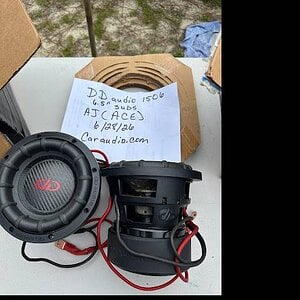
This one arrived today:


This one arrived last week:


I'll round up my musician bandmates, all with good ears, discerning taste, and try as much as possible to set it up as a blind sound test, see how it goes.

Not that it will change anyone's opinion, right?

:unsure:
 
Last edited:
If you're trying to narrow the field to simply the differences in topologies, you can only have an accurate test by having a controlled environment, comparing the two topologies, using almost identical gear, same music, same subs, same manufacturer, etc., except for the topologies.

That is the benchmark for testing the theory - accurately.
 
Last edited:
Like it or not, we've all got them.
We all have what exactly?
Not that it will change anyone's opinion, right?

:unsure:
Opinions on what?

My take on this thing comes from competing at local/regional/national level events. I ghosted the true Sq pursuit back in 1997 when I saw it for what it was. Some sort of game where you outspend the competition for mediocre output. I prefer accuracy until its time to let her rip and then stand back. I'm a spl guy at heart, I like cracking skulls. That said most nowadays want their taillights cracking, hood rippling and windshield breaking while 100 toads circle the vehicle recording video. My "opinion" on amplifier topology isn't something you can quantify with a "3K" stuffed and sealed substage... lol. Try something tuned specifically for those stoopid lows and report back.
 
Last edited:
We all have what exactly?

Opinions on what?

My take on this thing comes from competing at local/regional/national level events. I ghosted the true Sq pursuit back in 1997 when I saw it for what it was. Some sort of game where you outspend the competition for mediocre output. I prefer accuracy until its time to let her rip and then stand back. I'm a spl guy at heart, I like cracking skulls. That said most nowadays want their taillights cracking, hood rippling and windshield breaking while 100 toads circle the vehicle recording video. My "opinion" on amplifier topology isn't something you can quantify with a "3K" stuffed and sealed substage... lol. Try something tuned specifically for those stoopid lows and repot back.
Shredder1, triggered much?

The goal of SQ, SQL, SPL, all a matter of personal preference, not games, no super huge spending here, no I'm better than thou, no one is better than the other, just the quest for good info, cause there is room for all kind of sound, here.

Just a simple comparative, cause not everything in life has an ulterior or nefarious motive.

Look, it's simple, really. Opinions are just like a$$holes, we all have them.

Nobody is $hitting on anyone's opinion here, trying to eliminate it as a point of reference, as the argument is the topologies, not your personal SPL goal or preference, not my SQ/SQL goal or preference, because regardless of the outcome, any good comparative test will provide information that is applicable in all genres, pretty simple really.

And your retort, well, that kind of validates the statement now, doesn't it?

You've already written it off as not viable or relevant, because it's your "opinion" that, for some unknown reason, won't apply, not even in the general sense - and that's fine, not here to argue, not here to change anyones minds, just to help and provide info that's "sound" on its basis, not just opinion.

I see what you post, and I don't disparage it; I understand where it's coming from, sound-wise.

I appreciate the quality and dedication to the craft, even if it's not my preference in sound; it doesn't mean I dislike it or discount its contribution to the craft, on the contrary.

As a musician who plays bass guitar, drums, cello, and all manner of keys, my bandmates and I have good ears for what music should sound like acoustically and on stage with our Fender, MESA Boogie, Marshall, Crown and yes, even one Peavy stack, and the ensuing LOUD "ample" amplification.

With an engineering background, computer science too, certifications in sound engineering, etc, not like we, I don’t know what I’m talking about either.

At the end of the day, it’s all about the craft, the pursuit of one's “personal” idea of what sounds good, yes, and having more info is definitely better than not having enough.

That's how everything evolves, for the better in all genres.

 
Nobody is $hitting on anyone's opinion here, trying to eliminate it as a point of reference, as the argument is the topologies, not your personal SPL goal or preference, not my SQ/SQL goal or preference, because regardless of the outcome, any good comparative test will provide information that is applicable in all genres, pretty simple really.
My argument is more for damping factor. It does seem with just the way amps are manufactured with what people buy that's there's tendency that half bridges can perform better, particularly with playing the low hz stuff. But the damping factor (for me) is the main thing, not necessarily the specific topology or circuitry layout or whatever. It's been a while since I looked at this but full bridge amps used to tend to be cheaper for the same power, for whatever reason, so like when I'm referencing these things, I'm usually talking about cheap full bridge amps, not expensive one, because that's what people tend to buy and then they don't always perform the best.

But with that said, I've had customers with 8kw, 12kw, 20kw+ systems with steel cages around their boxes doing almost 160 db's in the 20 hz range tell me this themselves, they all happen to run half bridges that I've encountered. So, not saying it's true for all. But once again, they're doing a more specific type of bass, extreme heavy low end stuff, which is also what I'm into and how I ever noticed the difference between sub amps in the first place. Iirc, and anyone please check me on this, i like knowing this stuff, full bridge sub amps tend to have a lower damping factor than half bridges. I'm not saying it's always true, just a trend I noticed when I started paying attention to amps like this, but it's been years since I tracked it actively.
 
Last edited:
Shredder1, triggered much?

The goal of SQ, SQL, SPL, all a matter of personal preference, not games, no super huge spending here, no I'm better than thou, no one is better than the other, just the quest for good info, cause there is room for all kind of sound, here.

Just a simple comparative, cause not everything in life has an ulterior or nefarious motive.

Look, it's simple, really. Opinions are just like a$$holes, we all have them.

Nobody is $hitting on anyone's opinion here, trying to eliminate it as a point of reference, as the argument is the topologies, not your personal SPL goal or preference, not my SQ/SQL goal or preference, because regardless of the outcome, any good comparative test will provide information that is applicable in all genres, pretty simple really.

And your retort, well, that kind of validates the statement now, doesn't it?

You've already written it off as not viable or relevant, because it's your "opinion" that, for some unknown reason, won't apply, not even in the general sense - and that's fine, not here to argue, not here to change anyones minds, just to help and provide info that's "sound" on its basis, not just opinion.

I see what you post, and I don't disparage it; I understand where it's coming from, sound-wise.

I appreciate the quality and dedication to the craft, even if it's not my preference in sound; it doesn't mean I dislike it or discount its contribution to the craft, on the contrary.

As a musician who plays bass guitar, drums, cello, and all manner of keys, my bandmates and I have good ears for what music should sound like acoustically and on stage with our Fender, MESA Boogie, Marshall, Crown and yes, even one Peavy stack, and the ensuing LOUD "ample" amplification.

With an engineering background, computer science too, certifications in sound engineering, etc, not like we, I don’t know what I’m talking about either.

At the end of the day, it’s all about the craft, the pursuit of one's “personal” idea of what sounds good, yes, and having more info is definitely better than not having enough.

That's how everything evolves, for the better in all genres.
That response is epic, kudos to you for typing all that. Triggered? Nah... just a response to sq guys who tap out everytime the levels get over 145. Accuracy is something I treasure and am constantly tuning to achieve but when I get that bug? All bets are off.
I'm an ex sq guy, competed and all once upon a time so there's that. I stand by my statement especially when "esoteric" gear is involved in a shop environment. Its payday and the vultures circle from manufacturer reps to lol... tuning the thing. I never meant to disparage, but when lower octave output is being discussed regarding amplifiers its not a debate imo. I'm talking about stoopid subs in enclosures with stoopid bandwith. That is where I see most designs nowadays. I can't advise a T-Line or horn since they all want mad power and bandwith. I guess what was said is more about cone control in the lower frequencies and extreme levels.
 
Last edited:
That response is epic, kudos to you for typing all that. Triggered? Nah... just a response to sq guys who tap out everytime the levels get over 145. Accuracy is something I treasure and am constantly tuning to achieve but when I get that bug? All bets are off.
I'm an ex sq guy, competed and all once upon a time so there's that. I stand by my statement especially when "esoteric" gear is involved in a shop environment. Its payday and the vultures circle from manufacturer reps to lol... tuning the thing. I never meant to disparage, but when lower octave output is being discussed regarding amplifiers its not a debate imo. I'm talking about stoopid subs in enclosures with stoopid bandwith. That is where I see most designs nowadays. I can't advise a T-Line or horn since they all want mad power and bandwith. I guess what was said is more about cone control in the lower frequencies and extreme levels.
It's all good, information is king, and what you post is impressive, builds are top notch, just hard to fit in the hatch of my Mazda 3 (not saying I wouldn't do it if I could fit in there), that's what she said?

I take SQ seriously, as you take SPL seriously, and in either genre, there are limits to what money returns you; diminishing returns are a real thing, fo sho!

As one in the SPL arena, you know that as well as anyone. I think, and I think you would agree, that simply throwing great stuff in an untreated tin can is a waste of everything: money, time, and labor.

But I'm that guy in SQ, like you're that guy in SPL. I pull the headliner, I pull the seats, the dash, almost everything, and dampen it, inside and outside door panels, etc, within reason. I don't apply multiple layers (a fool's errand) or have the car dunked in goo, keep it sane, keep it reasonable (and I'm too f'n old to get upside down to do this $hit!).

I'm completely aware of diminishing returns, not a wealthy man, and have been saving for the better part of 6 years to acquire the gear I have, not going to throw it into a rice-burner tin can, nope, gotta be quiet like a caddy in that puppy!

I've read the full-bridge/half-bridge argument so many times, just wanna see what equalizing the field, eliminating most, is not all of the invariables, and see how that plays out.

When I was repping Adcom and Focal in the late 90s, here in the NW, I would swear by the greater than 700+, 1000+ dB damping factor, and to a degree, it was true, back then.

Amplifier design for cars is a whole lot different now, so heck, not a lot of money spent, should be interesting if nothing else.
 
Last edited:
My argument is more for damping factor. It does seem with just the way amps are manufactured with what people buy that's there's tendency that half bridges can perform better, particularly with playing the low hz stuff. But the damping factor (for me) is the main thing, not necessarily the specific topology or circuitry layout or whatever. It's been a while since I looked at this but full bridge amps used to tend to be cheaper for the same power, for whatever reason, so like when I'm referencing these things, I'm usually talking about cheap full bridge amps, not expensive one, because that's what people tend to buy and then they don't always perform the best.

But with that said, I've had customers with 8kw, 12kw, 20kw+ systems with steel cages around their boxes doing almost 160 db's in the 20 hz range tell me this themselves, they all happen to run half bridges that I've encountered. So, not saying it's true for all. But once again, they're doing a more specific type of bass, extreme heavy low end stuff, which is also what I'm into and how I ever noticed the difference between sub amps in the first place. Iirc, and anyone please check me on this, i like knowing this stuff, full bridge sub amps tend to have a lower damping factor than half bridges. I'm not saying it's always true, just a trend I noticed when I started paying attention to amps like this, but it's been years since I tracked it actively.
Yeah, I get it, me too, for the most part, but that's changing.

When I was repping Adccom and Focal gear in the NW, back in the mid to late 90's, I would point out the damping factor all the time.

There have been significant design changes to almost all car audio amplifiers in the last 20 years, which renders damping factor, well, less of a factor.

Here is some general info:

  • High negative feedback: Modern solid-state amplifiers use extensive negative feedback to minimize distortion, which also results in a very low output impedance.
  • Negligible improvement: When the amplifier's output impedance is already very low (e.g.,0.020.02 to 0.040.0 4ohms), increasing it further provides a negligible improvement in the damping factor.
  • A high enough damping factor: Modern amplifiers typically have a damping factor of 100 or more, which is sufficient to control the bass and provide tight, controlled sound.
  • Other factors are more important: The damping factor is affected by other components like the speaker wire gauge, speaker cable length, and the specific speaker's impedance characteristics. For a well-designed system with quality components, a high damping factor is less critical than the amplifier's other performance characteristics.
Real nerdy-geeky info if you don't mind all the math:


I was fortunate enough to be able to take a tour of the Pioneer R&D facility located in Japan, visiting the Tendo City, Yamagata Prefecture, and the one in Tokyo, and I picked the brains of some truly amazing engineers - car audio enthusiast who are leaps and bounds above my level and they explained a lot of what that article I just linked says, but even more specific to car audio amplification.

It's like the class "D", A/B arguments, I hear all the time.

Different amps do sound different, no question in my mind. I absolutely love my SIQ A/B for mids and tweets, they are stellar, crisp, clear, quiet, even when loud!

I even decided to go a/b Xcelus Magma 220x4 for the front midbass and the rear midbass too, just that old thing in the back of my head that says, it "might" sound better, and I don't want to wonder later "if only, if maybe I had", hate that!

I do feel like there is a universally "sound" way to get the best "sound" out of one's installation, and gear is only one part of it, but it's a significant part for sure.

Like anything, you're only as good as the weakest link, and all the money you might throw at it will only make the worst part of it more expensive.

My dad used to say to us when my brothers and I worked in the family bike business, cutting our teeth on a work ethos, "Doing things well is never cheap, but doing things cheap is always more expensive".
 
Last edited:
  • A high enough damping factor: Modern amplifiers typically have a damping factor of 100 or more, which is sufficient to control the bass and provide tight, controlled sound.
100% disagree that 100 damping factor is enough, at least for 1 ohm systems. I've noticed a significant difference from literally testing myself where the amp was the only change, where an amp with a like 100-150 damping factor did not play as low as an amp with a 250-300 damping factor by 2,3,4 hz (under ported box tuning). I tested this with bass tones. This is why I maybe come across strong on this subject bc I tested this some and installed a lot of amps and boxes and systems and paid attention to specifically the amps.

So this:

"The damping factor is the ratio of a loudspeaker's impedance to the amplifier's output impedance, which helps control the speaker's cone motion and reduce unwanted movement caused by back electromotive force (back EMF). A higher damping factor allows the amplifier to better manage the speaker's response, especially at low frequencies, leading to tighter and more accurate sound."


I once designed a box for 5 15 inch woofers each of which had a 45 mm one way X max, and a 4" VC with 800 MMS rated for 4500 W RMS. So that's 22500w rms. It wasn't ever built but just giving an extreme example- I can give other examples. I had to take amps into account with some designs. That system playing low notes where it's hitting high X max and shifting notes, there's a lot of back emf with that. The amp has to keep those big, super heavy coils under control under extreme xmax, and that would be an example of where 100 damping factor is going to hurt you. I can't imagine it wouldn't vs having idk 300-400-500 damping.
 
Last edited:
I once designed a box for 5 15 inch woofers each of which had a 45 mm one way X max, and a 4" VC with 800 MMS rated for 4500 W RMS. So that's 22500w rms. It wasn't ever built but just giving an extreme example- I can give other examples. I had to take amps into account with some designs. That system playing low notes where it's hitting high X max and shifting notes, there's a lot of back emf with that. The amp has to keep those big, super heavy coils under control under extreme xmax, and that would be an example of where 100 damping factor is going to hurt you. I can't imagine it wouldn't vs having idk 300-400-500 damping.
Sorry if I'm nerding out:

IMG_9510.jpeg


I def don't understand all of that in there- I just think it matters, the back emf, how the coil moves, and the relationship to damping factor. Basically seems like too low damping factor then the amp gets overloaded by back emf and can't control woofer as well.
 
Last edited:
100% disagree that 100 damping factor is enough, at least for 1 ohm systems. I've noticed a significant difference from literally testing myself where the amp was the only change, where an amp with a like 100-150 damping factor did not play as low as an amp with a 250-300 damping factor by 2,3,4 hz (under ported box tuning). I tested this with bass tones. This is why I maybe come across strong on this subject bc I tested this some and installed a lot of amps and boxes and systems and paid attention to specifically the amps.

So this:

"The damping factor is the ratio of a loudspeaker's impedance to the amplifier's output impedance, which helps control the speaker's cone motion and reduce unwanted movement caused by back electromotive force (back EMF). A higher damping factor allows the amplifier to better manage the speaker's response, especially at low frequencies, leading to tighter and more accurate sound."


I once designed a box for 5 15 inch woofers each of which had a 45 mm one way X max, and a 4" VC with 800 MMS rated for 4500 W RMS. So that's 22500w rms. It wasn't ever built but just giving an extreme example- I can give other examples. I had to take amps into account with some designs. That system playing low notes where it's hitting high X max and shifting notes, there's a lot of back emf with that. The amp has to keep those big, super heavy coils under control under extreme xmax, and that would be an example of where 100 damping factor is going to hurt you. I can't imagine it wouldn't vs having idk 300-400-500 damping.
Just the messenger here, it's a lot to analyze.

I do remember the folks at Adcom telling me that the newer amps coming out for cars were a bit different, then they quit making them, so I never got around to discussing that aspect.

That said, there is a lot of info on that observation, perspective, and it's not something new; been hearing it for some time.

There was also a time when they claimed, class "D" would never amount to anything "audiophile," soo, there is that.

It'll be really interesting as the use of GanFETs becomes more prevalent; the future is bright - well, at least loud and clear.
 
Last edited:
The "Atom 7.5k pro" protected 3 times, apparently 300A of alt, 50ah of lipo4 lithium + an agm wasn't enough. Bud she was digging low and bangin'. But with a 4hr rest the last protect was final. I heard sick lows, the kind that flex the dash and make the hu display unreadable. I'd guesstimate 151+ from 2 12's /w/ a low centered bandwith until the output section of the amp gave up. 7.5K fullbridge /w/ a 300A alt and 50ah next to the amp and /w/+100 dampening is hunky dory with a ported box but when you start exploring those lower octaves like a series 6th delivers you probably need X2 battery reserve and 400+ dampening.
Beast bandwith needs beast amplifiers. Nobody wants to pay for the real deal so maybe a US supported brand this time? If I had my way I'd vote for a DDM5 if they still produced them. Surfboard amps won't fit, so...
Maybe a DD M5000?
 
Last edited:
Activity
No one is currently typing a reply...

About this thread

shredder1

10+ year member
CarAudio.com Elite
Thread starter
shredder1
Joined
Location
AZ
Start date
Participants
Who Replied
Replies
31
Views
2,589
Last reply date
Last reply from
shredder1
1778578257023.png

Glen Rodgers

    May 12, 2026
  • 0
  • 0
Screenshot_20260511_212804_Amazon Shopping.jpg

Blackout67

    May 11, 2026
  • 0
  • 0

New threads

Top