- Thread Starter
- #31
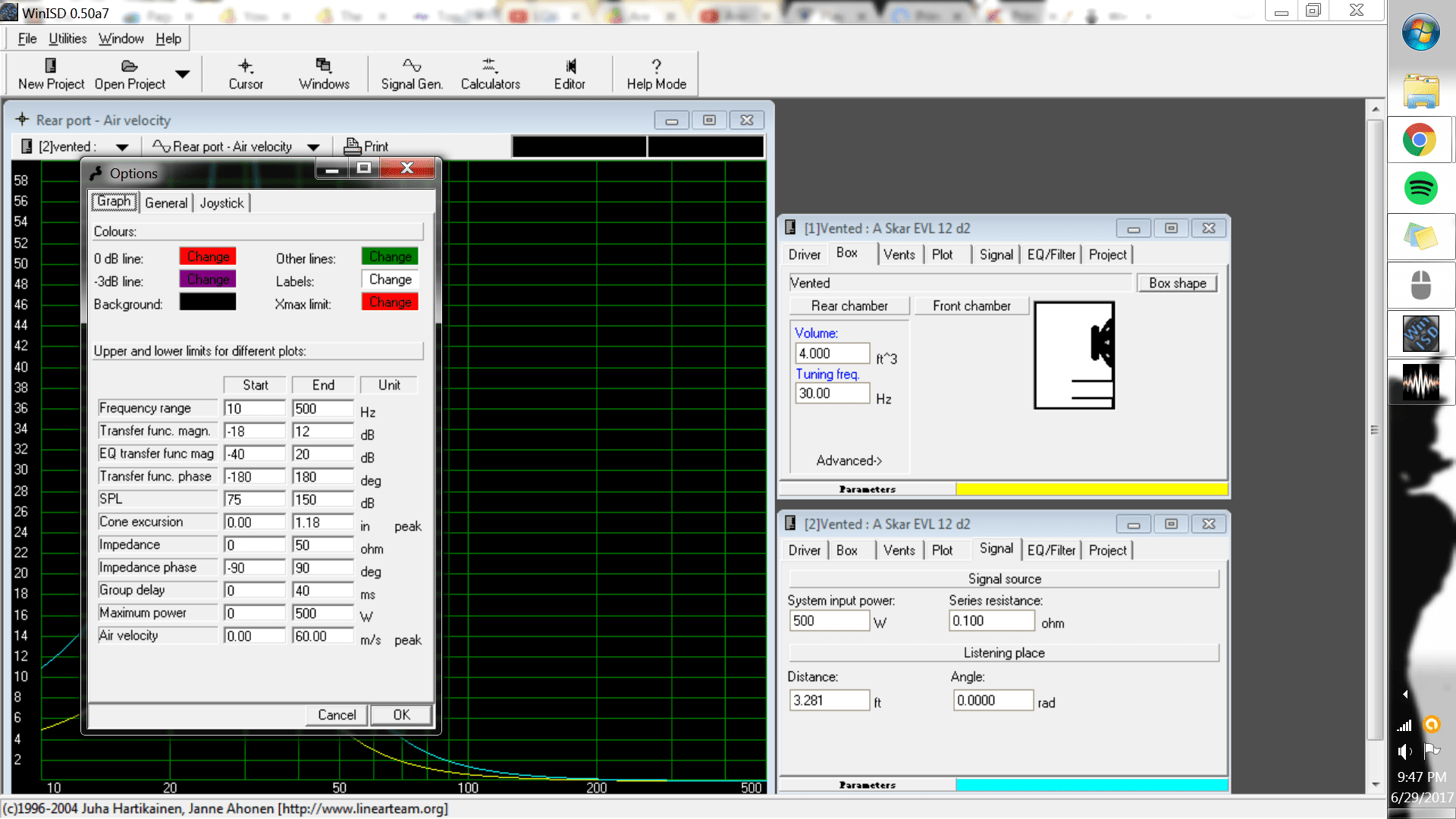
This info gives me something to digest... I can see now how one affects the other... but I am only trying to run Winisd at this point... eventually It'll make sense!.. LOL!For the mechanical aspect of the drivers we will assume the the parameter shifts are linear throughout stroke and that all aspects are linear ideally for sake of understand simplicity..
Electro/mechanical aspects/parameters of loudspeakers.
QMS- This is how the drivers suspension and moving parts damp the oscillations of the speakers moving mass.
A lower number means its more resistant to oscillation. IE it wants to stop the oscillations faster/earlier. The parameters that affect this primarily are CMS and MMS and RMS.
This leads to how controlled the mechanical aspect of the driver is. very low QMS designs can use larger alignments to take advantage of the huge transfer function and efficiency benefits of not only larger boxes but larger ports.
-----------------------------------------------------------------------------------------------------------------------
CMS- This is a measure of the stiffness of the suspension(spider/surround). The lower the number the less the diaphragm will more for a given amount of Force applied. realistically You will see figures between .15mm/N for very soft suspensions to as low as .02 for pur SPL drivers. note that drivers like dd 9515s SPL builds use very light moving parts in combination to get very low QMS to use very large enclosures and get HUGE transfer function gains.
In this case they are nearly identical in CMS and
-----------------------------------------------------------------------------------------------------------------------
MMS- is the moving mass of the driver. its the weight of the parts. IE the mass of the the moving parts of the driver.. pretty simple. The higher the harder it is to move and harder it is to stop moving.
-----------------------------------------------------------------------------------------------------------------------
RMS- is The mechanical resistance/impedance of the suspension. think of it as ohm of a electrical circuit. its a resistance to movement. the suspensions topology and material plays a huge role in this. The higher the RMS the hgiher the resistance. Higher numbers mean higher LOSSES.
so lower numbers mean a less losses and mean less damping/control for a given stiffness.
-----------------------------------------------------------------------------------------------------------------------
QTS- this is the total damping of the driver which accounts for QMS and QES.. The lower the number the more damped the driver is as a unit.. the lower the number The more powerful the resonation but the narrower the bandwidth of the resonation.
for example if you model these two drivers up you will see the FI peaks harder but the peak is much more narrow for a given box size you will also notice that the low end frequency extension and output is much more limited. Think of a higher Q as a inductor and a low Q as a capacitor of sorts
The capacitor is high energy high discharge in nature but limits low frequency from the natural properties of the frequency/wavelength.
While the higher Q speakers are more like a coil with a AC inductance on it. it resistive to higher frequency and has and inductive nature so it suffers from high frequency extension from the extremely fast polarity changes but is IDEAL for lower frequency and lower polarity changes offering a more natural movement and more efficient reproduction of the lower frequency production.
++++++++++++++++++++++++++++++++++++++++++++++++++++++++++++++++
FS- The is the resonance frequency of the driver. In essence its the natural frequency in which all hte aspects of the driver combine to make the signal input and signal output close as possible to mimic the natural reproduction of that frequencies oscillations.
drivers play more accurately as the driver nears its FS. the further from FS the less ideal the oscillation is and the more losses you have trying to reproduce the oscillations!
================================================================
Vas- is the compliance of the drive. its basically the acoustic variation of the mass ove surface area of hte loudspeaker. kinda like hte density of the driver in respect to the area of that or air. IE the more compressed the air is in a given airspace the lower the "vas" as compared to the loudspeaker suspension CMS and surface(SD) area as well as MMS.