
staggering crossover points

frankiebones
10+ year member

Senior VIP Member
based on the settings i saw suleman (shout out!) use for his pioneer 7800, i set my:

HPF @ 100 Hz, -6 dB/ocatave

LPF @ 80 Hz, -18 dB/octave

previously, i had it set at:

HPF @ 80 Hz, -12 dB/octave

LPF also @ 80 Hz, -18 dB/octave

all these settings refer to settings on the HU.

is this what is referred to as "staggering" your crossover pts. now i know everyones car, setup, gain settings, etc. are diff., but why does it sound so much better?

is it bc the morel components dont have to go as low in terms of the frequencies they are responsible for producing? what does this actually look like? here was my very rough and not-drawn-to-scale approximation:
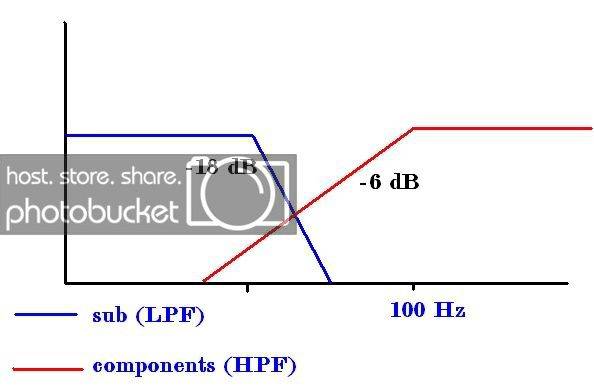
approximationofcrossoverpoint.jpg


in case that pic doesnt show, heres the link

http://i39.photobucket.com/albums/e164/fcelau1/approximationofcrossoverpoint.jpg

 
so joker, it starts to cut before the pt (in Hz) u choose?

i admit i still dont know enough about phase (everything i try to read is very difficult to digest and not overly technical, but too technical for me to fully understand it) or crossovers (whether active or passive).

 
is there a website or program i can put my crossover pts, slopes, etc. into that will generate some type of graphical display?

 
tech notes:

phase. phase is easiest to envision in the "steady state" sense. this means if you were to play a tone, and waited 100 cycles, then compared the input and outputs, you'd notice a shift (phase) between the two. (plot Sin(x) and Sin(x + 120deg) and Sin(x - 120deg) for examples of phase offsets)

for a single frequency, this will appear as a bounded phase offset (there is no way to see a difference between 10deg and 370deg). this phase offset can be translated into a time delay (for this frequency). this is where 10deg and 370deg would be different. a phase delay of 10deg corresponds to a short time delay, while 370deg would be a longer delay.

typically, people only care about how much frequency X is delayed with respect to other frequencies "near" X. eg, you only care about the delay on frequencies from 20hz to 20khz. if there is 1 hour of delay at 1Mhz, you could care less! this is where group delay comes in.

now is the interesting question -- why wait for 100 cycles to look at the steady state response? why can't you look at the first cycle? well as it turns out, the start of the first cycle isn't the same as the start of the 2nd or 3rd cycle. on the first cycle, the wave isn't changing, then suddenly increases from 0 to a peak. on the 2nd+ cycles, the wave IS changing as it crosses through 0 to a peak.

a number of math techniques can be used to show and quantify "how much" things are affected by this "transient" response. the Laplace transform is among the best. the Fourier transform is also applicable.

as for the staggered Question. its not uncommon to have a 1st-3rd combo. the phase of one speaker is usually inverted as there is more phase shift in the 3rd order filter.

(among the more interesting topics for phase is the realization that ACOUSTIC effects like distance affect the phase of the signal to your ear, and as such some filters will work better in practice even when they look like crap on paper. this is also why the LR filters are not really a good choice for car audio -- the tweeter is probably no where near the mid, and the major LR benefit of phase matching is lost!)

I have a wealth of information on the subject of filters. I should be able to answer any questions.

 
while i appreciate ur response, especially its detail, i dont know what u mean by 'cycle.'

also, when u said "(plot Sin(x) and Sin(x + 120deg) and Sin(x - 120deg) for examples of phase offsets)," you totally lost me...

what does the variable x stand for. also, when u take the sign and add or subtract the degrees, do u simply add (or subtract) the number 120 or is it in radians.

I REALLY APPRECIATE THE EFFORT, but like everything else i read about phase, it requires a background and understanding that I dont have, but everything i read assumes i have.

 
cycle -- one repetion.

for fun, (and because mathmatically its nice), lets say you've got a car. with wheels. and there is an air nozzel on each wheel.

so far so good, nothing complex. so lets drive the car at 5mph and look at the motion of the air nozzels. the air nozzels each move higher off the ground, and then move back down near the ground, then back up, ect... and they do this at a constant rate or "frequency". in this case, if you plot the vertical position of an air nozzel vs time, you'll get a "sine wave".

when the air nozzel is near the top of the wheel, turning it an extra 1/16th of a turn doesn't really move the nozzel much further up or down.

when the air nozzel is near the sides, turning it the extra 1/16th will move it significantly up or down.

thus a sine wave has somewhat flat peaks, and somewhat sharp transitions. (not as much as a square wave though).

ok. so lets say you have two wheels and two air spokes. both wheels are spinning at the same rate, and you plot the vertical position of EACH nozzel. both will give you sine waves.

now lets say that the air nozzel of the first tire started in the highest upward position, and the tire 2 nozzel pointed down. now as nozzel 1 is moving upward, nozzel 2 is moving downward! the two are not "in phase".

and if nozzel 1 started from the lowest point and nozzel 2 started at the mid point, the waves would not be in phase, but would also not be fully out of phase.

now it makes sense to replace "vertical position of nozzel" with "outward excursion of speaker", and suddenly there is a practical application -- the speaker is moving in and out at some frequency (for purpose of explaination).

lets concider that the speaker has mass. now when the amp starts to move the speaker cone. but when the amp wants to start moving the cone back, the cone wants to keep moving forward. eventually it will stop forward movement, and move backward, which is what the amp wanted. the same thing happens later when the amp wants the speaker to move forward -- the speaker keeps moving backwards.

similar things happen elsewhere in the audio system.

as for the plots, x is just "variable". it could be time or position or anything really. as x increases, the value of Sin(x) moves periodically from a low to high value. 120 is in degrees, and is 120*3.14/180 radians.

 
Activity
No one is currently typing a reply...
Old Thread: Please note, there have been no replies in this thread for over 3 years!
Content in this thread may no longer be relevant.
Perhaps it would be better to start a new thread instead.

About this thread

frankiebones

10+ year member
Senior VIP Member
Thread starter
frankiebones
Joined
Location
NYC
Start date
Participants
Who Replied
Replies
10
Views
1,859
Last reply date
Last reply from
thch
IMG_20260516_193114554_HDR.jpg

sherbanater

    May 16, 2026
  • 0
  • 0
IMG_20260516_192955471_HDR.jpg

sherbanater

    May 16, 2026
  • 0
  • 0

New threads

Top
