
Need information on testing passive crossover capacitors.

masterblaster1

CarAudio.com Recruit
Hi, I need help in verifying things involving my oldschool passive crossover capacitors.They are about 38 years old and I was going to check them with a multimeter ,If that is possible. I was told to turn the multimeter to capacitance mode to test them, Can the capacitors be tested this way. Also do you go by the number on the capacitor, and then look at what your multimeter display is showing. They are 38 years old. I can't imagine they would test anywhere to new specification. How far down from the original spec numbers, that are shown on the capacitor ,can it be,before they start effecting the sound quality.Also I've read that metalized polypropylene caps are not supose to ever suffer from heat and cold, drying them out, hense effect the sound quality,but I am not sure if changing to those style,even though they have the same spec measurements on the new metalized polypropylene capacitor will effect the original sound quality, Since the passive crossover originally came with electrolytic capacitors, and I really liked the sound quality they were producing when all original. But If I can still have exactly the same original sound quality still,and never half to worry about them drying out again,and slowly degrading the sound quality. I would replace them with metalized polypropylene caps.But if you guys think the original sound quality of the passive crossovers will be effected. Then I don't mind keeping on replacing original spec electrolytic capacitors, to keep the original sound quality I enjoy.Thanks in advance for everyone chiming in,and giving me the facts ,So I can keep the original sound quality.
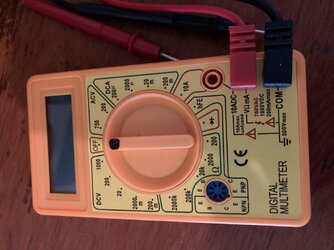
 
You can sort-of test if it is either good or bad, but you'll need a meter that specifically tests capacitance to know anything more than that.

A standard multimeter will not have the capability.
 
Mark Rumreich? Electrolytic, Mica, capacitors. Or ceramic capacitors, or Coupling capacitors. As filters. Which one is the capacitance mode? That is a good book. Though he doesn’t state it, assumed color to color as the basis of wiring procedures. And few other tricks​
 

Attachments

  • image.jpg
    image.jpg
    550.5 KB · Views: 41
Last edited:
For accuracy, you will need a spectrum analyzer and a sound processor that will generate the exact frequencies you are looking for. However, there are cheaper methods by using a phone app.
 
Any answers on, if replacing the original electrolytic capacitors with metalized polypropylene capacitors ,will effect the original sound quality.And when testing the electrolytic capacitors, How far down from original specifications, before sound quality starts to suffer.
 
Any answers on, if replacing the original electrolytic capacitors with metalized polypropylene capacitors ,will effect the original sound quality.And when testing the electrolytic capacitors, How far down from original specifications, before sound quality starts to suffer.
Given the tolerance on most caps in older crossovers, I would say that if anything, you're likely to hear an improvement even if you use the same type as original.
Newer are usually tighter specs.

I also say that you're unlikely to be able to identify two caps that are different type, if they meet the same specs, especially in the realm of car audio.

How much the sound quality can "suffer" depends on a lot of variables, including whether the original sound was within spec in the first place, how good your hearing is, how well your system can resolve small differences in crossover point, etc.
You may put in a new capacitor that actually brings the system into spec, but it will now sound totally wrong to you because you're used to the out of spec sound quality.
 
Last edited:
To robgmn that makes sense, As for sticking to electrolytic caps, Does that mean there may be a difference in sound quality from original electrolytic caps by changing to metalized polypropylene capacitors. Or are they just quite a bit more expensive.There are only 2 capacitors in these crossovers, So price one way or the other shouldn't be a problem. If the metalized polypropylene capacitor means I never half to replace them ever again, But if you feel the sound quality is going to change.Iwould just go back to using the original electrolytic style capacitor. Also are such things as cheap companies making cheap quality capacitors,for either the electrolytic style capacitor or metalized polypropylene capacitor.Aka certain companies or places to order quality capacitors from,thanks
 
Hi, Just getting back in. As to the questions Maylar is asking. I am not able to answer them right now, Since I am doing research for my brothers crossovers, and he has the crossovers, and is on hollidays right now. But I do know, they were oldschool alpine 6255 2 way dividing network crossovers. If you type in alpine 6255 on ebay there is a set or 2 being sold on ebay right now, but the seller is not showing any of the internals.If that helps a little.As for the other 2 posters that posted about sites to order new ones if necessary,thanks for the help on the web sites needed ,If they end up needing replaced,Should I just stay with the original electrolytic caps,same numbers on them,or go with more durable metalized polypropylene capacitors same numbers as on original cap.If you guys think the sound quality will change if using metalized polypropylene capacitors, I will just use the original style electrolytic capacitors. Everybodys help so far has been greatly appreciated.
 
Activity
No one is currently typing a reply...

About this thread

masterblaster1

CarAudio.com Recruit
Thread starter
masterblaster1
Joined
Location
Manitoba
Start date
Participants
Who Replied
Replies
28
Views
2,199
Last reply date
Last reply from
ThxOne
IMG_20260516_193114554_HDR.jpg

sherbanater

    May 16, 2026
  • 0
  • 0
IMG_20260516_192955471_HDR.jpg

sherbanater

    May 16, 2026
  • 0
  • 0

New threads

Top


