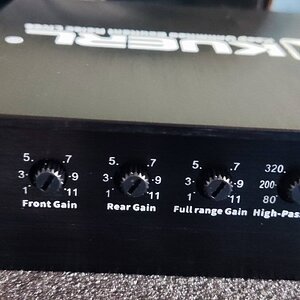
nope, its not like that. to work with any HU, the gain can be adjusted over an excessively wide range. lets say an amp's output is limited to 100V. one HU provides a 10V preout, while another provides a 1V preout. both at maximum volume settings on the HU. for the first case, the amp would need a gain of 10 to convert the 10V input into 100V output. the second case, it would need a gain of 100. so if the gain on the amp was set to 100, and the first HU is used, then the output should be 1000V, but the amp is limited to just 100V.*
so lets look at what really happens -- people do crank the gain, and without damage. (though not always). why? because these people instintively correct for the excessive gain by turning the volume on the HU way down. in the case above, the guy with the HU capable of 10V output at max volume would turn down the volume until the output was closer to 1V.
this is fine, not optimal, but not destructive. These people will typically see this as a sign of a quality system -- it gets very loud at low volume settings. the system may max out at 1/3rd the maximum volume setting on the HU, and be unlistenable at 2/3rd max volume setting.
Why is this not optimal? firstly, you've just removed 1/3rd of the volume settings on the HU. but that's probably ok, many people could probably be happy with just "very loud", "loud", and "talking" volumes. but now any other speakers might not be as loud (or too loud), or might not blend in. The fully cranked setting might limit your options to fix this. Also, the lower signal level might allow more noise to get into the signal, though for subwoofers this might not be as noticable.
This should explain why the amp's potential is not limited by the gain setting -- the amp is fully capable of outputting full power even at low gain settings, but that requires a higher input signal.
*the test method also smoothly moves from in to out. this means the amp's output voltage changes from 0 to +100V then back to 0V then to -100V then back, and does so smoothly. this leads to clipping when the gain is excessive. also, it leads to a case where the amp's actual output power is higher then its rated output power because the rated output was rated for the smoothly changing test signal.