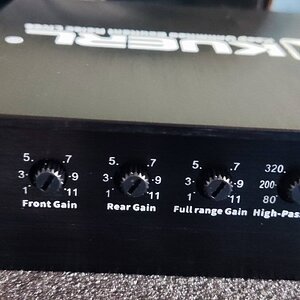
Whats wrong with turning the gain up all the way

you can turn your gains all the way up if you turn the volume on your head unit down more, especialy with a 2 volt preout. It is true. My amp has to be turned to 80% using the dmm just to achieve 40 volts. You never know where the levels are on the amplifier gain, some amps are more sensitive to turning the knob than others.
Flame on, but its true.
Herein lies your first problem.... Assuming that your Hifonics amp makes its advertised rated power without clipping @ 1 ohm. Unless you happened to get a hold of one of those mythical "good ones", it DOES NOT make rated power @ 1 ohm without clipping!

 
i have my 15" IA LI 4 ohm dvc wired for 2 ohms on my hifonics 1208d.. so it should put out 900w at full gain right? well the gain is like 3/4 of the way up so im getting 600-650.. whats wrong with turning the gain all the way up so im getting 900?
Your logic is flawed.

The gain level on your amplifier is to input the sensitivity of the input end of the amp. Head units / processors have a range of out-put voltage... most common are 2, 4, 5, and 8. Setting the gain is basically setting the input voltage from your head unit. When / if it's set at the perfect setting, then your amp will produce 900 W-RMS.

If you set the gain more, it will produce more than what it's rated, but it will no longer be a sine signal. The signal will be clipped creating a sort of trapezoid-shaped wave (and at the worst case of clipping, a square-shaped wave. It shifts from Sine to square as clipping gets worse), in which case it produces more power in one cycle than a sine wave. The problem with this is that the signal becomes distorted and it ends up giving your subwoofer more power over a cycle, making the coil get hotter than what it was designed for, lowering it's lifespan.

If you set the gains too low, then your amp will produce less power, but will produce an undistorted/unclipped signal.

Some people refer to it as a "volume knob." And, in technicality, they're right. But it can't be thought of as one, because as the amplifier clips a signal, it produces more power than what it's designed to produce (damaging the internal parts over time) and it damages your subwoofer (over time... to clarify: a little clipping won't substantially lower the lifespan of your equipment. However, a lot of clipping will. You can set it by ear, and you should be fine. But I prefer to set the gains by a DMM or an O-Scope.)

EDIT:: And what the *** EndofDays says is true...

Your amplifier's gain could be all the way up (most sensitive) and use the volume knob on your processor to play. It CAN work like that. However, the problem with this is that you've reversed the roles.... most people set the gains on their amp based on their head unit being at full volume. This way, you can completely crank your head unit, and it will produce a clean sound. But if you crank your head unit with your amp at most sensitive, then you are surely to blow something.

The mechanics of this is that at lower volumes, your head unit gives out a lower voltage. Let's say your head unit is 5 volts... at, say, 10% volume, the voltage is .5v... the volts at 25% volume is 1.25v, and so on and so forth.

This of course in a perfect world where a head unit produces it's advertised pre-out voltage unclipped.


 
Your logic is flawed.
The gain level on your amplifier is to input the sensitivity of the input end of the amp. Head units / processors have a range of out-put voltage... most common are 2, 4, 5, and 8. Setting the gain is basically setting the input voltage from your head unit. When / if it's set at the perfect setting, then your amp will produce 900 W-RMS.

If you set the gain more, it will produce more than what it's rated, but it will no longer be a sine signal. The signal will be clipped creating a sort of trapezoid-shaped wave (and at the worst case of clipping, a square-shaped wave. It shifts from Sine to square as clipping gets worse), in which case it produces more power in one cycle than a sine wave. The problem with this is that the signal becomes distorted and it ends up giving your subwoofer more power over a cycle, making the coil get hotter than what it was designed for, lowering it's lifespan.

If you set the gains too low, then your amp will produce less power, but will produce an undistorted/unclipped signal.

Some people refer to it as a "volume knob." And, in technicality, they're right. But it can't be thought of as one, because as the amplifier clips a signal, it produces more power than what it's designed to produce (damaging the internal parts over time) and it damages your subwoofer (over time... to clarify: a little clipping won't substantially lower the lifespan of your equipment. However, a lot of clipping will. You can set it by ear, and you should be fine. But I prefer to set the gains by a DMM or an O-Scope.)

EDIT:: And what the *** EndofDays says is true...

Your amplifier's gain could be all the way up (most sensitive) and use the volume knob on your processor to play. It CAN work like that. However, the problem with this is that you've reversed the roles.... most people set the gains on their amp based on their head unit being at full volume. This way, you can completely crank your head unit, and it will produce a clean sound. But if you crank your head unit with your amp at most sensitive, then you are surely to blow something.

The mechanics of this is that at lower volumes, your head unit gives out a lower voltage. Let's say your head unit is 5 volts... at, say, 10% volume, the voltage is .5v... the volts at 25% volume is 1.25v, and so on and so forth.

This of course in a perfect world where a head unit produces it's advertised pre-out voltage unclipped.
i have to agree with this post, very good read.

 
you can turn your gains all the way up if you turn the volume on your head unit down more, especialy with a 2 volt preout. It is true. My amp has to be turned to 80% using the dmm just to achieve 40 volts. You never know where the levels are on the amplifier gain, some amps are more sensitive to turning the knob than others.
Flame on, but its true.
Now THIS is the guy you should be listening to about literally ANYTHING car audio related. No bs, no hypotheses, pure facts and knowledge. Trust me, this guy knows what he's talking about.

 
Now THIS is the guy you should be listening to about literally ANYTHING car audio related. No bs, no hypotheses, pure facts and knowledge. Trust me, this guy knows what he's talking about.
I refuse to listen to anyone who thinks his Hifonics Brutus 1606 puts out rated power @ 1 ohm mono, free of distortion and clipping!

 
i bet it is only putting out around 1000 watts before distorting
You said that you had to crank your gain to 80% in order to get 40 volts of output, which according to my calculation means that you are trying to squeeze 1,600 watts RMS out of your amp @ 1 ohm.... See a problem here?

 
You said that you had to crank your gain to 80% in order to get 40 volts of output, which according to my calculation means that you are trying to squeeze 1,600 watts RMS out of your amp @ 1 ohm.... See a problem here?
i bet i can't even turn the volume up to get to that 1600 rms without major distortion. I'm gonna buy a new 1606 and run each woofer at 2 ohms and i bet it will be much cleaner and probably twice as loud. What do you think?

 
i bet i can't even turn the volume up to get to that 1600 rms without major distortion. I'm gonna buy a new 1606 and run each woofer at 2 ohms and i bet it will be much cleaner and probably twice as loud. What do you think?
Twice as loud... NO! A few decibels, probably. Doubling your output, HELL NO! If you mention anything about 3 dB being perceived doubling by the human ear, I am going to send Vince McMahon to **** the dude in your avatar like he used to do in the good old days!

Cleaner... YES

 
Twice as loud... NO! A few decibels, probably. Doubling your output, HELL NO! If you mention anything about 3 dB being perceived doubling by the human ear, I am going to send Vince McMahon to **** the dude in your avatar like he used to do in the good old days!
Cleaner... YES
think about it though, that amp is maybe putting out 1400 watts total. But with it being at 1 ohm, it would bring much more distortion in making it alot harder to achieve that power without hearing heavy distortion wouldn't it? And then adding another 600 watts to that, you never know. Maybe not twice as loud, but i'm thinking considerably louder for sure. And happier/:D

 
think about it though, that amp is maybe putting out 1400 watts total. But with it being at 1 ohm, it would bring much more distortion in making it alot harder to achieve that power without hearing heavy distortion wouldn't it? And then adding another 600 watts to that, you never know. Maybe not twice as loud, but i'm thinking considerably louder for sure. And happier/:D
The Ultimate Warrior's rectum is quivering right now because of this response. Vince McMahon just popped a Viagra and is on his way!

In all seriousness, more power isn't a bad thing, as long as you know how to control your excess power!

 
Activity
No one is currently typing a reply...
Old Thread: Please note, there have been no replies in this thread for over 3 years!
Content in this thread may no longer be relevant.
Perhaps it would be better to start a new thread instead.

About this thread

Jakeeck

10+ year member
CarAudio.com Elite
Thread starter
Jakeeck
Joined
Location
Eutopia
Start date
Participants
Who Replied
Replies
112
Views
20,421
Last reply date
Last reply from
IDSkoT
IMG_20260506_140749.jpg

74eldiablo

    May 22, 2026
  • 0
  • 0
design.jpeg

WNCTracker

    May 22, 2026
  • 0
  • 0

New threads

Top