What most people dont realize is, an amplifier is ALWAYS working at 100%. Yep, its true. Know why it doesn't always output the same amount of power though? Because its input source varies how large of a signal it has to amplify. The larger the input signal is (in volts), the larger the output from the amplifier. The amp's output stage is always 'pushing' with the same 'force', it simply has more, or less, to start with. This is exactly why amplifiers are sometimes called "gain blocks" and how you control the amplifier's output from the driver's seat, with the headunit's volume controls. Wrap your brains around that one kids.
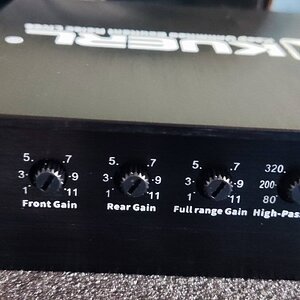
So, knowing this, explaining gains correctly becomes easier. The gain knob simply adjusts the input sensitivity of the amplifier. The output stage always pushes with the same force, but how much signal voltage it has to start with is determined not just by the source unit's output voltage (your head unit), but by how sensitive you adjust the input stage of the amplifier to be. Will your h/u max at 1 volt of output signal, or 8 volts? The gain knob tells the amplifier this.
What happens when you adjust the input stage of your amp to be too sensitive given the input signal it can receive? Clipping. As shown in a pic above, its a squaring off the of the signal waveform. What was said about it was true, the problem does lie in the fact that more power exists under the shape of a squared wave. This is because amplitude does not increase, while area under the waveform does. More power, but no more cone excursion to help dissipate the excess heat that will be generated. So no, clipping will not help exceed your speaker's mechanical limits, but it certainly can help exceed its thermal limits.
To argue if 'clipping' or 'excess power killed a speaker is semantics. The excess heat was caused by the clipping. So long as its understood that 'clipping' in and of itself does not kill speakers, only when it helps drive the speaker past its thermal limits, then saying clipping killed the speaker is acceptable. But, we do love to revel in these arguments here, dont we.