OHMS - What set up is best?

dc_the_boss

Junior Member
Hello forum!

I have been installing basic car audio systems in my vehicles and friends vehicles for about 10 years but I have never bothered to learn how ohms really work until now. I have done my research and I believe I understand the basics of wiring down the ohms as well as matching the amp with the sub setup. One question I can't seem to figure out is which setup is best.

Here are a few examples...please tell me if any of these is preferred over the rest.

Option 1: (2 subs, 1amp)

x2 12" subs(750w RMS) wired to 1ohm with an amp that puts out 1500w @ 1ohm

Option 2: (2 subs, 1amp)

x2 12" subs(750w RMS) wired to 2ohms with an amp that puts out 1500w @ 2ohms

Option 3: (2 subs, 2amps)

x1 12" sub(750w RMS) wired to 4ohms with an amp that puts out 750w @ 4ohms

x1 12" sub(750w RMS) wired to 4ohms with an amp that puts out 750w @ 4ohms

Option 4: (2 subs, 2amps)

x1 12" sub(750w RMS) wired to 2ohms with an amp that puts out 750w @ 2ohms

x1 12" sub(750w RMS) wired to 2ohms with an amp that puts out 750w @ 2ohms

All of these end up pushing the same amount of power to each sub correct? Im thinking one of these will be better because of product availability, heat issues, power consumption & cost right?

 
Being that i am national tech advisor for a company that produces both 1 and 2 ohm versions of their own amplifiers, let me give you what i know from their engineering-

1 ohm vs 2 ohm stability version, same amp model.

Efficiency differs only by 1-4% typically so not much change.

Our cost is the same.

Any other option, typically an amplifier than can produce power at a higher impedance would cost more but not true with our engineering.

Now, since our option is scarcely available for other brands, i will show you how brand A differs from brand B which is more common conversation.

Amp A is 1500w 1ohm for x amount.

Amp B is 1500w 2ohm for $50 more.

Higher mono impedance cost more mainly because of lack of demand.

Efficiency-

This will vary greatly because comparing brands so cannot comment.

The difference is typically not an actual feature.

Looking at efficiency ratings on the SAME amp from 1 to 2 to 4ohm is where the greatest difference is but not when comparing different amps different stability levels.

I never said this is in concrete though.

There are exceptions.

We have 1 model that is 78% efficient on 1ohm model and 87% efficient on 2 ohm model.

The 2ohm model will be right around 100% efficient after taking into account the realtime impedance curve used on said transducer.

We have several amplifiers that are capable of near 100% efficiency but im sure doesnt fit this kind of topic... for the elite customer. Heavy wattage.

In terms of thermal- power is power ( wattage) so any heat burn off should be equal to the proportion of its efficiency rating when comparing amp to amp.

Again, this is pointless to care about. Not a feature or problem.

 
l

Being that i am national tech advisor for a company that produces both 1 and 2 ohm versions of their own amplifiers, let me give you what i know from their engineering-
1 ohm vs 2 ohm stability version, same amp model.

Efficiency differs only by 1-4% typically so not much change.

Our cost is the same.

Any other option, typically an amplifier than can produce power at a higher impedance would cost more but not true with our engineering.

Now, since our option is scarcely available for other brands, i will show you how brand A differs from brand B which is more common conversation.

Amp A is 1500w 1ohm for x amount.

Amp B is 1500w 2ohm for $50 more.

Higher mono impedance cost more mainly because of lack of demand.

Efficiency-

This will vary greatly because comparing brands so cannot comment.

The difference is typically not an actual feature.

Looking at efficiency ratings on the SAME amp from 1 to 2 to 4ohm is where the greatest difference is but not when comparing different amps different stability levels.

I never said this is in concrete though.

There are exceptions.

We have 1 model that is 78% efficient on 1ohm model and 87% efficient on 2 ohm model.

The 2ohm model will be right around 100% efficient after taking into account the realtime impedance curve used on said transducer.

We have several amplifiers that are capable of near 100% efficiency but im sure doesnt fit this kind of topic... for the elite customer. Heavy wattage.

In terms of thermal- power is power ( wattage) so any heat burn off should be equal to the proportion of its efficiency rating when comparing amp to amp.

Again, this is pointless to care about. Not a feature or problem.

Care to share what company?

 
Being that i am national tech advisor for a company that produces both 1 and 2 ohm versions of their own amplifiers, let me give you what i know from their engineering-1 ohm vs 2 ohm stability version, same amp model.

Efficiency differs only by 1-4% typically so not much change.

Our cost is the same.

Any other option, typically an amplifier than can produce power at a higher impedance would cost more but not true with our engineering.

Now, since our option is scarcely available for other brands, i will show you how brand A differs from brand B which is more common conversation.

Amp A is 1500w 1ohm for x amount.

Amp B is 1500w 2ohm for $50 more.

Higher mono impedance cost more mainly because of lack of demand.

Efficiency-

This will vary greatly because comparing brands so cannot comment.

The difference is typically not an actual feature.

Looking at efficiency ratings on the SAME amp from 1 to 2 to 4ohm is where the greatest difference is but not when comparing different amps different stability levels.

I never said this is in concrete though.

There are exceptions.

We have 1 model that is 78% efficient on 1ohm model and 87% efficient on 2 ohm model.

The 2ohm model will be right around 100% efficient after taking into account the realtime impedance curve used on said transducer.

We have several amplifiers that are capable of near 100% efficiency but im sure doesnt fit this kind of topic... for the elite customer. Heavy wattage.

In terms of thermal- power is power ( wattage) so any heat burn off should be equal to the proportion of its efficiency rating when comparing amp to amp.

Again, this is pointless to care about. Not a feature or problem.
shizzzon - Nice post. I can't really argue with anything you have stated here. As far as the OP's question, it sounds like you are saying the OP's decision would be based mostly on efficiency of a given combo, otherwise availability and budget are probably only remaining decision factors.

Can you be more specific about the high-end models you said could achieve "around 100%" or "near 100%" efficiencies? What exactly is their efficiency and under what condition (RMS power out and load impedance)? Thanks.

 
shizzzon - Nice post. I can't really argue with anything you have stated here. As far as the OP's question, it sounds like you are saying the OP's decision would be based mostly on efficiency of a given combo, otherwise availability and budget are probably only remaining decision factors.
Can you be more specific about the high-end models you said could achieve "around 100%" or "near 100%" efficiencies? What exactly is their efficiency and under what condition (RMS power out and load impedance)? Thanks.

Class D designs work in very high efficiency at maximum unclipped (or soft clipped) output and typically at higher impedance than most would run them.

 
shizzzon - Nice post. I can't really argue with anything you have stated here. As far as the OP's question, it sounds like you are saying the OP's decision would be based mostly on efficiency of a given combo, otherwise availability and budget are probably only remaining decision factors.
Can you be more specific about the high-end models you said could achieve "around 100%" or "near 100%" efficiencies? What exactly is their efficiency and under what condition (RMS power out and load impedance)? Thanks.
In reality, he would be comparing Brand A to Brand B instead of 1ohm to 2ohm stability because 2ohm stable monos are far less common than 1ohm.

Because of that, it would be unfair comparison because efficiency designs from one company to another can very greatly based on what they focused their engineering on.

The high efficiency models i was referring to earlier-

About 94% of all the amplifiers this company makes uses what's called Full Bridge Rectification compared to what most other companies use which is Half Bridge Rectification.

To put it into simple terms-

Full Bridge uses the least amount of components on the board resulting in much less cost, heat buildup, greater efficiency, etc..

Half Bridge uses twice the components on the board adding more cost, much heavier heatsinks, hotter amplifier, efficiencies vary.

So, in the real world, to build a Full Bridge amplifier, it's initial cost for a small amp(let's say 1000w) is high.

Compared to a Half Bridge amp, the Half Bridge can and will typically be cheaper in cost.

IT's not until we start to get up to ~2,500-3,500w before Full Bridge Rectification starts to produce power a LOT less in cost compared to Half Bridge.

And this is where it makes no business sense to this day-

Today, there are Half Bridge amplifiers surpassing 10,000w for well over $2,000. Why?

Here are examples of how inefficient Half Bridge amplifier design is for large power-

These are pulled from SonicElectronix-

DC Audio 3.5k- $999

Taramp's 3.5k- Under $500

Main difference- Taramp's cannot be ran at 0.5ohm but DC Audio can. This is common among Full Bridge technology.

So, this is what we will do.

We will take 2 amplifiers that are 1ohm stable, and compare the 1ohm Half Bridge design to Taramp's Full Bridge 2ohm rating instead of 1ohm because in the real world, your impedance jumps up so this will be much more ideal.

So, back to Sonicelectronix-

DC Audio 5K- $1,479

Taramp's HD8000(6,300w 2ohm)- $809

Let's compare the largest 12v amps together-

DC Audio 10K- $2,399

Taramp's T20.2K (20,200w)- $1849

Massive difference!

So, we see how Half Bridge is a terrible design method still used by most companies today when it comes to cost to performance.

So, now let's move over to high efficiency models with Full Bridge-

The T20.2K amp is actually 88% efficient at 1ohm. The highest 1ohm amplifier they produce and possibly any other as well.

IT's 2 and 4 ohm ratings will be in the mid to high 90% range.

The highest comes from the Elite line of amplifiers, the HV line.

This particular line runs on the following nominal voltage levels based on model-

115v

126v

240v

336v

430v

This means user has to wire many batteries in series to achieve these voltages.

So, let's focus on the lower voltage levels as they only require 10 batteries-

126v

This particular amp is their largest- 50,000w

So 10 batteries in series is very ideal.

Cost- under $1,500!

Is Full Bridge making sense yet?

Efficiency- 91% @0.5ohm (it's rated for this load)

That means all impedance values above this will basically be a pure power in\power out scenario resulting in almost 0 energy loss.

Now, i won't get into how to safely wire these HV models up or how to charge them but yes, it's 100% possible to do so while driving.

In the end, i question when companies will drop Half Bridge Rectification..

I can use this as an analogy-

We still build all vehicles with only 2 gears instead of 4-6 but still try to read 140mph with over 30mpg.

We are never going to make it happen if we don't change the design...

So, we keep adding more devices to the vehicle that increases cost just to gain 1 more mpg for that next year model.

The cost just keeps going up and up..

 
Shizzzon -

Wow. All those words and you didn't answer the only question I asked.

BTW. I am an electronics design engineer. Been designing circuits since 1986. So I understand full bridge rectification versus half bridge rectification.

I hope you will still answer my question about amplifier efficiency.

Also, now I have another question... where exactly are bridge rectifiers used in a car amplifier (which is essentially a DC powered device)?

Thanks

 
The high efficiency will be seen in the 2 to 4 ohm range on the 20k 12v model.

on high voltage models, 1 to 2ohm range.

remember, they are mostly already around 90% at 0.5ohm.

Power output-

50,000w 0.5ohm 91% efficiency.

28,600w 1ohm 94%

16,000w 2ohm 97%

Thats one example.

Therr are also 35,000w at 240v

20,000w at 140v

10,000w at 115v

All share high end efficiency.

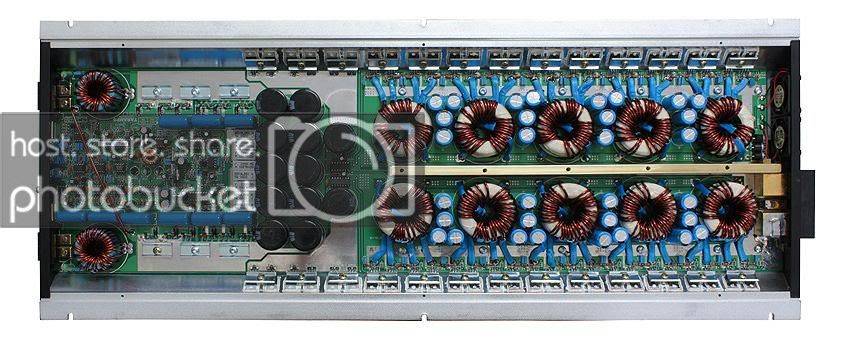
Here is a picture of the 20kw 12v model-

taramps.jpg


The high efficiency will be seen in the 2 to 4 ohm range on the 20k 12v model.on high voltage models, 1 to 2ohm range.

remember, they are mostly already around 90% at 0.5ohm.

Power output-

50,000w 0.5ohm 91% efficiency.

28,600w 1ohm 94%

16,000w 2ohm 97%

Thats one example.

Therr are also 35,000w at 240v

20,000w at 140v

10,000w at 115v

All share high end efficiency.

Here is a picture of the 20kw 12v model-

taramps.jpg
Thanks for the additional info. For what it is worth, you have an error in your prior post. Full Bridge and Half Bridge class D amplifier topologies have nothing to do with "rectification". You should remove any reference to rectification in your prior discussion. Full Bridge and Half Bridge refer to single ended or differential drive arrangements on the amplifier output stage.

 
Activity
No one is currently typing a reply...
Old Thread: Please note, there have been no replies in this thread for over 3 years!
Content in this thread may no longer be relevant.
Perhaps it would be better to start a new thread instead.

About this thread

dc_the_boss

Junior Member
Thread starter
dc_the_boss
Joined
Location
Houston, TX
Start date
Participants
Who Replied
Replies
11
Views
1,412
Last reply date
Last reply from
shizzzon
20260423_214720.jpg

BP1Fanatic

    May 14, 2026
  • 0
  • 0
20260419_124349.jpg

BP1Fanatic

    May 14, 2026
  • 0
  • 0

New threads

Top