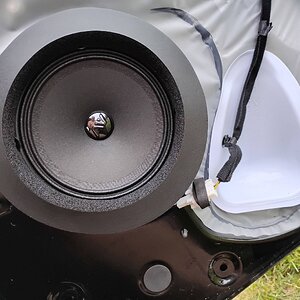
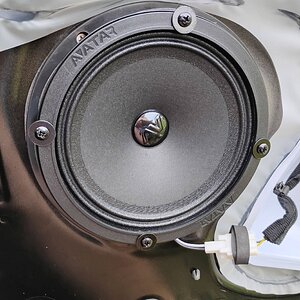
Little help on wiring up second battery.... pics :)

Just because the alty is only 70A doesn't mean that will be the max the amps will draw from the batteries.
yeah im fusing the batteries for 150 amps.... between the batteries and between back battery and amplifier.... the amp only draws 120 amps....

 
Just because the alty is only 70A doesn't mean that will be the max the amps will draw from the batteries.
Just because the fuse says 120 doesn't mean it limits the system to 120 amps. Fuses can exceeds twice their rated current for 20-30 seconds. They don't trip from short peaks of thier rated current.

So a 200 amp fuse could pass 300-400 amps for several seconds. There is no reason for a fuse that size on his system. He could use zero gauge wire if he want's to. The wire is good for 325 amps, but a fuse that big would provide almost no protection for him in a 70-120 amp electrical system.

When picking fuses your trying to stay within a target of safety and reliablity. You want it large enough that your not poping it with the occasional bass note, but small enough to protect your wire and electrical system at the first serious problem.

In the case of the OP, I would go with a fuse rated at what his future HO would be, as long as it is less than what the wire is rated at, probably 120-160 amps.

This graph lets you see the estimated time that it might take for an ANL type fuse to open. The data used to create the graph was found on the Bussmann® web site. You can see that it would take as much as 10 seconds to blow at double its rated current flow but it would only take approximately 0.1 seconds to blow it if 1000 amps of current passed through the 100 amp fuse. If your amplifiers would intermittantly draw 200 amps, the fuse probably would not blow. If they drew 200 amps for more than 10 seconds, the fuse would likely blow. If the wire was shorted to ground, the current flow would be extremely high (probably more than 1000 amps) and the fuse would blow almost instantly.
Graph of opening time vs current flow through a 100 amp ANL type fuse.

fusegraph.gif


http://www.bcae1.com/
 
preaching to the quire. //content.invisioncic.com/y282845/emoticons/wink.gif.608e3ea05f1a9f98611af0861652f8fb.gif I've ran 6kw through 160A of fuse before. //content.invisioncic.com/y282845/emoticons/smile.gif.1ebc41e1811405b213edfc4622c41e27.gif

 
preaching to the quire. //content.invisioncic.com/y282845/emoticons/wink.gif.608e3ea05f1a9f98611af0861652f8fb.gif I've ran 6kw through 160A of fuse before. //content.invisioncic.com/y282845/emoticons/smile.gif.1ebc41e1811405b213edfc4622c41e27.gif
Well I woudn't do that either. //content.invisioncic.com/y282845/emoticons/tongue.gif.6130eb82179565f6db8d26d6001dcd24.gif

I'm just pointing out to the OP that, IMO, a 200 amp fuse is too big for what is really a 70 amp system. Even though the wire can take it, and the battery can occasionally deliver it, it would be safer to go with a smaller fuse. Anything from 100- 160 would be fine, but a 200 amp fuse is almost 3 times the nominal capacity of his system. There is no reason for that.

Most people just slap in what ever fuse came with the holder, which is certainly better than nothing, but a properly designed system should be as exact as possible.

I have a 120 amp system; a 120 amp alternator, 125 amp fuses, 4 gauge cable, and 85 amps of audio. With 2 batteries I can slam my system while starting the engine without fear of blowing anything, but the fuses should trip quickly if anything goes wrong.

 
With a 70 amp alternator, he doesn't have 200 amps to give.
Explain that statement. And I hope its good, because with all your explanations and charts in this thread, that one single comment suggests you do not understand the utmost fundamentals of how your vehicle's charging system works.
Just because the fuse says 120 doesn't mean it limits the system to 120 amps. Fuses can exceeds twice their rated current for 20-30 seconds. They don't trip from short peaks of thier rated current.
So a 200 amp fuse could pass 300-400 amps for several seconds. There is no reason for a fuse that size on his system. He could use zero gauge wire if he want's to. The wire is good for 325 amps, but a fuse that big would provide almost no protection for him in a 70-120 amp electrical system.

When picking fuses your trying to stay within a target of safety and reliablity. You want it large enough that your not poping it with the occasional bass note, but small enough to protect your wire and electrical system at the first serious problem.

In the case of the OP, I would go with a fuse rated at what his future HO would be, as long as it is less than what the wire is rated at, probably 120-160 amps.
You can buy fuses with different burn characteristics (slow-blow, etc), so I find your 'twice the rated current for 20-30 seconds' curious. Where did you obtain this data?
If a 200 amp fuse would pass 300-400 amps for 30 seconds, why do you think they rate it for 200 amps?

"The wire is good for 325 amps, but a fuse that big would provide almost no protection for him in a 70-120 amp electrical system."

So, you have concluded that even with a dead short, his system could not provide more than 120 amps of current? At this point I have to advise hoxie to stop taking your advice. For all your seemingly good intentions, you misunderstand some basic ideas that lead to flawed conclusions.

You are right about one thing though, finding the right window to properly size your fuse. Your mistake is on the low end however, as the amplifier can draw current spikes in upwards of its peak power rating while operating normally (and even more if clipped).

You do not understand what happens in the charging system when system voltage varies. The alternator powers/charges the system (batts, caps, etc) by providing a higher voltage than the battery. If the amplifier(s) pulls more current than the alt can provide, system voltage drops to the point that the battery starts supplying to make up the difference. If the power demand is great enough, or lasts long enough, the battery will deplete, dropping system voltage even further. This can also happen in very short periods of time while the system makes up for loses due to resistance in the battery and cables.

 
Explain that statement. And I hope its good, because with all your explanations and charts in this thread, that one single comment suggests you do not understand the utmost fundamentals of how your vehicle's charging system works.
You can buy fuses with different burn characteristics (slow-blow, etc), so I find your 'twice the rated current for 20-30 seconds' curious. Where did you obtain this data?

If a 200 amp fuse would pass 300-400 amps for 30 seconds, why do you think they rate it for 200 amps?

"The wire is good for 325 amps, but a fuse that big would provide almost no protection for him in a 70-120 amp electrical system."

So, you have concluded that even with a dead short, his system could not provide more than 120 amps of current?
Really? Where did I say that? I think I said the opposite. His system could put out over 325 amps, for a few seconds. Long enough to set fire to his car before the fuse blows. That was the point I was making. Maybe I wasn't clear, or you just misunderstood me?
At this point I have to advise hoxie to stop taking your advice. For all your seemingly good intentions, you misunderstand some basic ideas that lead to flawed conclusions.
You seem do be drawing some strange conclusions based on things I have not said.
You are right about one thing though, finding the right window to properly size your fuse. Your mistake is on the low end however, as the amplifier can draw current spikes in upwards of its peak power rating while operating normally (and even more if clipped).

You do not understand what happens in the charging system when system voltage varies. The alternator powers/charges the system (batts, caps, etc) by providing a higher voltage than the battery. If the amplifier(s) pulls more current than the alt can provide, system voltage drops to the point that the battery starts supplying to make up the difference. If the power demand is great enough, or lasts long enough, the battery will deplete, dropping system voltage even further. This can also happen in very short periods of time while the system makes up for loses due to resistance in the battery and cables.
Maybe your right, forget everything I said. He should install a 200-250 amp fuse as others suggested. You don't seem to find fault with those statements, only mine.

He's fine with running 120 amps of audio off his 70 amp alt, that won't be a problem at all. I'll stop posting now that you've shown me how I've lead this person dangerously astray. Clearly I'm trying to kill this guy.

//content.invisioncic.com/y282845/emoticons/rolleyes.gif.c1fef805e9d1464d377451cd5bc18bfb.gif

 
Activity
No one is currently typing a reply...
Old Thread: Please note, there have been no replies in this thread for over 3 years!
Content in this thread may no longer be relevant.
Perhaps it would be better to start a new thread instead.

About this thread

hoxie08

5,000+ posts
i <3 drugs
Thread starter
hoxie08
Joined
Location
Nashville, TN
Start date
Participants
Who Replied
Replies
50
Views
2,329
Last reply date
Last reply from
DidUHearThat?
IMG_20260516_193114554_HDR.jpg

sherbanater

    May 16, 2026
  • 0
  • 0
IMG_20260516_192955471_HDR.jpg

sherbanater

    May 16, 2026
  • 0
  • 0

New threads

Top