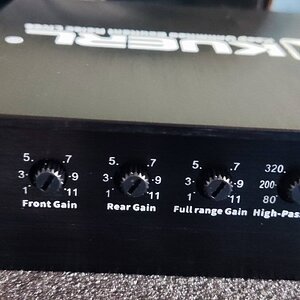
for those who've used 18's?

Acceleration is SPL/amplitude, not transient response.
Rate of change of acceleration, which is dictated by inductance and not mass, is what controls "woofer speed".

And even then....who's to a say an 18" has more moving mass than a 12" sub of a different brand?
Rate of change (intertia) is based on mass. Its Newton's 1st law, and object thats in motion, has the tendancy to stay in motion. The more of an object (mass), the more of the tendancy to want to stay in motion. Don't even bother arguing against the laws of the universe.

 
Rate of change (intertia) is based on mass. Its Newton's second law. Don't even bother arguing against the laws of the universe.
Maybe I interpreted this wrongly, but rate of change is not inertia. Inertia resists movement due to mass. The Law of Inertia is Newton's First Law.

 
Rate of change (intertia) is based on mass. Its Newton's 1st law, and object thats in motion, has the tendancy to stay in motion. The more of an object (mass), the more of the tendancy to want to stay in motion. Don't even bother arguing against the laws of the universe.
The overriding factor here is the inductance. Any effect of the Mms increasing simply isn't measurable vs. the impact that increasing the Le has on the driver.

 
Maybe I interpreted this wrongly, but rate of change is not inertia. Inertia resists movement due to mass. The Law of Inertia is Newton's First Law.
Yeah, its the 1st law ( I just edited it ). Rate of change is intertia. What else whould it be?

 
Okay, so you were wrong. bye.
?

I never said otherwise...

A driver's inductance has far more to do with transient response than Mms (moving mass) does...Dan Wiggins of Adire (http://www.adireaudio.com) has already done and published the work on this.
http://www.adireaudio.com/Files/TechPapers/WooferSpeed.pdf

The paper I was referring to...

Mass isn't the problem - inductance is! So if you want faster transient response, ignore that moving mass parameter manufacturers push and look at the inductance...
Numbers don't lie.

 
Yeah, its the 1st law ( I just edited it ). Rate of change is intertia. What else whould it be?
From my physics book "inertia- The reluctance of any body to change its state of motion. Mass is the measure of inertia."

Edit - Doesn't rate require time?

 
just get 4 mt 18's in a 40cube ported box or get 4 rl-s 15's and put them in a 40cube sealed box with 2 goliath amp and call it a day
80
4 RE 18" MT's and 2 Goliaths sounds like a winner to me.

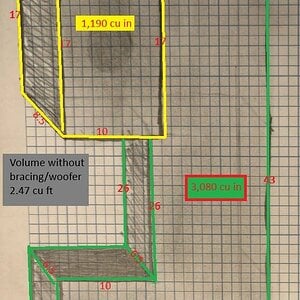
hovever my box is 25^3ft with 280^2in of port tunned to 33hz

 
From my physics book "inertia- The reluctance of any body to change its state of motion. Mass is the measure of inertia."
Edit - Doesn't rate require time?
Do this expiriment, take a pencil, and shake it back and forth, then take a 10 lb dumbell and do it. Thats the point Im trying to make, the more massive the object, the harder it is move it back and forth (just like a woofer). In terms of it mattering with woofers, Someone might argue that it won't matter, and thats really dependant on woofer design I would guess.

Then of course you could argue about the definition of transient response. Im not an audio engineer, so I can;t talk about that type of stuff. Both my parents have their phd's in physics, so I have a library of information at my disposal. I also think its funny that alot of people completely ignore the fact that there is an atmosphere. Did Dan wiggins actually change the woofer size, or did he just add wieght?

 
Rate of change (intertia) is based on mass. Its Newton's 1st law, and object thats in motion, has the tendancy to stay in motion. The more of an object (mass), the more of the tendancy to want to stay in motion. Don't even bother arguing against the laws of the universe.
No one is agruing against the laws of physics. However, you are ignorantly arguing the wrong points of physics and incorrectly applying them to loudspeakers.

Stop talking and start reading. I'm not going to go through it all as Mr. Wiggins has adequately done it on more than one occasion.

 
Do this expiriment, take a pencil, and shake it back and forth, then take a 10 lb dumbell and do it. Thats the point Im trying to make, the more massive the object, the harder it is move it back and forth (just like a woofer).
You could still adequately move the 10lb dumb bell back and forth as many times as the pencil (transient response)....but do to it's heavier weight, you wouldn't be able to move it as far in each direction (amplitude).

In your example; your neural system..the frequency you can control your arm to move, is the inductance and will control the transient response. Your muscle system...how much force you can apply combined with the weight of the pencil/dumbell..will control the amplitude of the movement.

 
Do this expiriment, take a pencil, and shake it back and forth, then take a 10 lb dumbell and do it. Thats the point Im trying to make, the more massive the object, the harder it is move it back and forth (just like a woofer). In terms of it mattering with woofers, Someone might argue that it won't matter, and thats really dependant on woofer design I would guess.Then of course you could argue about the definition of transient response. Im not an audio engineer, so I can;t talk about that type of stuff. Both my parents have their phd's in physics, so I have a library of information at my disposal. I also think its funny that alot of people completely ignore the fact that there is an atmosphere. Did Dan wiggins actually change the woofer size, or did he just add wieght?
Interesting you mention this test, as Ive related a similar test for this topic before:

Pick up two pebbles off the ground and place one in each hand. Shake them back and forth vigorously. Eventhough the pebbles are approximately the same size, there obviously is some slight different in weight between the two. When your arm shook them back and forth, did this difference in mass make any noticeable difference in the movement of your arm? There was a mass difference, and it did affect the speed at which you shook each arm, but it did not create any noticeable change. This is also true when comparing the few gram differences between cone sizes of speakers in relation to the amount of force they have with which to excurt on said cones. There is a mass difference, and it does affect the things you are suggesting here, but what you are missing is everyone is telling you those factors you are questioning are simply too small of a factor to need consideration (much like the actual mass difference between the two pebbles).

Lastly, why do people assume a speaker was designed with the smallest size only taken into consideration. If a manufacturer is capable of producing a motor with sufficient force to adequately control a 12" diaprhagm, why would we assume they cannot do the same for an 18" version? IMO, those who say 18's are so much sloppier than 12's are assuming the motor was designed for the perameters of a 12" cone, then they just slapped an 18" cone on it. Perhaps, and if they were smart this is true, the speaker designers designed the motor while keeping in mind it would be accomodating an 18" cone, and design it thusly. Thereby creating a speaker capable of a certain performance level given a certain MMs, and any lowering of that MMs (building smaller cone versions) would produce no audible gains.

When chosing a cone size, several factors need to be considered like space available, output desired, frequency response needed, etc etc. But, transient response based on some notion of MMs figures or cone diameter is not a consideration.

 
Those eclipse 18s look pretty expensive, however, not too many people make 18s these days.
I like 18s. I think items like this eclipse and the xxx can sound pretty good (from what I have read) while getting pretty loud + the "wow" factor...all the better.

(re, ma audio, pyramid, kicker (only in the solo-x) That's all I can think of that have models currently available.
And the JL 18W3 //content.invisioncic.com/y282845/emoticons/biggrin.gif.d71a5d36fcbab170f2364c9f2e3946cb.gif

 
Yeah, thats kind of the point I was getting at, if the manufactor designs it to handle the weight, than it shouldn't be a problem. Mms is important, but you shouldn't base anything solely off of it. I mean, theres a reason companies strive to produce cone materials that are rigid and light. If they were to make a cone out of cast iron, it would probally sound like a piece of shit and have horrible ineffciency.

BTW I know alot of you say its "unnoticeable" but keep in mind some audiophiles can hear significant differences between RCA cords. Car's don't even have proper imaging to start with, so my guess is there are lots of things to worry about besides cone diameter.

 
There will be no real difference in sound or accuracy with an 18. maybe being able to play lower louder because of shear displacement.
18's are kind of pointless IMO unless you have a ton of room to play with.
nothings pointless:cool: its just louder:)

 
Activity
No one is currently typing a reply...
Old Thread: Please note, there have been no replies in this thread for over 3 years!
Content in this thread may no longer be relevant.
Perhaps it would be better to start a new thread instead.

About this thread

lightning2004

10+ year member
Member
Thread starter
lightning2004
Joined
Location
illinois
Start date
Participants
Who Replied
Replies
71
Views
2,009
Last reply date
Last reply from
DBfan187
IMG_20260506_140749.jpg

74eldiablo

    May 22, 2026
  • 0
  • 0
design.jpeg

WNCTracker

    May 22, 2026
  • 0
  • 0

New threads

Top