SyKo13
5,000+ posts
Bewb Saving Lawn Tech
Here is a short run-through of how lead-acid batteries work. I'll start with some basics.
Voltage
Voltage is an electrical measure which describes the potential to do work. The higher the voltage the greater its risk to you and your health. Systems that use voltages below 50V are considered low-voltage and are not governed by an as strict (some might say arcane) set of rules as high-voltage systems.
Current
Current is a measure of how many electrons are flowing through a conductor. Current is usually measured in amperes (A/Amps). Current flow over time is defined as ampere-hours (a.k.a. amp-hours or Ah), a product of the average current and the amount of time it flowed.
Power
Power is the product of voltage and current and is measured in Watts. Power over time is usually defined in Watt-hours (Wh), the product of the average number of watts and time. Your energy utility usually bills you per kiloWatt-hour (kWh), which is 1,000 watt-hours.
Lead-Acid Battery?
A lead-acid battery is a electrical storage device that uses a reversible chemical reaction to store energy. It uses a combination of lead plates or grids and an electrolyte consisting of a diluted sulphuric acid to convert electrical energy into potential chemical energy and back again. The electrolyte of lead-acid batteries is hazardous to your health and may produce burns and other permanent damage if you come into contact with it. So, when dealing with electrolyte protect yourself appropriately.
Deep Cycle vs Starting Batteries
Batteries are typically built for specific purposes and they differ in construction accordingly. Broadly speaking, there are two applications that manufacturers build their batteries for: Starting and Deep Cycle.
• As the name implies, Starter Batteries are meant to get combustion engines going. They have many thin lead plates which allow them to discharge a lot of energy very quickly for a short amount of time. However, they do not tolerate being discharged deeply, as the thin lead plates needed for starter currents degrade quickly under deep discharge and re-charging cycles. Most starter batteries will only tolerate being completely discharged a few times before being irreversibly damaged.
• Deep Cycle batteries have thicker lead plates that make them tolerate deep discharges better. They cannot dispense charge as quickly as a starter battery but can also be used to start combustion engines. You would simply need a bigger deep-cycle battery than if you had used a dedicated starter type battery instead. The thicker the lead plates, the longer the life span, all things being equal. Battery weight is a simple indicator for the thickness of the lead plates used in a battery. The heavier a battery for a given group size, the thicker the plates, and the better the battery will tolerate deep discharges.
• Some Marine batteries are sold as dual-purpose batteries for starter and deep cycle applications. However, the thin plates required for starting purposes inherently compromise deep-cycle performance. Thus, such batteries should not be cycled deeply and should be avoided for deep-cycle applications unless space/weight constraints dictate otherwise.
Regular vs Valve-Regulated Lead Acid (VRLA) Batteries
Battery containers come in different configurations. Flooded batteries can be either sealed or open.
• Sealed flooded cells are frequently found as starter batteries in cars. Their electrolyte cannot be replenished. When enough electrolyte has evaporated due to charging, age, or just ambient heat, the battery has to be replaced.
• Deep-Cycle flooded cells usually have removable caps that allow you to replace any electrolyte that has evaporated over time. Take care not to contaminate the electrolyte - wipe the exterior container while rinsing the towel frequently.
- VRLA batteries remain under constant pressure of 1-4 psi. This pressure helps the recombination process under which 99+% of the Hydrogen and Oxygen generated during charging are turned back into water. The two most common VRLA batteries used today are the Gel and Absorbed Glass Mat (AGM) variety.
• Gel batteries feature an electrolyte that has been immobilized using a gelling agent like fumed silica.
• AGM batteries feature a thin fiberglass felt that holds the electrolyte in place like a sponge.
- Neither AGM or Gel cells will leak if inverted, pierced, etc. and will continue to operate even under water.
Battery Cells
Battery Cells are the most basic individual component of a battery. They consist of a container in which the electrolyte and the lead plates can interact. Each lead-acid cell fluctuates in voltage from about 2.12 Volts when full to about 1.75 volts when empty. Note the small voltage difference between a full and an empty cell (another advantage of lead-acid batteries over rival chemistries).
Battery Voltage
The nominal voltage of a lead-acid battery depends on the number of cells that have been wired in series. As mentioned above, each battery cell contributes a nominal voltage of 2 Volts, so a 12 Volt battery usually consists of 6 cells wired in series.
State of Charge
The State of Charge describes how full a battery is. The exact voltage to battery charge correlation is dependent on the temperature of the battery. Cold batteries will show a lower voltage when full than hot batteries. This is one of the reasons why quality alternator regulators or high-powered charging systems use temperature probes on batteries.
Depth of Discharge
The Depth of Discharge (DOD) is a measure of how deeply a battery is discharged. When a battery is 100% full, then the DOD is 0%. Conversely, when a battery is 100% empty, the DOD is 100%. The deeper batteries are discharged on average, the shorter their so called "cycle life".
Battery Storage Capacity
The Amp-hour (Ah) capacity of a battery tries to quantify the amount of usable energy it can store at a nominal voltage. All things equal, the greater the physical volume of a battery, the larger its total storage capacity. Storage capacity is additive when batteries are wired in parallel but not if they are wired in series.
Most marine, automotive, and RV applications use 12V DC. You have the choice to either buy a 12V battery or to create a 12V system by wiring several lower-voltage batteries/cells in Series.
Battery Wiring
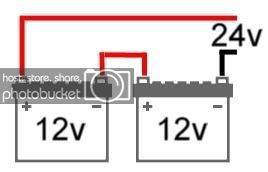
When two 6V, 100Ah batteries are wired in Series, the voltage is doubled but the amp-hour capacity remains 100Ah (Total Power = 1200 Watt-hours).
You may decide to wire batteries in series because a single 12V battery with the right storage capacity is simply too heavy, unwieldy, or awkward to lift into place. Batteries consisting of fewer cells (and hence lower voltage) in series can provide the same storage capacity yet be portable. It is not unusual to see solar power installations where the battery bank consists of a sea of 2V batteries that have been wired in series
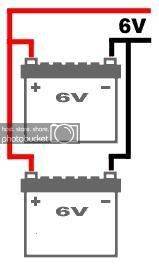
Two 6V, 100Ah batteries wired in Parallel will have a total storage capacity of 200Ah at 6V (or 1200 Watt-hours).
Battery banks consisting of 12V batteries wired in parallel are often seen on OEM installations in boats and RVs alike. Such banks are simple to wire up and require a minimum of cabling. However, the wiring must have the capacity to deal with a full battery bank.
You should fuse each battery individually in such a bank to ensure that a battery gone bad will not affect the rest of the bank.
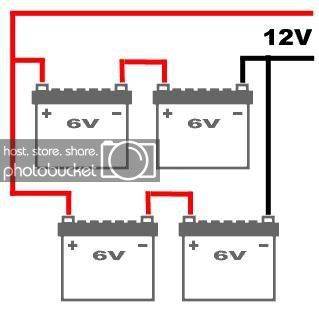
Battery banks wired in Series-Parallel are even more complicated. Here, four 6V cells are wired in two "strings" of 12VDC that were then wired in parallel. Using 6V, 100Ah batteries, this system will have a storage capacity of 200Ah at 12V or 2,400Wh.
Since such a system has more wiring, it is very important to group "strings" logically and to label everything. Furthermore, it is a very good idea to fuse every "string" of series-wired batteries to ensure that a problem in one part of the battery bank does not take the whole bank down.
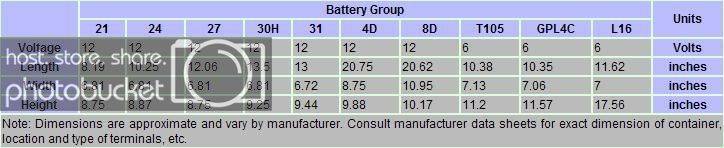
Group GPL4C batteries are exclusively used on boats. Since these batteries have a nominal voltage of 6V, we have wired them in series for the starter bank (2 batteries) and series-paralell for the house bank (4 batteries).
Despite advances in instrumentation, the battery industry mostly still advertises amp-hours as a capacity measure instead of watt-hours. Hopefully, the battery and marine power instrumentation industry will make a transition to Watt-hours (Wh) in the future.
Voltage
Voltage is an electrical measure which describes the potential to do work. The higher the voltage the greater its risk to you and your health. Systems that use voltages below 50V are considered low-voltage and are not governed by an as strict (some might say arcane) set of rules as high-voltage systems.
Current
Current is a measure of how many electrons are flowing through a conductor. Current is usually measured in amperes (A/Amps). Current flow over time is defined as ampere-hours (a.k.a. amp-hours or Ah), a product of the average current and the amount of time it flowed.
Power
Power is the product of voltage and current and is measured in Watts. Power over time is usually defined in Watt-hours (Wh), the product of the average number of watts and time. Your energy utility usually bills you per kiloWatt-hour (kWh), which is 1,000 watt-hours.
Lead-Acid Battery?
A lead-acid battery is a electrical storage device that uses a reversible chemical reaction to store energy. It uses a combination of lead plates or grids and an electrolyte consisting of a diluted sulphuric acid to convert electrical energy into potential chemical energy and back again. The electrolyte of lead-acid batteries is hazardous to your health and may produce burns and other permanent damage if you come into contact with it. So, when dealing with electrolyte protect yourself appropriately.
Deep Cycle vs Starting Batteries
Batteries are typically built for specific purposes and they differ in construction accordingly. Broadly speaking, there are two applications that manufacturers build their batteries for: Starting and Deep Cycle.
• As the name implies, Starter Batteries are meant to get combustion engines going. They have many thin lead plates which allow them to discharge a lot of energy very quickly for a short amount of time. However, they do not tolerate being discharged deeply, as the thin lead plates needed for starter currents degrade quickly under deep discharge and re-charging cycles. Most starter batteries will only tolerate being completely discharged a few times before being irreversibly damaged.
• Deep Cycle batteries have thicker lead plates that make them tolerate deep discharges better. They cannot dispense charge as quickly as a starter battery but can also be used to start combustion engines. You would simply need a bigger deep-cycle battery than if you had used a dedicated starter type battery instead. The thicker the lead plates, the longer the life span, all things being equal. Battery weight is a simple indicator for the thickness of the lead plates used in a battery. The heavier a battery for a given group size, the thicker the plates, and the better the battery will tolerate deep discharges.
• Some Marine batteries are sold as dual-purpose batteries for starter and deep cycle applications. However, the thin plates required for starting purposes inherently compromise deep-cycle performance. Thus, such batteries should not be cycled deeply and should be avoided for deep-cycle applications unless space/weight constraints dictate otherwise.
Regular vs Valve-Regulated Lead Acid (VRLA) Batteries
Battery containers come in different configurations. Flooded batteries can be either sealed or open.
• Sealed flooded cells are frequently found as starter batteries in cars. Their electrolyte cannot be replenished. When enough electrolyte has evaporated due to charging, age, or just ambient heat, the battery has to be replaced.
• Deep-Cycle flooded cells usually have removable caps that allow you to replace any electrolyte that has evaporated over time. Take care not to contaminate the electrolyte - wipe the exterior container while rinsing the towel frequently.
- VRLA batteries remain under constant pressure of 1-4 psi. This pressure helps the recombination process under which 99+% of the Hydrogen and Oxygen generated during charging are turned back into water. The two most common VRLA batteries used today are the Gel and Absorbed Glass Mat (AGM) variety.
• Gel batteries feature an electrolyte that has been immobilized using a gelling agent like fumed silica.
• AGM batteries feature a thin fiberglass felt that holds the electrolyte in place like a sponge.
- Neither AGM or Gel cells will leak if inverted, pierced, etc. and will continue to operate even under water.
Battery Cells
Battery Cells are the most basic individual component of a battery. They consist of a container in which the electrolyte and the lead plates can interact. Each lead-acid cell fluctuates in voltage from about 2.12 Volts when full to about 1.75 volts when empty. Note the small voltage difference between a full and an empty cell (another advantage of lead-acid batteries over rival chemistries).
Battery Voltage
The nominal voltage of a lead-acid battery depends on the number of cells that have been wired in series. As mentioned above, each battery cell contributes a nominal voltage of 2 Volts, so a 12 Volt battery usually consists of 6 cells wired in series.
State of Charge
The State of Charge describes how full a battery is. The exact voltage to battery charge correlation is dependent on the temperature of the battery. Cold batteries will show a lower voltage when full than hot batteries. This is one of the reasons why quality alternator regulators or high-powered charging systems use temperature probes on batteries.
Depth of Discharge
The Depth of Discharge (DOD) is a measure of how deeply a battery is discharged. When a battery is 100% full, then the DOD is 0%. Conversely, when a battery is 100% empty, the DOD is 100%. The deeper batteries are discharged on average, the shorter their so called "cycle life".
Battery Storage Capacity
The Amp-hour (Ah) capacity of a battery tries to quantify the amount of usable energy it can store at a nominal voltage. All things equal, the greater the physical volume of a battery, the larger its total storage capacity. Storage capacity is additive when batteries are wired in parallel but not if they are wired in series.
Most marine, automotive, and RV applications use 12V DC. You have the choice to either buy a 12V battery or to create a 12V system by wiring several lower-voltage batteries/cells in Series.
Battery Wiring
When two 6V, 100Ah batteries are wired in Series, the voltage is doubled but the amp-hour capacity remains 100Ah (Total Power = 1200 Watt-hours).
You may decide to wire batteries in series because a single 12V battery with the right storage capacity is simply too heavy, unwieldy, or awkward to lift into place. Batteries consisting of fewer cells (and hence lower voltage) in series can provide the same storage capacity yet be portable. It is not unusual to see solar power installations where the battery bank consists of a sea of 2V batteries that have been wired in series
Two 6V, 100Ah batteries wired in Parallel will have a total storage capacity of 200Ah at 6V (or 1200 Watt-hours).
Battery banks consisting of 12V batteries wired in parallel are often seen on OEM installations in boats and RVs alike. Such banks are simple to wire up and require a minimum of cabling. However, the wiring must have the capacity to deal with a full battery bank.
You should fuse each battery individually in such a bank to ensure that a battery gone bad will not affect the rest of the bank.
Battery banks wired in Series-Parallel are even more complicated. Here, four 6V cells are wired in two "strings" of 12VDC that were then wired in parallel. Using 6V, 100Ah batteries, this system will have a storage capacity of 200Ah at 12V or 2,400Wh.
Since such a system has more wiring, it is very important to group "strings" logically and to label everything. Furthermore, it is a very good idea to fuse every "string" of series-wired batteries to ensure that a problem in one part of the battery bank does not take the whole bank down.
Group GPL4C batteries are exclusively used on boats. Since these batteries have a nominal voltage of 6V, we have wired them in series for the starter bank (2 batteries) and series-paralell for the house bank (4 batteries).
Despite advances in instrumentation, the battery industry mostly still advertises amp-hours as a capacity measure instead of watt-hours. Hopefully, the battery and marine power instrumentation industry will make a transition to Watt-hours (Wh) in the future.