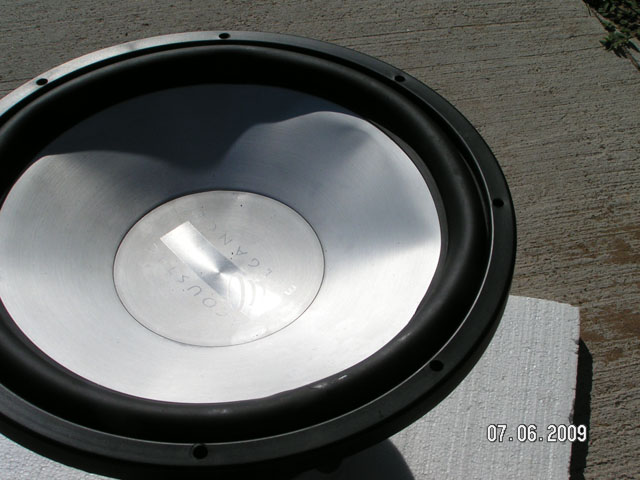
2.5" coil driver rated for 1000w. No.
This is one of the easiest parts to respond to. Power handling is not about VC size, it is about keeping the coil within a safe operating temperature. A chinese made coil will fail about 375F as the glue used to secure the windings begins to fall apart around that temperature. A well made US coil will withstand around 600F before it has any issues delaminating as they are baked at close to this temperature during the curing process. That gives US coils a huge advantage regardless of size.
The more ability you have to pull heat from the coil, the more power you can apply. The tighter the gap, the better you can transfer heat from the coil to the top plate and pole where it can be absorbed into the massive amounts of steel. Having a highly conductive layer close to the coil like the copper sleeve on the pole increases the thermal conductivity and pulls more heat. Also the more heatsinking area the better. This is why larger diameter coils have an advantage. Thicker top plates also increase the ability to pull heat from the coil as they increase the heatsinking area on the OD of the coil. Our 2.5" coil has more heatsinking area than most 3" coils. Our 2.5" coil pro audio 18 was recently proven to have lower power compression than one of the highly regarded industry standard 4" coil 18's. There is no magic, no smoke and mirrors, just more heatsinking area so the heat comes away from the coil faster. Then the tighter the gap, the faster the coil will force air back and forth through it and the more heat is dissipated that way.
The AES1986 standard for power handling for a subwoofer will require power handling of a given amount of power over one decade of the frequency spectrum for a period of 2 hours. This uses 12dB filters at the top and bottom of that decade and 6dB crest factor. So in the case of a subwoofer like the AV series we do 1000W from 20-200hz filtered pink noise with 6dB crest factor for a period of 2 hours. They will easily exceed this 1000W continuous rating.
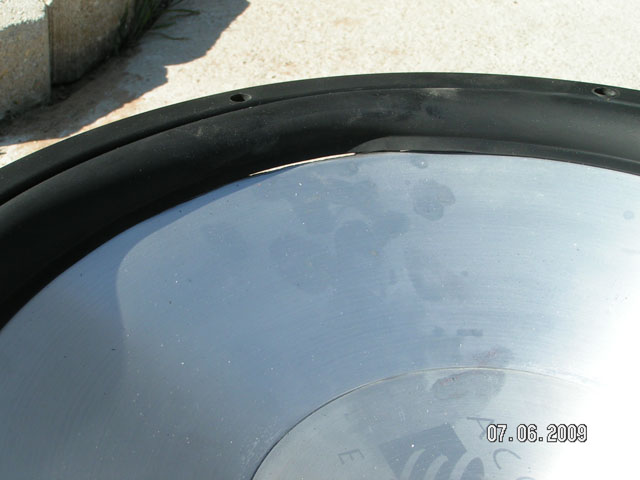
Aluminum cone + tinsels that aren't woven. No.
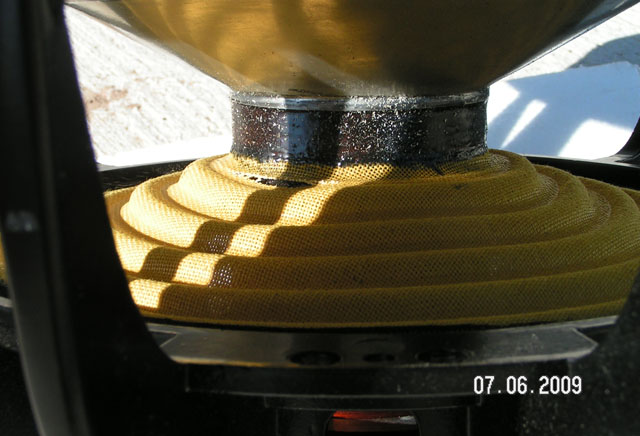
Woven in tinsels are great except they become very brittle throughout the forming process as the spider is formed with heat. I have seen MANY drivers with the woven in leads what have frayed, sparked, and even started 100% cotton spiders on fire. Also in a single VC driver if both wires are on the same side they tend to pull and rock the coil. The sewn on top wires are much better for spider linearity.
Very soft suspension that there have been many reports of people messing up within days. No.
Smearing silicone on the cone to fix the tinsel problem. Laughable at best.
Actually there has been ONE person exactly who has had a problem with the spider. I'm not sure how ONE and MANY are considered the same. We have a Cms of .22 mm/N. If you look at drivers like the IDMAX, their compliance is .39mm/N, nearly twice as soft as what we have. Our AV12X and the IDMAX Mms are nearly identical, but the IDMAX Fs is significantly lower. The main difference is only that we have significantly more motor strength and more low end efficiency. I don't believe I have yet to see anyone giving the kind of abuse to an IDMAX that was given to our driver and then criticizing it the way our AV woofers have been.
The standard policy that nearly everyone in the industry does to avoid lead wires tapping on the bottom of the cone is to glue a piece of felt or foam to the underside of the cone. With a paper cone that is easy. With an aluminum cone that absorbs and dissipates a lot of heat it gets harder. The adhesive has to be able to withstand 300F and higher temperatures. We actually have a silicone foam in stock to glue to the underside of the cone, sourced from these people.
http://www.ipotec.com/ It is good to 500F. The clear silicone you see is the adhesive they sell with it as not much other than silicone sticks to itself. The adhesive is good to 600F. After doing a few it became very clear that the silicone itself was plenty to make an insulating layer without the foam being glued on. There was no need to add extra weight with the actual foam.
John, I respect your efforts, but this is really a sophomoric attempt at the market you're trying to penetrate. You failed to "idiot-proof" your sub. Seems to me that what you have is a 5-700w driver capable of taking 1000w if you're careful. But, if you rate it at 1000w and put it in the hands of the general car audio crowd, they'll tear it up within hours.
Yes, I agree that i did not "idiot-proof" the sub. My intent was to make a very low distortion driver for many of the applications we sell drivers to that include home theater, recording studios, and live sound use. As people have been buying our TD woofers and IB woofers for SQ applications in vehicles, it was only a matter of time before people started buying the AV series for vehicles as well. Thermally they will handle 1000W all day like I mentioned above. The problem in the car market is that people don't realize that a power rating is specifically a thermal rating. The mechanical limits are always going to be application specific. We have people using our AV15's in infinite baffle subwoofers for home theater where they wish to get output down to 10hz. (Yes, many movies have bass this low.) The difference is that they realize that at 10hz in an infinite baffle it may take only 100W to reach the suspension limits of the driver. However, this is not a negative, it means it is very efficient here. It is much better to reach the physical limits with 100W in this application than it is to require 1000W to reach the same physical limits and the same output levels.
-If you're aiming at the car audio market, who cares about extension beyond 100hz?
I really never was aiming at the car market. I started out with only single 4ohm coils as that is what was needed by our OEM customers and most of the home theater people. I only decided to offer dual 2ohm and dual 4ohm drivers to the car market after many requests. Maybe I should have decided against that.
The high frequency extension is not a needed factor in car audio. It comes from the copper sleeve though. The low distortion and increased heat transfer from the coil are however beneficial to any application.
John