wire quality.

To answer your original question,YES there is a difference in wire between companies. There are many differences in wire. 1/0 awg welding wire is not the same as 1/0 high current electrical wire which is still different than 1/0 car audio wire. Generally the main difference is the wire count or strand count. In car audio you generally are looking for wire with the larger strand count. This actually helps to conduct the electrical current (movement of charged particals like electrons and protons) through the wire either more efficiantly or at a quicker rate. So YES there is a difference and as said by XsabesX I like to deal with knukonceptz

 
To answer your original question,YES there is a difference in wire between companies. There are many differences in wire. 1/0 awg welding wire is not the same as 1/0 high current electrical wire which is still different than 1/0 car audio wire. Generally the main difference is the wire count or strand count. In car audio you generally are looking for wire with the larger strand count. This actually helps to conduct the electrical current (movement of charged particals like electrons and protons) through the wire either more efficiantly or at a quicker rate. So YES there is a difference and as said by XsabesX I like to deal with knukonceptz
You have no idea what you are talking about.

A higher strand count does nothing more than making the wire more flexible. Any true 1/0 wire will have the same conductive properties as any other 1/0 cable when talking about DC power delivery. AWG is defined by resistance not diameter. Learn basic electrical theory before spouting.

 
Gauge is determined by area, not resistance. Otherwise silver 4 gauge would be smaller then copper 4 gauge (not like you'll see pure silver in 4 gauge as it would be insanely expensive)

10 gauge cable made up of many fine strands is equal to one solid 10 gauge strand. THe area will be the same, but the stranded cable will be larger in appearance due to the lay of the strands and space between strands (air). Solid copper will have no air between itself like the stranded cable.

AWG - American Wre Gauge - is the standard we use here in the US. However, not all companies follow that standard and will call their product 4 gauge when in fact it is only 6 gauge. The way to determine the facts is ask for strand count and gauge of the strands. If they will not or can not provide those facts, I would look else where. Most of the generics found online are often the case mentioned above. So just be smart when you are shopping.

use rating is also a good indicator, if you get a 60A with your 4 gauge kit, there is a good chance you bought 6 gauge

 
So then the Raptor 1/0 and our 1/0 would conduct the same, which is not true, because raptor is not true 1/0. Thats the dilemma faced by buyers, its more like Buyer Beware

 
I always love your long responses Bill //content.invisioncic.com/y282845/emoticons/smile.gif.1ebc41e1811405b213edfc4622c41e27.gif I'm constantly learning from people like you.

One of the reasons I use Knu products is because the "man behind the company" knows his shit. Just my 2 cents.

 
not to be overlook is the insulation material which will also determine the suitableness of the wire for its intended environment. abrasion resistance, temp rating, etc.

here's a web page (not my wire bible, just an example) that outlines the properties of various insulation materials http://www.houwire.com/products/technical/thermoplastic_properties.html

notice that teflon out-performs in almost all categories, though more expensive than pvc which lacks in abrasion resistance by comparison. wire gauge aside it comes down to insulation.

 
I always love your long responses Bill //content.invisioncic.com/y282845/emoticons/smile.gif.1ebc41e1811405b213edfc4622c41e27.gif I'm constantly learning from people like you.
One of the reasons I use Knu products is because the "man behind the company" knows his shit. Just my 2 cents.
Not to mention he has great customer service.

 
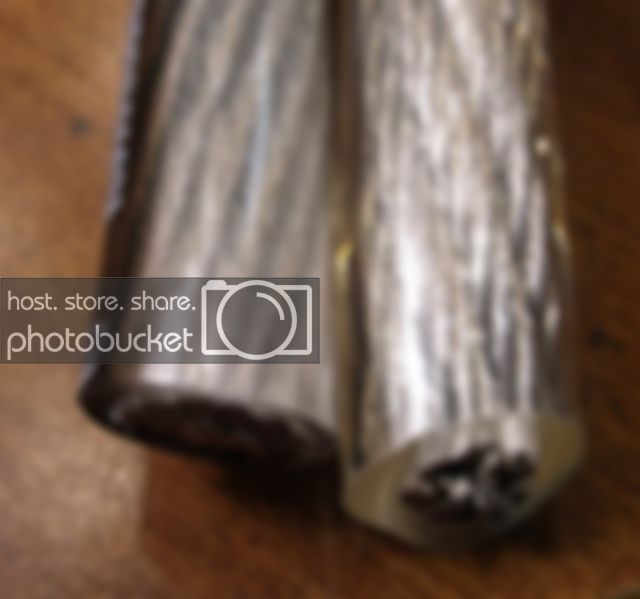
This may help. I went through the same ordeal, but I will save you some money. I first bought Raptor wire that was said to be 0awg wire, and it was quite cheap. Well I later bought some Knuconptz wire, and as you will see I was shocked. In these pics the Knu wire is on the left, and the Raptor is on the right.

PB270004.jpg


PB270006.jpg


As you can see the rubber is the same size, but the wire is not. Its easy to say here..... You get what you pay for.

On top of that, even though there is a ton more wire in the Knu wire, its actually less stiff then the Raptor wire. The Raptor wire is much harder to bend, and it tend to want to go back to its original position. The Knu wire bends very easily and stays in the position you put it. Hope this helps ya.

 
WOW - raptor should be embarassed.

I guess the first time they get sued by someone who's car burnt to the ground because of the false advertisement on their wire they'll start to market it honestly.

 
Gauge is determined by area, not resistance. Otherwise silver 4 gauge would be smaller then copper 4 gauge (not like you'll see pure silver in 4 gauge as it would be insanely expensive)
The origin of the diameters used from what I've found was based on resistance of copper wire of that thickness. 10ga has a resistance of 1 ohm per 1000'. From there it is a logrithmic scale to arrive at the other sizes based on cross-sectional area using the 10ga copper as the basis. Ferrous wire has differing measures.
10 gauge cable made up of many fine strands is equal to one solid 10 gauge strand. THe area will be the same, but the stranded cable will be larger in appearance due to the lay of the strands and space between strands (air). Solid copper will have no air between itself like the stranded cable.
This explains exactly why wire with fewer thick strands usually looks much smaller than that with a ton of strands. The resistance is the same because the actual conducting area is the same, but the wire is not as flexible because of the thicker strands and doens't look as big so most people think that it isn't really the stated guage. A measure of resistance will indicate otherwise, getting back to my original point. I'm not saying that everything sold as 4ga is but that you can't just look at the wire and tells what it is.
AWG - American Wre Gauge - is the standard we use here in the US. However, not all companies follow that standard and will call their product 4 gauge when in fact it is only 6 gauge. The way to determine the facts is ask for strand count and gauge of the strands. If they will not or can not provide those facts, I would look else where. Most of the generics found online are often the case mentioned above. So just be smart when you are shopping.
The highlighted portion is the really important part here, and not just when shopping for wire.
 
Activity
No one is currently typing a reply...
Old Thread: Please note, there have been no replies in this thread for over 3 years!
Content in this thread may no longer be relevant.
Perhaps it would be better to start a new thread instead.

About this thread

lukeduke28

10+ year member
Member
Thread starter
lukeduke28
Joined
Location
danville
Start date
Participants
Who Replied
Replies
13
Views
1,403
Last reply date
Last reply from
helotaxi
IMG_20260516_193114554_HDR.jpg

sherbanater

    May 16, 2026
  • 0
  • 0
IMG_20260516_192955471_HDR.jpg

sherbanater

    May 16, 2026
  • 0
  • 0

New threads

Top