why that was nice

Should i start using crystal meth?

  • Sure...its not that bad...

    Votes: 93 62.0%
  • Just say no!

    Votes: 57 38.0%

  • Total voters
    150
Eh. I suppose so

I dunno I thought it was an interesting find. I sure would like to know why they specify such terms... It's fishy to me

Care to explain? I don't quite understand how you came to that conclusion.
I googled "opec irrelevant" looking for a succinct summary and this was the first result:

Conventional wisdom holds that the OPEC oil cartel has the world in its grasp. It can manipulate prices by tinkering with supplies. Last month OPEC released a new study on world oil demand that seemed to signal the cartel was readying to tighten the taps because higher prices were slaking the world's thirst for oil. The American Petroleum Institute released fresh data showing that demand for oil products in the United States (the world's largest market) dropped a whopping 3 percent from the year earlier. The news about lower demand has caused oil prices to fall a bit, and all eyes are on OPEC's wizards to tighten supplies.
But the conventional wisdom is mostly wrong. OPEC (which stands for the Organization of the Petroleum Exporting Countries) is no wizard. For the most part, its actions lag behind fundamental changes in oil supply and demand rather than lead them. OPEC looks like a masterful cartel when, in fact, it is mainly just riding the waves.

It is hard to figure out exactly what goes on behind's OPEC's closed doors, but glimpses are possible by probing what the cartel members say about prices and how they set quotas. Over the last five years, OPEC members have announced ever-higher price goals only after the market had already delivered those high prices. As the market has soared, OPEC has followed. Only in the last few months has Saudi Arabia suggested that the cartel would be better off if prices reversed because high prices would encourage the world's big oil consumers to wean themselves from oil. It proffered $125 a barrel. The markets shrugged and kept on rising until real facts about slowing demand revealed that fundamentals were changing.

OPEC also sets quotas so that each member knows its role. Throughout its history, OPEC has faced the difficult task of holding the cartel in the face of strong incentives by each member to cheat. Today's oil market makes that job easy because nearly every member, except Saudi Arabia, is producing at full capacity. OPEC, more or less, has nothing to do.

In fact, the last time OPEC made a major adjustment to its quotas—September 2007—it jiggered them to reflect what its members were already pumping. Algeria got a big boost because it was already supplying nearly 50 percent more than its quota. Kuwait, Libya and Qatar also got boosts that aligned their OPEC quotas with existing reality. OPEC also set, for the first time, a quota on Angola's output. Since then, Angola has attracted a steady stream of new production projects, which makes it inevitable that OPEC will adjust Angola's quota to reflect the new reality. (Iraq has no quota; it has troubles enough without pretending to align its oil output to OPEC strictures.)

Nigeria and Venezuela got haircuts because their political troubles meant they were already producing far less than their quotas. Indonesia also cut its quota and a few months later left OPEC because it realized that as a big oil user it actually had more in common with oil importers than its fellow OPEC members. These changes in quotas were reflections of political realities that OPEC doesn't control.

Today's oil cartel, even more than in the past, is really about Saudi Arabia. But Saudi Arabia also is no wizard at the controls of the world market. The Saudis can adjust their output a bit since they control nearly all of spare capacity in the world market. (Earlier this month they pledged another 200,000 barrels per day to dampen pressure from the United States and other governments that are reeling from high oil prices. But that move was more symbolic than real as the markets were already expecting the new supplies.)

Saudi Arabia is on the front lines of the new reality in world oil supply. It is proving much harder and more costly to bring on more supplies. The Saudis have an ambitious plan to increase output about one third over the coming decade, but they are finding that will be a stretch. Their fellow OPEC members are in a similar situation, and those hard facts also produce high oil prices. In fact, the Middle East members of OPEC are, today, producing at just the same level as they were three decades ago because none of them invested much in finding and producing new supplies. High prices into the future reflect these fundamental facts rather than the assumption that OPEC is a masterful cartel.

Conventional wisdom holds that because OPEC is raking in more cash than ever, it has never been stronger than it is today. In fact, OPEC has rarely been weaker. It is the accidental beneficiary of forces that have caused today's high prices, and it will be nearly as powerless when prices come down.

Once you've caught up with that we can talk about Saudi Arabia and why its interesting.

 
true but irrelevant.


exactly so why did you post it? I doubt it was to warn people that fox was once again trying to frighten people, but instead to help them out. but i digress.

Back to the point. The majority of our oil doesnt come from OPEC and OPEC doesnt have anyone by the balls... except maybe their own citizens.

The market has OPEC by the balls... just like the US.. we both ride the market and react to it.
I am going to disagree with you a bit here...There is a perception by market participants that OPEC's releases will cause other market participants to react irrationally, thus influencing price. To imply that OPEC is not a major player is quite false.

If you want, I guess I can find data trying to see if there is a Granger causality between OPEC statements and oil price swings on a 1, 3, and 5 day level. I am not so certain they influence prices in the long run.

 
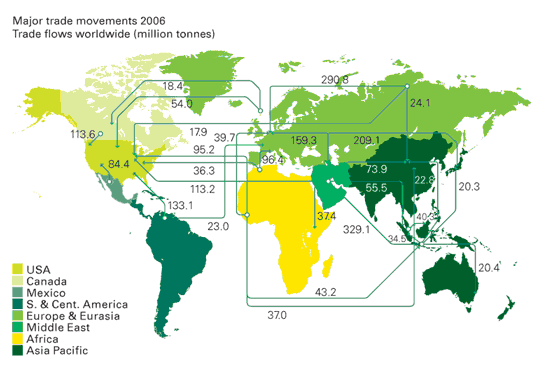
What does this tell us?

oil_map_oil_trde_movements_560.gif


The source is the BP Statistical Review of World Energy June 2008.

http://www.bp.com/sectiongenericarticle.do?categoryId=9023778&contentId=7044199

If you have a problem with this source i can provide others demonstrating the same thing.

 
I googled "opec irrelevant" looking for a succinct summary and this was the first result:


Once you've caught up with that we can talk about Saudi Arabia and why its interesting.
It's a lot to take in, but the gist of it seems to be that OPEC is more reactive than proactive, and what price it sets really has no effect on demand and is dieing, in a sense.

 
What does this tell us?
oil_map_oil_trde_movements_560.gif


The source is the BP Statistical Review of World Energy June 2008.

http://www.bp.com/sectiongenericarticle.do?categoryId=9023778&contentId=7044199

If you have a problem with this source i can provide others demonstrating the same thing.
I don't believe that one fellow is arguing with you anymore.

I'd like you to find a source that says OPEC releases do not have an impact on the price of oil in the short term. Hell, the anticipation of a release causes a large increase in transaction volume no matter what it says.

 
I am going to disagree with you a bit here...There is a perception by market participants that OPEC's releases will cause other market participants to react irrationally, thus influencing price. To imply that OPEC is not a major player is quite false.
If you want, I guess I can find data trying to see if there is a Granger causality between OPEC statements and oil price swings on a 1, 3, and 5 day level. I am not so certain they influence prices in the long run.
i didnt imply they weren't a major player and i am pretty sure that 1,3,5 day level causality is not what he was referring to when he said OPEC has us by the balls.

 
It's a lot to take in, but the gist of it seems to be that OPEC is more reactive than proactive, and what price it sets really has no effect on demand and is dieing, in a sense.
OPEC has to be reactive because it is not a monopoly. It is a oligolopy. therefore a price taker, not a price maker. However, OPEC does influence price. Faulkton's sources do not explain the leverage, loans, and deals cut between OPEC and non-OPEC countries in terms of capital goods and knowledge workers.

 
It's a lot to take in, but the gist of it seems to be that OPEC is more reactive than proactive, and what price it sets really has no effect on demand and is dieing, in a sense.
Now move onto this one.

What does this tell us?
oil_map_oil_trde_movements_560.gif


The source is the BP Statistical Review of World Energy June 2008.

http://www.bp.com/sectiongenericarticle.do?categoryId=9023778&contentId=7044199

If you have a problem with this source i can provide others demonstrating the same thing.
//content.invisioncic.com/y282845/emoticons/smile.gif.1ebc41e1811405b213edfc4622c41e27.gif

 
i didnt imply they weren't a major player and i am pretty sure that 1,3,5 day level causality is not what he was referring to when he said OPEC has us by the balls.
I do like where you are going with this though. I just want to make sure your lesson keeps "perception" in mind. You keep quoting hard facts that don't always cause price changes.

 
I'd like you to find a source that says OPEC releases do not have an impact on the price of oil in the short term. Hell, the anticipation of a release causes a large increase in transaction volume no matter what it says.
Slow down flip, we'll get there.

Once you've caught up with that we can talk about Saudi Arabia and why its interesting.
Here is a keyword/concept for you to ponder.

SWING PRODUCER!

 
Activity
No one is currently typing a reply...

About this thread

faulkton

5,000+ posts
CarAudio.com Veteran
Thread starter
faulkton
Joined
Location
neverland
Start date
Participants
Who Replied
Replies
31,921
Views
598,355
Last reply date
Last reply from
natisfynest
1778578257023.png

Glen Rodgers

    May 12, 2026
  • 0
  • 0
Screenshot_20260511_212804_Amazon Shopping.jpg

Blackout67

    May 11, 2026
  • 0
  • 0

New threads

Top