Understanding series/parallel help please

Robahr24
10+ year member

Senior VIP Member
I understand that wiring speakers in series will give it more resistance, so raising it, while parallel will lower it and so no and so forth. But what kind of benefits are you getting when you wire speakers in series or in parallel? And how to do you wire a system active or passive and whats the difference in that. Schematics always help out a lot if somebody has them. Thanks a lot.

 
Really the difference in series and parallel for speaker wiring is to just match the impedance of the speaker system to your amplifier.

Active and passive usually refers to pre-amp processors or X-overs.

A passive crossover will not have power going to it and connects between the amp and speaker. And an Active crossover uses power to modify the signal and connects in the RCA line into the amp.

 
One thing ive never understood is that wouldn't subs in series see a lower voltage then if they were in parallel? How does the affect the subs performance?

 
well actually current and voltage are different in series vs. parallel circuits.

I always have high powered application for mostly SPL in my car. So I dont like to series anything since current remains high and the coils heat up more than in a parallel circuit.

 
well actually current and voltage are different in series vs. parallel circuits. I always have high powered application for mostly SPL in my car. So I dont like to series anything since current remains high and the coils heat up more than in a parallel circuit.
Yeah thats what I was refereing to. So series could potentially have adverse affects on a sub (speaker) then? (for example coils burning up faster due to more current as you suggested)

Does it affect sound in anyway or is it the same since its the same wattage?

 
Yeah thats what I was refereing to. So series could potentially have adverse affects on a sub (speaker) then? (for example coils burning up faster due to more current as you suggested)
Does it affect sound in anyway or is it the same since its the same wattage?
Theoretically sound can be affected, especially if there is more heat on the coil.

The heat will change impedance of the coil and if the moving parts heat up, the speaker will move differently.

 
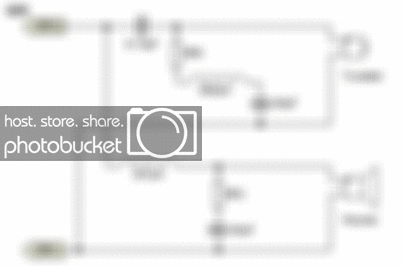
Can you show me a rough diagram of what you mean when it comes to active and passive cross overs? I just can't get the concept of it. Sorry for being so dumb lol

 
here is a basic active crossover

30278_5lo.jpg


Theoretically sound can be affected, especially if there is more heat on the coil.The heat will change impedance of the coil and if the moving parts heat up, the speaker will move differently.
hmm... that makes sense. So this could be what happened with my guitar amp when I hook up a second speaker cabinet. Amp itself has 2 12" and the extra cabinet has 2 12" os a total of 4 12" wired in parallel. When adding the cabinet divides the current... but wait that changes the resistance the amp sees so theres more going on then that... k thats getting off topic.

OP here is a sticky about passive vs active http://www.caraudio.com/forum/showthread.php?t=146726

Active is setting your crossover points before your amps and running 1 amp per speaker or speaker pair or a 4 channle to mids and tweets ect. Passive is running crossovers on the speaker outs after the amp and connecting mid and tweet to the same channle. More indepth explanation is in that thread

 
well actually current and voltage are different in series vs. parallel circuits.
True. In a series circuit the voltage is divided between the loads in inverse proportion to the resistance/impedance of in the individual loads. In a parallel circuit the voltage is the same on every load in the circuit and the current is divided in inverse proportion to the impedance/resistance.
I always have high powered application for mostly SPL in my car. So I dont like to series anything since current remains high and the coils heat up more than in a parallel circuit.
You are mistaken here. Say that you have 2 DVC 2 ohm drivers and you want a 2 ohm final load. There are two ways to wire this. First is to series wire the coils of each driver to create 2x 4 ohm loads and then parallel those for a 2 ohm final load (this is the better method but not for reasons of heat into the coils as I'll demonstrate in a seoncd). The second is to parallel the coils on each driver for 2x 1 ohm loads and then series the drivers for a final load of 2 ohms.
Now let's look at the voltage and current (power) into each coil in the system. We'll assume that we have 800w @ 2 ohms (cause it makes the math easy). For wiring method #1, voltage at the amp terminals would be 40V and total current would be 20A. Voltage to each driver would be 40v (voltage is constant in a parallel circuit) and the current through each driver would be 10A. Now that gives us 400w to each driver. Each driver has 2 coils that we wired in series. Current is constant in a series circuit so each coil is seeing 10A of current and voltage in proportional per Ohm's law so we have 20V dropped across each coil. The result is that there is 10A @ 20V for 200w on each coil.

Now let's look at situation #2. We have the same final load on the same amp so we have the same basic voltage and current. The drivers are in series this time so current is constant on each driver @ 20A. The voltage is divided evenly, so 20V each for a total of 400w per driver. On each driver the coils are in parallel so the voltage is constant and the current is split and once again we find that each coil is seeing 10A @ 20V for a total of 200W.

If you can explain how the same voltage and current heats the coil differently simply because of how it's wired in a circuit, the Nobel foundation has a million dollars for you.

Now parallel wiring between drivers has an advantage in that the amp acts as a shunt for back EMF and reduces intermodulation between drivers, but that does not reduce the heating of the coils in the system.

 
True. In a series circuit the voltage is divided between the loads in inverse proportion to the resistance/impedance of in the individual loads. In a parallel circuit the voltage is the same on every load in the circuit and the current is divided in inverse proportion to the impedance/resistance.You are mistaken here. Say that you have 2 DVC 2 ohm drivers and you want a 2 ohm final load. There are two ways to wire this. First is to series wire the coils of each driver to create 2x 4 ohm loads and then parallel those for a 2 ohm final load (this is the better method but not for reasons of heat into the coils as I'll demonstrate in a seoncd). The second is to parallel the coils on each driver for 2x 1 ohm loads and then series the drivers for a final load of 2 ohms.

Now let's look at the voltage and current (power) into each coil in the system. We'll assume that we have 800w @ 2 ohms (cause it makes the math easy). For wiring method #1, voltage at the amp terminals would be 40V and total current would be 20A. Voltage to each driver would be 40v (voltage is constant in a parallel circuit) and the current through each driver would be 10A. Now that gives us 400w to each driver. Each driver has 2 coils that we wired in series. Current is constant in a series circuit so each coil is seeing 10A of current and voltage in proportional per Ohm's law so we have 20V dropped across each coil. The result is that there is 10A @ 20V for 200w on each coil.

Now let's look at situation #2. We have the same final load on the same amp so we have the same basic voltage and current. The drivers are in series this time so current is constant on each driver @ 20A. The voltage is divided evenly, so 20V each for a total of 400w per driver. On each driver the coils are in parallel so the voltage is constant and the current is split and once again we find that each coil is seeing 10A @ 20V for a total of 200W.

If you can explain how the same voltage and current heats the coil differently simply because of how it's wired in a circuit, the Nobel foundation has a million dollars for you.

Now parallel wiring between drivers has an advantage in that the amp acts as a shunt for back EMF and reduces intermodulation between drivers, but that does not reduce the heating of the coils in the system.
That is just one example, however, where your switching from series/parallel to different parts of the circuit. Your not switching from a parallel to a series circuit your just chaning which part of the circuit is series/parallel.

I am sure what ed lester was refering to is choosing your amps and subs so that you are wiring in parallel instead of series. For example what if you had just 1 sub? Would you buy a DVC 4 ohm and wire it parallel or buy a DVC 1 ohm (do they even make these???!?) and wire it series... bad example I know but yeah... lol

 
In the case of your example there, it wouldn't matter at all and I'd buy whichever one was produced and suited my need. You can actually prove mathematically that the T/S parameters of a sub don't change when the coils are wired in series or parallel. Power distribution between the coils is the same either way as well. The only difference is the load presented to the amp.

Plenty of companies make D1 subs, BTW.

D4 sub wired in parallel to 200w (easy math) would be 20v 10A total or 20v and 5A per coil.

D1 wired in series would be 20V 10A total, 10V 10A per coil.

When on the same former, connected to the same cone and getting the same signal, the coils of a sub, regardless of how many there are act as a single coil. Wiring them in series or parallel only changes the load to the amp. There are some trick that you can play powering only one of hte coils, but those are best left ot people who know exactly what they're doing and are trying to achieve a specific result.

 
Activity
No one is currently typing a reply...
Old Thread: Please note, there have been no replies in this thread for over 3 years!
Content in this thread may no longer be relevant.
Perhaps it would be better to start a new thread instead.

About this thread

Robahr24

10+ year member
Senior VIP Member
Thread starter
Robahr24
Joined
Location
New York
Start date
Participants
Who Replied
Replies
31
Views
2,116
Last reply date
Last reply from
Bun-Bun
1778578257023.png

Glen Rodgers

    May 12, 2026
  • 0
  • 0
Screenshot_20260511_212804_Amazon Shopping.jpg

Blackout67

    May 11, 2026
  • 0
  • 0

New threads

Top