
too many remote turn on wires

no your useing the remote wire to trigger the relay, with an with a constant batt source running through the relay.
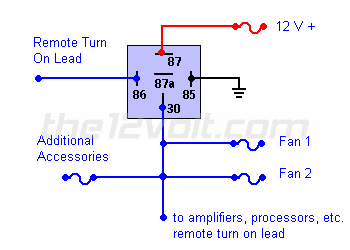
Exactly, the remote wire triggers the relay and thus powers the amp turn on circuit using a constant 12V source provided into the relay. The outout of the relay would then be connected to a terminal strip or small distribution block.

 
addremacc.gif


Using a 30 amp SPDT relay, connect terminal #87 to constant 12 volts positive with a fuse rated to the sum of the additional accessories you've added and the components you need to turn on. (If you have two fans rated at 5 amps each and a neon light rated at 10 amps, you would use a 20 amp fuse plus 200 ma for each amplifier and processor.) Connect terminal #85 to ground, terminal #86 to the remote turn on lead from the head unit, and terminal #30 to each accessory with an appropriate fuse. A fuse (not shown) could also be used between the output of the relay (#30) and the remote turn on lead of the amplifiers and/or processors for extra precaution.
this is what i did, and it works focking awesome. just tap the 12v+ wire from your fuse block, and ground the relay with a selftapping screw and a ring terminal right where you mount it. this way the battery is what is supplying power directly and the headunit is acting as a switch to tell the battery when to turn on all your electronics. i wouldnt try pulling more than 1a from your headunits remote line.

i buy stuffs from here all the time, great service, awesome site.

http://www.allelectronics.com/cgi-bin/item/RLY-351/search/12V_SPDT_30_AMP_AUTOMOTIVE_RELAY_.html

http://www.allelectronics.com/cgi-bin/item/TS-207/search/7-POSITION_DUAL-ROW_STRIP,_20_AMP_.html

http://www.allelectronics.com/cgi-bin/item/9206/search/%22#35;6_SPADE_TERMINAL,_BLUE_.html

http://www.allelectronics.com/cgi-bin/item/WRB-16/825700/16_AWG_%22#34;AUTO_ZIP%22#34;_WIRE_.html

what you do, is get some spade connectors (not sure if those are the right size for 16 guage wire) and some 16 guage wire. hook up the relay as shown above, and then make a bunch of little connectors that bridge all of the terminals on that strip together. like a daisy chain. then each terminal on the other side can go out to each piece of equipment you have to run.

that is the CORRECT way to install more than 2 pieces of equipment that need a remote turn on wire. and fuse any power wires. you do not have to fuse any wires that go from the output side of the relay to the equipment.

 
Ok I've seen what not using a relay can do. Buddies car last night burned up the remote turn on wire for his HU. Hu now has problems.

He was running 3 amps, and a dc inverter

The wire is scorched in several places.

So Use a **** relay!

 
this is what i did, and it works focking awesome. just tap the 12v+ wire from your fuse block, and ground the relay with a selftapping screw and a ring terminal right where you mount it. this way the battery is what is supplying power directly and the headunit is acting as a switch to tell the battery when to turn on all your electronics. i wouldnt try pulling more than 1a from your headunits remote line.
i buy stuffs from here all the time, great service, awesome site.

http://www.allelectronics.com/cgi-bin/item/RLY-351/search/12V_SPDT_30_AMP_AUTOMOTIVE_RELAY_.html

http://www.allelectronics.com/cgi-bin/item/TS-207/search/7-POSITION_DUAL-ROW_STRIP,_20_AMP_.html

http://www.allelectronics.com/cgi-bin/item/9206/search/%22#35;6_SPADE_TERMINAL,_BLUE_.html

http://www.allelectronics.com/cgi-bin/item/WRB-16/825700/16_AWG_%22#34;AUTO_ZIP%22#34;_WIRE_.html

what you do, is get some spade connectors (not sure if those are the right size for 16 guage wire) and some 16 guage wire. hook up the relay as shown above, and then make a bunch of little connectors that bridge all of the terminals on that strip together. like a daisy chain. then each terminal on the other side can go out to each piece of equipment you have to run.

that is the CORRECT way to install more than 2 pieces of equipment that need a remote turn on wire. and fuse any power wires. you do not have to fuse any wires that go from the output side of the relay to the equipment.
are there different power ratings for relays and those 7-dual strips, or only one size basically? how can i know how many amps i have to correctly buy the right power size relay and strip?

 
Yes there are different power ratings for relays but just about anyone you find should work. The most common one you will come across will be 30amps. Or a lot of places have mini relays which are 10-15 amps. The mini's are a p.i.t.a. to hook up cause the dont have posts just wire comming out from the relay so you gotta look at the diagram it comes with as to what each color wire is.

 
psssst-heres a little secret, folks have been using the Bosch 30A Automotive relay in audio for the past 20 years. There may be a draw, but it is the battery side and not the remote turn on side, ie where it can damage your HU turn on circuit. And when that goes, other things seem to stop working in the HU too.

But, if you insist run fans, neon, and three amps of your HU turn on and let us know how that turns out.......

 
psssst-heres a little secret, folks have been using the Bosch 30A Automotive relay in audio for the past 20 years. There may be a draw, but it is the battery side and not the remote turn on side, ie where it can damage your HU turn on circuit. And when that goes, other things seem to stop working in the HU too.
But, if you insist run fans, neon, and three amps of your HU turn on and let us know how that turns out.......
Ever since I watched a friend of mine burn the remote accessory activation circuit out of a Blaupunkt HU I have used a 30a SPST relay in every setup I've ever had that had more than 2 devices that needed to turn on and off with the HU. Never had a problem out of any of them (which includes my current, daily use setup)

 
*raises my hand*
do NOT use a 30amp automotive relay, as these will draw more current than like 10 amplifier would use on their remote turn on line combined...
You do have an argument, but a relay current draw being equivalent to 10 amplifiers is WAY high.

On the LOW side a cheap 12v relay coil is 85 ohms - that equates to 141mA at 12v, 164mA at 14. Most HU turn on circuits are good for about 1/2A, and some relays have resistance as high as 400 ohms. The point is - if you're turning on a bunch of stuff - you're a lot better off with a relay than w/o one.

 
You do have an argument, but a relay current draw being equivalent to 10 amplifiers is WAY high.
On the LOW side a cheap 12v relay coil is 85 ohms - that equates to 141mA at 12v, 164mA at 14. Most HU turn on circuits are good for about 1/2A, and some relays have resistance as high as 400 ohms. The point is - if you're turning on a bunch of stuff - you're a lot better off with a relay than w/o one.
In the "old" days, amplifier remotes were often relay coils. Each one could be 150 ma, so any more than 2 of them would be a risk for most HU remote circuits. Today's amps use the "shutdown" pin on the power supply chip to impliment remote, and they're extremely low current. One of my RF amps specs only 1 ma for remote current. The old rules no longer apply.

I did a survey of random amps about two years ago and found that the typical remote current spec was about 15 ma. So 10 amp remotes being equivalent to a single relay is not "way high". The only exception was a JL 1200 which still used a relay.

The Bosch relay that everyone references draws 160 ma. Relays are an inductive load, which isn't healthy for a transistor drive circuit (PLEASE use a diode supressor if you use a relay).

Bottom line is that you should read the spec sheets of the things you intend to power and if the total current is less than 160 ma, you're better off without the relay. Obviously fans, neons, inverters and such would easily exceed that, but amp remotes wouldn't.

And the distribution block gizmo is usually called a terminal strip or barrier strip. Radio Shack has an 8 position jobber and jumper bars to make it all one terminal.

 
I did a survey of random amps about two years ago and found that the typical remote current spec was about 15 ma. So 10 amp remotes being equivalent to a single relay is not "way high". The only exception was a JL 1200 which still used a relay.
the only trigger current info I can reference is the data on bcae1 where 5 to mid-upper 20's is the range - with RF & Jensen going as high as mid 40's.

 
Activity
No one is currently typing a reply...
Old Thread: Please note, there have been no replies in this thread for over 3 years!
Content in this thread may no longer be relevant.
Perhaps it would be better to start a new thread instead.

About this thread

95Prober

10+ year member
CarAudio.com Elite
Thread starter
95Prober
Joined
Location
Canada
Start date
Participants
Who Replied
Replies
28
Views
2,379
Last reply date
Last reply from
spudracer326
IMG_20260513_214311575.jpg

ThxOne

    May 13, 2026
  • 0
  • 0
IMG_20260513_213956814.jpg

ThxOne

    May 13, 2026
  • 0
  • 0

New threads

Top