Hey marco, I'll just explain it here //content.invisioncic.com/y282845/emoticons/smile.gif.1ebc41e1811405b213edfc4622c41e27.gif
In science and mathematics, there is a phenomenon called a standing wave. What a standing wave is is just what it sounds like: a wave that is not moving but still has amplitude and frequency. The way that this happens is that when a wave is generated, if it encounters a medium under one of two conditions, the result will be a standing wave. The first way is if the medium is moving exactly opposite to the wave, aka, 180 degrees out of phase with the movement of the wave. This isn't very likely in speaker enclosures, so the second way which is when you have two waves moving in opposite directions, there is no net result and while they don't actually cancel out, they do not sum to create a larger wave. Instead, it causes the wave to sit there and oscillate from 0 to 180 degrees in phase without actually changing its displacement. This picture from wikipedia might help you to understand what I mean:
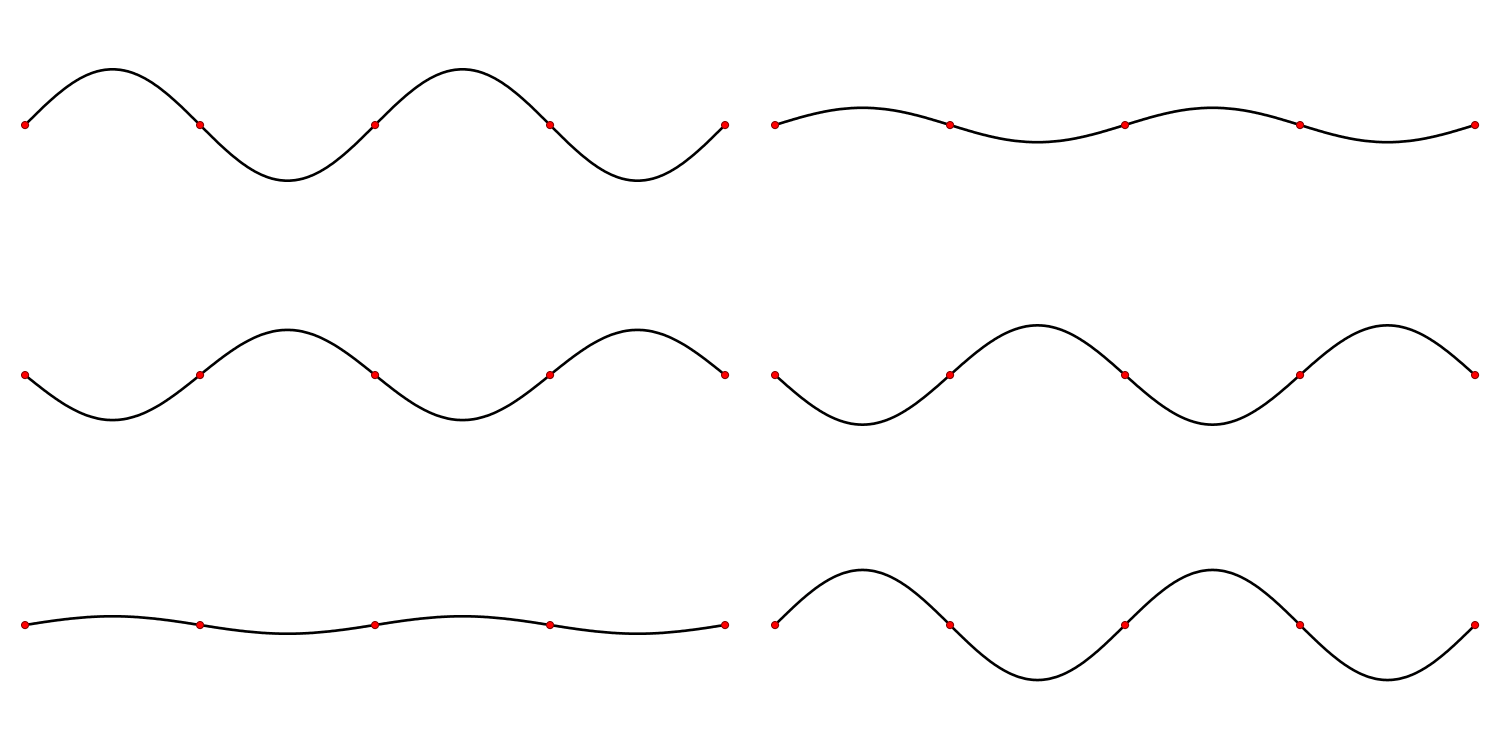
Note that if you take each wave (one positive sine wave and one negative sine wave) and sum them, the net result should be absolute destructive interference, aka, no net result. Instead, since this is a standing wave, it just sits there and goes back and forth between positive and negative phases.
Now, why is this important to speaker designers? Well, along with their amplitude, your sound waves in your enclosure have a wavelength, which as you probably can assume, is the length of the wave //content.invisioncic.com/y282845/emoticons/biggrin.gif.d71a5d36fcbab170f2364c9f2e3946cb.gif Why is that important to consider? Well, depending on how far away your enclosure walls are from the source of the sound (the back of the cone), certain wavelengths in certain enclosure sizes can create standing waves. Why is that bad? Because when you have standing waves, you can end up with certain frequencies being more amplified than others. Some might cancel out, some might add, and some might be standing. You don't want that because it creates differences in air pressure aka output which is noticable especially in the midrange and upper bass regions. Although you can use them to your advantage in transmission line enclosures, that's not the point. The point is that you want as few parallel surfaces as possible in a speaker cabinet because when you have parallel surfaces, if a wave is reflected off one side and coincides with the opposite side, you can end up with a standing wave. If there are no parallel sides, then that can't happen. To keep a rectangular shape, using the ratio of phi allows you to use parallel sides without the risk of standing waves (there are some complicated mathematics which I neither understand fully nor feel like explaining if I did //content.invisioncic.com/y282845/emoticons/laugh.gif.48439b2acf2cfca21620f01e7f77d1e4.gif ). Some people end up going to extremes such as Shinobiwan over at diyaudio.com with his project called Tarantism:


Yes, that was all built by hand and with garage tools, in case you were wondering //content.invisioncic.com/y282845/emoticons/drool.gif.b5e863e893038027711d4402f340dad0.gif
Anyway, to use the ratio, make one side be a value of one, so let's make the face be 10" tall. Now, let's use 1.618 * 10 = 16.18" wide. Finally, 1/1.618 = .618 so we make the depth 6.18". That's all. It's more useful in hi-fi speaker design, but it still applies here //content.invisioncic.com/y282845/emoticons/smile.gif.1ebc41e1811405b213edfc4622c41e27.gif