So i Need Some Enclosure Design Help

zerocarpileup
10+ year member

The Birds The Word!!!!!!!
so i decided to go on 1 15" Orion HCCA Dual 2 ohm instead of two. So now i cant think of an ideal box to work with. So with respects to specs i was hoping i could still have a box that would take up the whole width of my 02 Escalade, which is about 44" and i guess "shorten" the box front to back. Is this possible? If so or not, am i better off with the massive sub firing up or towards the rear? How about the port?Id prefer the sub in the center and ill be powering it with 1 Orion D5000 at 1 ohm. Eventually i plan to PP someone some $ to make me some plans, but id like to get some ideas first, before the audioshop guys overcharge me for a box thats not even to spec.. Please Help!

 
so i decided to go on 1 15" Orion HCCA Dual 2 ohm instead of two. So now i cant think of an ideal box to work with. So with respects to specs i was hoping i could still have a box that would take up the whole width of my 02 Escalade, which is about 44" and i guess "shorten" the box front to back. Is this possible? If so or not, am i better off with the massive sub firing up or towards the rear? How about the port?Id prefer the sub in the center and ill be powering it with 1 Orion D5000 at 1 ohm. Eventually i plan to PP someone some $ to make me some plans, but id like to get some ideas first, before the audioshop guys overcharge me for a box thats not even to spec.. Please Help!
send me a pm, we can work something out. im asuming you want a ported box?

 
You have to be careful with your designing. Just any space isn't going to work which is contrary to popular belief. Your enclosure should ideally stick to the ratio of Phi: 1-.618-1.618. Now, that isn't entirely feasible to the contraints of car audio, but there are reasons why you shouldn't make a rectangular enclosure long and skinny. I'm not going to get into them since it'd bore the pants off of most people, but just keep in mind that what's going on inside of your enclosure is more than just air moving about //content.invisioncic.com/y282845/emoticons/smile.gif.1ebc41e1811405b213edfc4622c41e27.gif

 
Hey marco, I'll just explain it here //content.invisioncic.com/y282845/emoticons/smile.gif.1ebc41e1811405b213edfc4622c41e27.gif

In science and mathematics, there is a phenomenon called a standing wave. What a standing wave is is just what it sounds like: a wave that is not moving but still has amplitude and frequency. The way that this happens is that when a wave is generated, if it encounters a medium under one of two conditions, the result will be a standing wave. The first way is if the medium is moving exactly opposite to the wave, aka, 180 degrees out of phase with the movement of the wave. This isn't very likely in speaker enclosures, so the second way which is when you have two waves moving in opposite directions, there is no net result and while they don't actually cancel out, they do not sum to create a larger wave. Instead, it causes the wave to sit there and oscillate from 0 to 180 degrees in phase without actually changing its displacement. This picture from wikipedia might help you to understand what I mean:
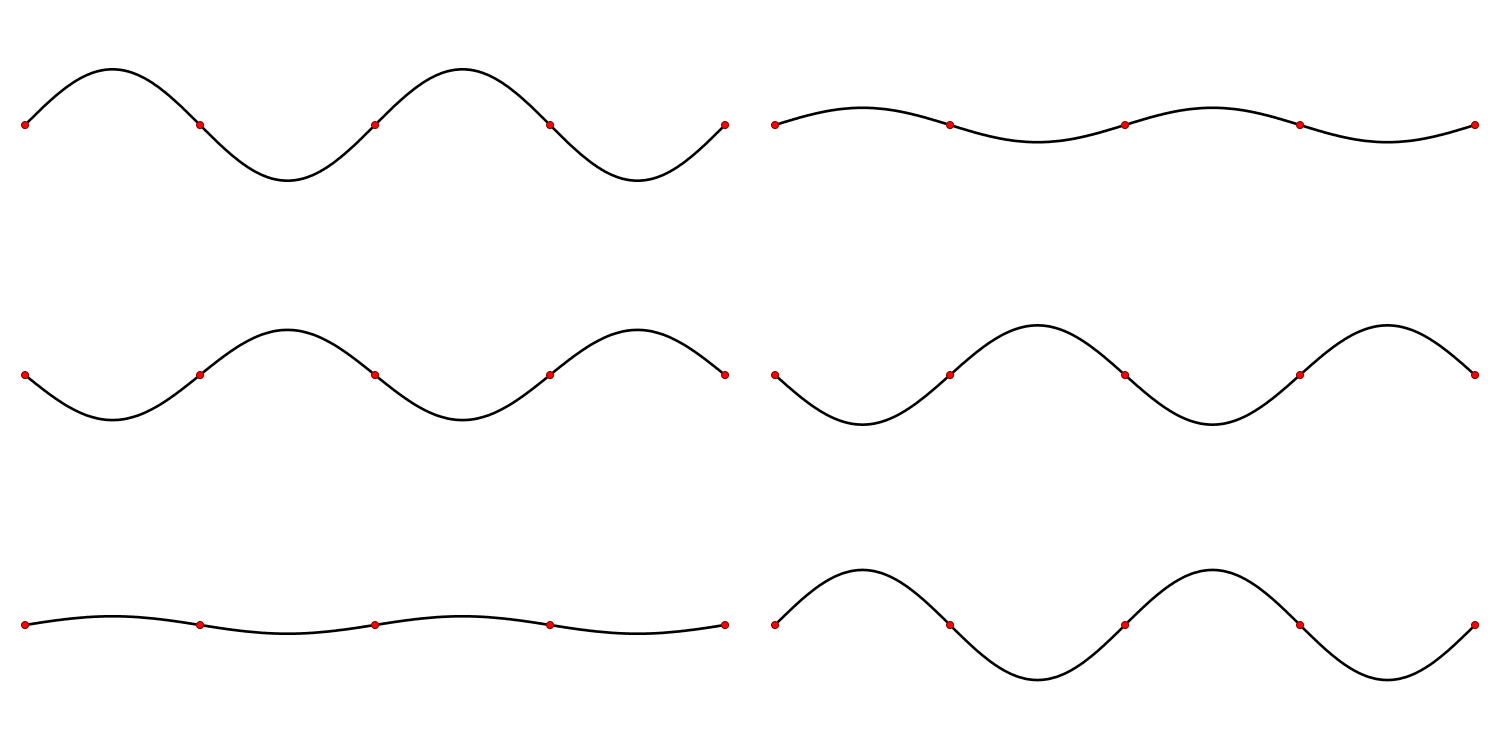
Standing_wave.gif


Note that if you take each wave (one positive sine wave and one negative sine wave) and sum them, the net result should be absolute destructive interference, aka, no net result. Instead, since this is a standing wave, it just sits there and goes back and forth between positive and negative phases.

Now, why is this important to speaker designers? Well, along with their amplitude, your sound waves in your enclosure have a wavelength, which as you probably can assume, is the length of the wave //content.invisioncic.com/y282845/emoticons/biggrin.gif.d71a5d36fcbab170f2364c9f2e3946cb.gif Why is that important to consider? Well, depending on how far away your enclosure walls are from the source of the sound (the back of the cone), certain wavelengths in certain enclosure sizes can create standing waves. Why is that bad? Because when you have standing waves, you can end up with certain frequencies being more amplified than others. Some might cancel out, some might add, and some might be standing. You don't want that because it creates differences in air pressure aka output which is noticable especially in the midrange and upper bass regions. Although you can use them to your advantage in transmission line enclosures, that's not the point. The point is that you want as few parallel surfaces as possible in a speaker cabinet because when you have parallel surfaces, if a wave is reflected off one side and coincides with the opposite side, you can end up with a standing wave. If there are no parallel sides, then that can't happen. To keep a rectangular shape, using the ratio of phi allows you to use parallel sides without the risk of standing waves (there are some complicated mathematics which I neither understand fully nor feel like explaining if I did //content.invisioncic.com/y282845/emoticons/laugh.gif.48439b2acf2cfca21620f01e7f77d1e4.gif ). Some people end up going to extremes such as Shinobiwan over at diyaudio.com with his project called Tarantism:

tism171.jpg


tarantism-2.jpg


Yes, that was all built by hand and with garage tools, in case you were wondering //content.invisioncic.com/y282845/emoticons/drool.gif.b5e863e893038027711d4402f340dad0.gif

Anyway, to use the ratio, make one side be a value of one, so let's make the face be 10" tall. Now, let's use 1.618 * 10 = 16.18" wide. Finally, 1/1.618 = .618 so we make the depth 6.18". That's all. It's more useful in hi-fi speaker design, but it still applies here //content.invisioncic.com/y282845/emoticons/smile.gif.1ebc41e1811405b213edfc4622c41e27.gif

 
Hey marco, I'll just explain it here //content.invisioncic.com/y282845/emoticons/smile.gif.1ebc41e1811405b213edfc4622c41e27.gif
In science and mathematics, there is a phenomenon called a standing wave. What a standing wave is is just what it sounds like: a wave that is not moving but still has amplitude and frequency. The way that this happens is that when a wave is generated, if it encounters a medium under one of two conditions, the result will be a standing wave. The first way is if the medium is moving exactly opposite to the wave, aka, 180 degrees out of phase with the movement of the wave. This isn't very likely in speaker enclosures, so the second way which is when you have two waves moving in opposite directions, there is no net result and while they don't actually cancel out, they do not sum to create a larger wave. Instead, it causes the wave to sit there and oscillate from 0 to 180 degrees in phase without actually changing its displacement. This picture from wikipedia might help you to understand what I mean:

Standing_wave.gif


Note that if you take each wave (one positive sine wave and one negative sine wave) and sum them, the net result should be absolute destructive interference, aka, no net result. Instead, since this is a standing wave, it just sits there and goes back and forth between positive and negative phases.

Now, why is this important to speaker designers? Well, along with their amplitude, your sound waves in your enclosure have a wavelength, which as you probably can assume, is the length of the wave //content.invisioncic.com/y282845/emoticons/biggrin.gif.d71a5d36fcbab170f2364c9f2e3946cb.gif Why is that important to consider? Well, depending on how far away your enclosure walls are from the source of the sound (the back of the cone), certain wavelengths in certain enclosure sizes can create standing waves. Why is that bad? Because when you have standing waves, you can end up with certain frequencies being more amplified than others. Some might cancel out, some might add, and some might be standing. You don't want that because it creates differences in air pressure aka output which is noticable especially in the midrange and upper bass regions. Although you can use them to your advantage in transmission line enclosures, that's not the point. The point is that you want as few parallel surfaces as possible in a speaker cabinet because when you have parallel surfaces, if a wave is reflected off one side and coincides with the opposite side, you can end up with a standing wave. If there are no parallel sides, then that can't happen. To keep a rectangular shape, using the ratio of phi allows you to use parallel sides without the risk of standing waves (there are some complicated mathematics which I neither understand fully nor feel like explaining if I did //content.invisioncic.com/y282845/emoticons/laugh.gif.48439b2acf2cfca21620f01e7f77d1e4.gif ). Some people end up going to extremes such as Shinobiwan over at diyaudio.com with his project called Tarantism:

tism171.jpg


tarantism-2.jpg


Yes, that was all built by hand and with garage tools, in case you were wondering //content.invisioncic.com/y282845/emoticons/drool.gif.b5e863e893038027711d4402f340dad0.gif

Anyway, to use the ratio, make one side be a value of one, so let's make the face be 10" tall. Now, let's use 1.618 * 10 = 16.18" wide. Finally, 1/1.618 = .618 so we make the depth 6.18". That's all. It's more useful in hi-fi speaker design, but it still applies here //content.invisioncic.com/y282845/emoticons/smile.gif.1ebc41e1811405b213edfc4622c41e27.gif
thats the main thing i didint understand, the way you wrote it was confusing just a jumble of numbers to me haha, standing waves is a term im familiar with. and the idea of cancelation. but the ratios you just mentioned are new info to me, thankyou very much for the typeup. //content.invisioncic.com/y282845/emoticons/smile.gif.1ebc41e1811405b213edfc4622c41e27.gif

cant see images unfortunately because the school blocks most image hosting sites, only one i know that works is image shack

 
hello,friend

We are one of biggest supplier in China. wholesale sports shoes , handbags, apparels, etc.We appriciate to establish long-term business with you. We are honest Supplier Trade Co., Ltd in china

website: http://www.topnikeworld.com

msn:nikesell001@hotmail.com

1) More and New pictures available on our website and in stock list

2) Brand new, with original tag attached.

3) cheapest price with high quality

4) Send the items to you within 24 hours after confirming your order

5) Delivery time: 3 - 7 working days

7) Well packaged to protect items demanding

8) Payment method: PayPal, Western Union

9)The more you order , the more discount you get .

You also can provide the product picture for us,we will try our best to find for you

If you want to get more , welcome to contact us or send us by emails directly!

Hope to business with you for a long-term

Best wishes

kathleen

 
Activity
No one is currently typing a reply...
Old Thread: Please note, there have been no replies in this thread for over 3 years!
Content in this thread may no longer be relevant.
Perhaps it would be better to start a new thread instead.

About this thread

zerocarpileup

10+ year member
The Birds The Word!!!!!!!
Thread starter
zerocarpileup
Joined
Location
60618
Start date
Participants
Who Replied
Replies
8
Views
924
Last reply date
Last reply from
-Leister-
IMG_20260515_202650612_HDR.jpg

sherbanater

    May 15, 2026
  • 0
  • 0
IMG_20260515_202732887_HDR.jpg

sherbanater

    May 15, 2026
  • 0
  • 0

New threads

Top