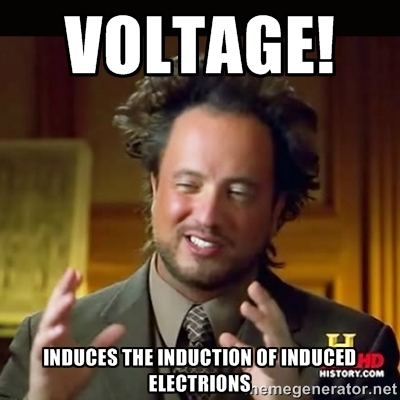
quick question

i claimed on the dynamic test it did do 3kw and if you would be smart enough to try and disprove me again you could easily quote the NEC. following is a link for the proof is CAN in fact do 3kw.

1) You seem to like quoting NEC a lot....What does NEC have to do with anything in this scenario? We are not trying to be in line with electrical codes?! Electrical codes do not say anything about what can or cannot be done. They just provide a guideline for best practices in professional applications (read as go to borderline extremes to reduce potential liability issues)//content.invisioncic.com/y282845/emoticons/fyi.gif.9f1f679348da7204ce960cfc74bca8e0.gif I'm not going to argue against the fact a bigger wire is better. That's pretty safe to assume for most of the time, but in this case it is not required. My point with the lightning example is you have potentially hundreds of thousands of amps going through the ground cabling, but I would be surprised if anywhere suggested really gigantic grounding because a lightning strike is a instantaneous peak not a sustained current, so you can get away with smaller wires than you would use in say an application covered by NEC.

2)...Electricity is the flow of electrons....AC or DC....There are a couple centuries of physics that are going against you there. When a conductive medium is exposed to voltage a current(or electron drift) is created. The voltage pushes electrons which result in a current. I=vd*n*e*A (vd=drift velocity, n=number of electrons per volume, e = electron charge, A=area of conduction, I = current). Hey look! Amperage has something to do with electron drift velocity! I'm going to say this discussion only applies to wires as some things can get sort of funky once you go into something like doped semiconductors

If I'm completely wrong, please tell how energy "moves" along the electrons? What causes the heat then? There's only a few ways energy can move from one place to another....

3) Finally something we can agree on. Yeah, schools can be **** expensive and in my opinion somewhat exploitative. During my brief stints as an educator I've suggested to my more directionless students when they ask for advice to actually go seek a skill like welding, plumbing, machining, programming, etc...University isn't for everyone and a skill set can be way more valuable than many degrees.

 
btw. the nex is national electrical standard and ampacity ratings are generally 5% voltage loss and length is accounted in these formulas.

5% in 14 volts 7/10ths of a vote. buy none the less with 500amps thats 350 watts loss just through just the wire!

 
i quote the nec because in anything having to do with electrical they have tested day in day out its efficent and safe.

every engineer and electrician follows these standards. the ONLY field that doesnt is car audio. its such a low capital low risk system not many standards are set in place but the nec covers alot of it actually.

 
1/0 gauge power wire1/0 gauge ground

(2) SA-12D4 Rev.3 subs

CAB 1600.1 amp

now here is my question... i want to wire these down to 1ohm! as far as speaker wire, what size should i use to wire these up? i was going to use 12 gauge but the jumper wire and the positive wire joined is to big for the voice coils! would 14 or 16 gauge be ok to use?
get you a 50ft roll of good ofc copper 12ga. use one run per voice coil and get some banna plugs for both ends..

use these at the amp..Gold Plated Banana Plug Connectors 14-8 AWG 4 Pcs. Set Screw-Type Termination You can fit two number 12s in there and its a nicer and better connection at the amp. then you can use these at the blindingpost at the subs.Parts Express Banana Plug Black

thats the professional way to do it..

its about time someone shows people the right way.

 
electricity isn't the flow of electrions. thats a YYUUUUUUUGGGEE misconseption it is charged particals that flows along electrions..https://en.m.wikipedia.org/wiki/Electricity
Quoting your wikipedia article "The movement of electric charge is known as an electric current." so I'm confused here. What particles are you talking about? There are no charged particles that flow along electrons...the electrons carry the charge themselves.

Look man. There are two main charged particles. Protons and electrons. Protons are bound in the nucleus with neutrons and the number of protons dictate the element of an atom, so that leaves electrons. The whole concept behind how a traditional loudspeaker works is the flow of electrons are moving with some velocity along the wire which is exposed to the magnetic field of the motor. The Lorentz Force law then describes some of the fundamental physical behavior which can then be used to derive Amperes law and the resulting magnetic field in a coil. (I would list equations, but without advanced text editing they would look garbled; you can look them up if you wish) Now one catch is the convention of saying electrons have a negative charge is you have to be careful maintaining the sign convention....

Unless you specifically need to know the underlying theory behind electricity many profession certification programs can get by with providing basic formulas and guidelines, so many people have a YUUUGGEEE (feelthebern16) misconception about several EM topics. It's not like plumbers need to know the anomalous properties of water or someone who builds computer for a living needs to know the underlying concepts behind things like volatile memory, caching, semiconductors, etc...?

NEC is a best practices guidelines OP can safely use 12 or 14 gauge wire in this scenario at the expense of bit more voltage drop of which he won't hear the effects and a slight amount of additional heat along the wire from the additional power dissipation. Now saying that, the weak points/points of failure will be his connections between amp and subs which you can likely offer good, practical advice about that with your electrician experience. //content.invisioncic.com/y282845/emoticons/smile.gif.1ebc41e1811405b213edfc4622c41e27.gif

 
There's a line between ideal and real world that papermaker isn't understanding. Standards are great, but someone has to interpret into a real world usable answer that actually makes sense. The cumulation of numerous factors will absolutely allow that type of wire to be used.

 
Quoting your wikipedia article "The movement of electric charge is known as an electric current." so I'm confused here. What particles are you talking about? There are no charged particles that flow along electrons...the electrons carry the charge themselves.
Look man. There are two main charged particles. Protons and electrons. Protons are bound in the nucleus with neutrons and the number of protons dictate the element of an atom, so that leaves electrons. The whole concept behind how a traditional loudspeaker works is the flow of electrons are moving with some velocity along the wire which is exposed to the magnetic field of the motor. The Lorentz Force law then describes some of the fundamental physical behavior which can then be used to derive Amperes law and the resulting magnetic field in a coil. (I would list equations, but without advanced text editing they would look garbled; you can look them up if you wish) Now one catch is the convention of saying electrons have a negative charge is you have to be careful maintaining the sign convention....

Unless you specifically need to know the underlying theory behind electricity many profession certification programs can get by with providing basic formulas and guidelines, so many people have a YUUUGGEEE (feelthebern16) misconception about several EM topics. It's not like plumbers need to know the anomalous properties of water or someone who builds computer for a living needs to know the underlying concepts behind things like volatile memory, caching, semiconductors, etc...?

NEC is a best practices guidelines OP can safely use 12 or 14 gauge wire in this scenario at the expense of bit more voltage drop of which he won't hear the effects and a slight amount of additional heat along the wire from the additional power dissipation. Now saying that, the weak points/points of failure will be his connections between amp and subs which you can likely offer good, practical advice about that with your electrician experience. //content.invisioncic.com/y282845/emoticons/smile.gif.1ebc41e1811405b213edfc4622c41e27.gif
I was waitng for you to get really mad, figured you would loose your cool. your a bit hared to **** with but im getting there.

i understand what electricity is. they way you described it was just not how it works. a charge in induced(hence its called induction) and it Forces a charge in the electrons and that charge moves amoung the electrions..

its the basis of current flow. its now much flow of charged partlicles you exhibited at a give time .

voltage is the FORCE. its not a pushing or pulling its simply a force that induces a change in charge. that is WHY currecnt flows easier with higher voltage.

a speaker actually is a amperage driver device. voltage is only important becasue of the FORCE behind the elecrtion flow IE it induces a greater portentual in charge so you have more electrion flow.

are you talking about inductance? you seem to be quotng a website as opposed to explaining these fucntions.

Iuductance is the oppsition of a change of charge when a charge is present that cause a opposing force in the conductor(hence back EMF) lorenze force is simply put is the effect on a charge for example of the voice coil reacting to the external EM of the permant magnet field and how it afftect said charge.

while ill admit its probably been 10 years since ive gotten into this it was time for a revist. but honestly your vauge and genertic explinations just confused me.

 
There's a line between ideal and real world that papermaker isn't understanding. Standards are great, but someone has to interpret into a real world usable answer that actually makes sense. The cumulation of numerous factors will absolutely allow that type of wire to be used.
wew lad

this is YUUUUGGGGEEE

**** i love that name and im stuck on them clowing trump. so forgive me for being a child.

these basis where tested and alot of electronics are desgined in according of these standards. why not use them when there fundomently sound? i mean im literitally teaching people how and why. who else does that? no im not always correct and no not everybody wants to learn but at least i put the effort forwad to tell the your people what and why.

The power levels we use today are much greater. with 3000RMS wattage your looking at 15-50 amps of current to the voice coil with a typical 1ohm load. in the case of you wanted to run a single wire and just a jumper for the other coil(which is fine) the primary conductor would need to be a number 8.

can you get away with less? yes, will it afftect the proformance? YES

wire is cheap and its almost senseless to buy the 12GA for such an application when you could use 8.

In this application, with 400 watts PER COIL with a 4 ohm load. sure 14 is fine even 16 in **** a short run would WORK . if your running one wire and simply jumping from one coil to another I would recommend the largest possible usable wire. in this case 12GA would work but you nearing the limits of the wire in the sense that your getting excssive voltage drop IE power lost. which is retarted since your paying fod muney for as much possible output as you can get so why use ****** undersized wire?

that being said. I pesonally use one conductor per coil. why not!? this lowers the voltage loss and increases the power sent to the coil. its simple because its no longer carrying current for the entire load only a part of the load. so voltage is identical but amperage is reduced.

depending on the circuit and the load limits in 3kw at a one ohm load to a single driver I would use numver 10 per coil.. what i mean is you can just generically recommend using a wire without truey know the current flow/consumption!

 
I get slightly agitated about ignorance being spread, but no I don't loose my cool easily. :)

Vague....no, I fell I'm being pretty descriptive given the circumstance. I'm giving you leads to peruse for your own edification since I don't have the time to write out an entire book for you when there's plenty of material out there.
Generic...yes What would crunching numbers and throwing them at you accomplish when you can't even get your head around basic concepts.

An electron has a finite amount of charge. -1.60217662 × 10^-19 Coulombs to be close to exact. Any electron you run across will have that amount of charge. It doesn't change; same with its mass. A proton has the same amount of charge except the opposite sign so I don't know wtf you're talking about. It sounds like psychoactive drug inspired garbage....Induction is a vague term to use. Are you talking about logic? Induced current? Induced magnetic field, induced coma? (lol jk on the coma).

Hold up a sec whats a force if not some interaction that that results in a push or pull? You're contradicting yourself again.

Voltage is not a force. since you insist upon arguing semantics about various topics on everything else. Its a potential difference. You're sitting there saying electron flow and then point out I'm wrong about the flow of electrons? (I think that's what you mean by electrion flow?) You're contradicting yourself again.

That's exactly what I said about a speaker. Current=amps (or Coulombs per second) hey wait didn't we see coulomb earlier in this post? It's the amount of charge on something... say maybe an electron?!?

Lorentz force requires a moving charge. Charge itself isn't some magical entity; there are charge carriers ie electrons & protons

I'm not quoting a website at all. It's all from the knowledge I've gained from reading, tinkering, and then applying. I'm flattered that you think I just ripped it off a website though:blush: I've already cut up your food for you; don't expect for me to chew it as well. Even if I explained the physical ramification of a cross product and walked through an entire derivation would it even help you or most people? No, because in this case OP and most other car audio peeps will be fine if they don't follow NEC code when wiring their subs. They don't need to know NEC code nor do they need to know the physics of E&M. I would rather not derail this thread any further with our bickering. If you want to have additional discourse please start a thread/create posts giving terrible information that I can trash or PM me.


aIXDnxI.jpg


@papermaker - Sorry forgot to quote you post
 
Last edited by a moderator:
lol it's crazy to see people who actually understand physics, i mention potential difference and people look at me like I'm speaking a foreign language.

whoever taught you physics did well

 
I used 16ga wire with a 2500w amp.. No issues. Although I do recommend using the largest size that will fit, while being reasonable.

Resistance is the main concern with speaker wire, not current carrying capability.

 
yea im not going to argue this. thanks for the information. if you want to guess the size of the wire you need be my guest. ive listed NATONAL ELECTRICAL CODES. these are paruliar and accurate standards used in the REAL PROFESSIONAL AND SENTIFIC world.

If you want to use your own standars and think you know be my guest but dont try to argue with me when im giving you standards set by engineers all over the USA.

these are the standards from marine 12volt and 24 volt systems to navigation low voltage systems both power and communitcaion.

im not gonna argue the fundementals of physics as im have a good understand. honestly probly been 10 years since i really had to look nto it as i dont use it on a daily basis. clearly we not getting anywhere.

i researched alot of teslas work and thats what got me interested.

voltage by definition is the poentontial difference of a charge between two points that is equal to one joule per coulomb.

what i meant by force is its often compared to "pressure" in a sense that and electricially charged partical flows easier as voltage rises just as pressure in a phnumatic system. your arguing definition. like stight out of a book. which i understand. thats what school does. and knowing this you still fail to agree that the NEC code has a very accurate and techinal guildlines that should be followed for the best possible results.

if you wanted to argue that the voltage on hte output is potentually high wnough and resistance is lower enough in the 14 guage for 3000 watts that we can your the "text book, school based" abstarct to prove. i use the NEC because its done for you.

as for as resistance being the main concer, resistance is simply how much opposition to current flow for a given voltage/amperage. and simply put your are in a sense correct bt the largerhte wire the les the resistance. and YES amperage carring capibilties do matter.

im gong to provide chrats here, you can say what you want I proved the MATH and the standars that are used in every field but car audio. that why noone takes it seriously. you have people recommend 14 ga for a load that has the potentual of 2400 watts.

again since you have a degree in physics(i assure i dont know you) ill do the math then you can ook at ANY site and find out if im full of **** based on the standards on which conductors are rated.

in the case of a 3000 watts load @ 1ohm (the orginal argument)

to FIND your amperage is the SQR(3000/1) the square r0ot of 3000 is 55. so 55 amps.

now to find voltage when you know amerage and power is amperage*resistance(ohm) so 52*1 is 52. so at a 1ohm load its can carry as much as 50 amps. NEC recommends 8 gauge for that load.

now since yall refuse to use this standard im going to find a few other graphs and link them..

this one is @ 120 volts. which we know is DOUBLE the voltage in this situation so the wires ampicity will be sightly less.

http://www.allfordmustangs.com/forums/attachments/audio-alarms/62425d1235669252-wire-gauge-ampacity-table-wiringdiagram.jpg

http://tse3.mm.bing.net/th?id=OIP.M1135bc88cd3e8f466170b3c3e23acafaH0&pid=15.1

http://www.hitmanhotrods.com/en/admin/sources/editor/assets/chartsGraphs/wire_sizing_chart2_titled_filled.jpg

like i sadi you choose the wire that can handle the maxinum current in the circuit. not the average circuit.

thank fully none of you guys are electricans becasue **** would be burning up.

 
Activity
No one is currently typing a reply...
Old Thread: Please note, there have been no replies in this thread for over 3 years!
Content in this thread may no longer be relevant.
Perhaps it would be better to start a new thread instead.

About this thread

yroc434

Member
Thread starter
yroc434
Joined
Location
Va
Start date
Participants
Who Replied
Replies
69
Views
4,881
Last reply date
Last reply from
keep_hope_alive
IMG_20260516_193114554_HDR.jpg

sherbanater

    May 16, 2026
  • 0
  • 0
IMG_20260516_192955471_HDR.jpg

sherbanater

    May 16, 2026
  • 0
  • 0

New threads

Top