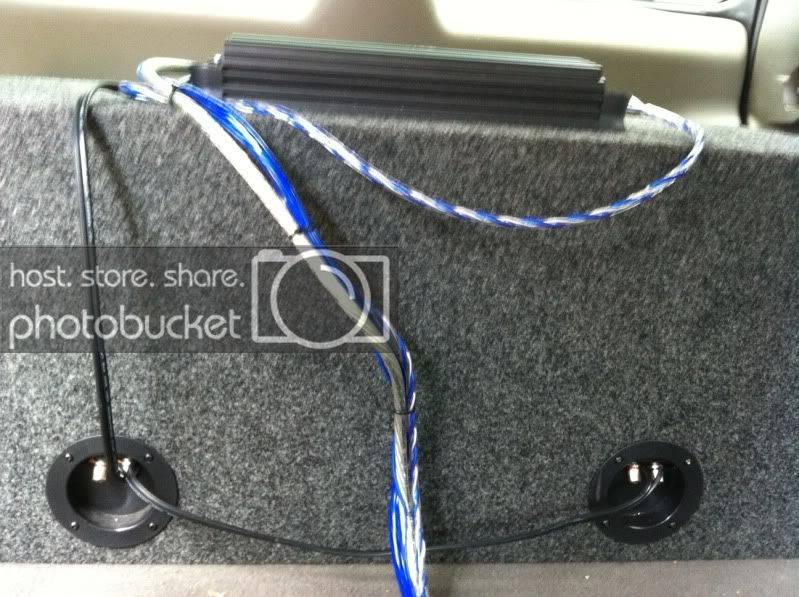
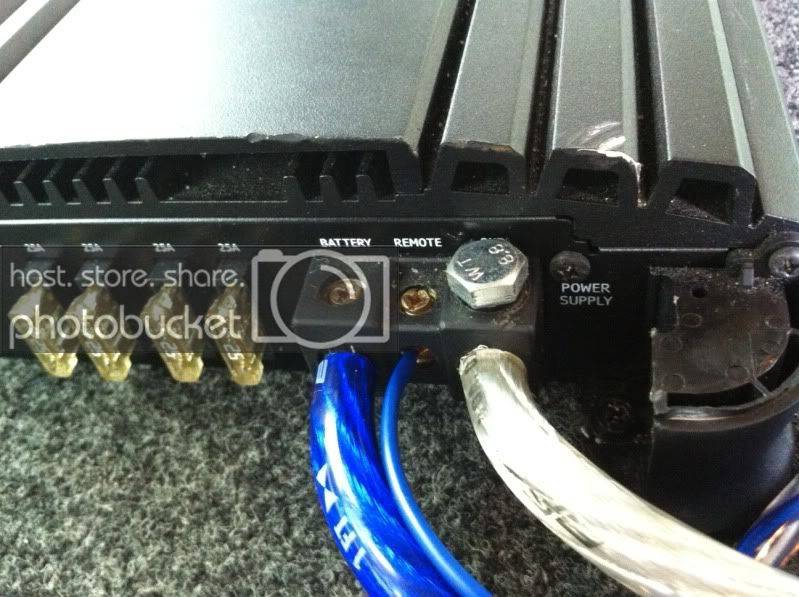
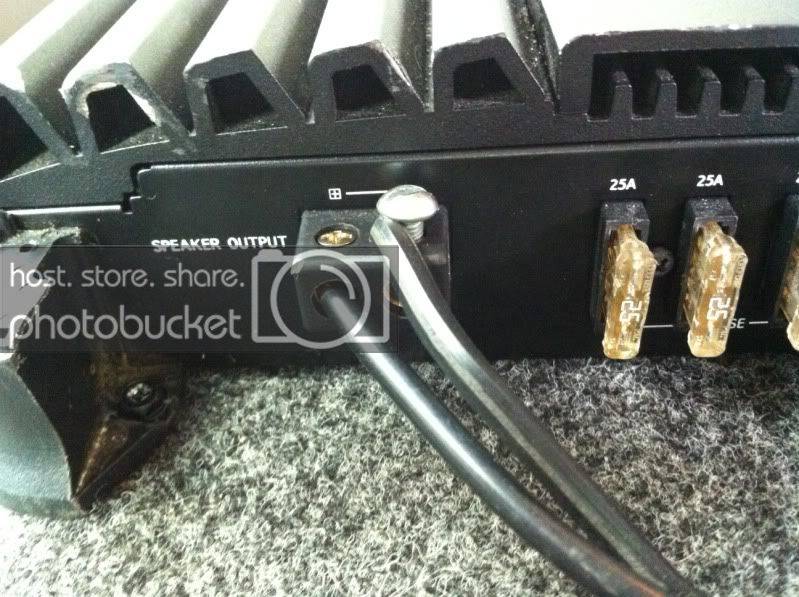
just installed RF P312D4's... not working PLEASE HELP

An amplifier does not have to be 1 ohm stable to be a "true monoblock"... Seriously though, it's nothing personal and no offense is intended, but I recall recent threads from you where you had absolutely no clue what you were doing. Please leave advice-giving to those that have a little bit more experience.

The majority of class d mono-block amps I see are 1 ohm stable, not just have the ability to be wired to 1 ohm. I'll leave the advice giving to the more experienced people, perhaps your right I should be even more studious.
 
a "mono-block" means it has 1 channel. Nothing to do with what impedance it can handle. please just stop spreading misinformation. I have no idea why you're bringing in amplifier topography either....

Anyways, if you have a dmm. turn it to AC and put the positive probe on the + speaker terminal and the negative probe at the negative speaker terminal (both at the amp and the box) and raise and lower the volume. THere should be an increase and decrease in volts AC. If there is not, then either the amp is not getting signal, or your amplifier is not outputting.

To test if it's getting signal take the meter (same settings) and put the positive probe on the center pole of the rca and the negative on the outer shield (all done at the tip). Once again this should raise and lower with volume (depending on your HU anywhere from .5v AC to 2 or 4 or 5v AC). Becareful not to touch any of the probes together while testing these.

Also Alpines blue square in the middle usually turns red when in protect.

Check the voltage at the amplifier too. Sometimes amps will turn on but they will not actually be getting enough voltage and current (if the battery terminals corroded, etc.) and thus it will appear as if the amplifier is on and operating, when its not.

P.S. the amps not 1 ohm stable, especially with enough power to adequately push the P3's. LMK if you need a P1000-1BD //content.invisioncic.com/y282845/emoticons/smile.gif.1ebc41e1811405b213edfc4622c41e27.gif

 
An amplifier does not have to be 1 ohm stable to be a "true monoblock"... Seriously though, it's nothing personal and no offense is intended, but I recall recent threads from you where you had absolutely no clue what you were doing. Please leave advice-giving to those that have a little bit more experience.
Exactly.

also I'm not the smartest guy out there but i thought mono means 1

 
The majority of class d mono-block amps I see are 1 ohm stable, not just have the ability to be wired to 1 ohm. I'll leave the advice giving to the more experienced people, perhaps your right I should be even more studious.
not all class D amps are 1ohm stable my memphis is a 2000watt rms monster but only at 2ohms! go one ohm and it will protect or cook.

 
a "mono-block" means it has 1 channel. Nothing to do with what impedance it can handle. please just stop spreading misinformation.
For the 3rd time, the majority of true channel separation (mono-block) amps I've seen are 1 ohm stable, not just have the ability to be wired to 1 ohm.

I never said Ohm's (impedance) has to do with channel separation per-se. My comments are based on my experience with class d amps. If you want to

say it doesn't matter whether an amp that claims to be a true mono-block and is 8 or 4 or 2 ohms stable, fine.

 
For the 3rd time, the majority of true channel separation (mono-block) amps I've seen are 1 ohm stable, not just have the ability to be wired to 1 ohm. I never said Ohm's (impedance) has to do with channel separation per-se. My comments are based on my experience with class d amps. If you want to

say it doesn't matter whether an amp that claims to be a true mono-block and is 8 or 4 or 2 ohms stable, fine.
Yes most underground class d amps are 1 ohm stable which is what is mostly on the forums. But a lot of mainstream class d amps are only 2 ohm stable.

 
For the 3rd time, the majority of true channel separation (mono-block) amps I've seen are 1 ohm stable, not just have the ability to be wired to 1 ohm. I never said Ohm's (impedance) has to do with channel separation per-se. My comments are based on my experience with class d amps. If you want to

say it doesn't matter whether an amp that claims to be a true mono-block and is 8 or 4 or 2 ohms stable, fine.
There is no such thing as "Channel Separation" in reference to a Monoblock amplifier. The L/R channels are combined into one mono channel.

It is one of the specs of a stereo amp that is not even taken into consideration unless you manage to somehow find a manufacturer that builds a stereo amp with less than 50db channel separation. Like a 25 - 35 db stereo sep MIGHT affect imaging...but manufacturers use close enough tolerances that it is pretty much a non-issue with todays media.

 
Yes most underground class d amps are 1 ohm stable which is what is mostly on the forums. But a lot of mainstream class d amps are only 2 ohm stable.
This is because the underground amp are designed for one thing - POWA!

Mainstream production in their better offerings maintain closer tolerances and tighter regulation to maintain a tight balance of efficiency, sq and power.

 
There is no such thing as "Channel Separation" in reference to a Monoblock amplifier. The L/R channels are combined into one mono channel.
Sup @quackhead. To my understanding the utilization of mono-block amps were to separate the channels (individually) to eliminate cross

talk caused by the propagation of two channel signals. Mono of course, means one, but I've heard of mono-block amps, with two amps one

for each individual channel. Have you ever heard of such a thing? Idk. Pretty sure I've read this somewhere.

Yes most underground class d amps are 1 ohm stable which is what is mostly on the forums. But a lot of mainstream class d amps are only 2 ohm stable.
Well this was my point! Like the Kenwood KAC-7200+'s-9105'S (and Alpines). The higher end Kenwood Excelon X1200M Class D monoblock amp is 1 Ohm stable though.

 
Sup @quackhead. To my understanding the utilization of mono-block amps were to separate the channels (individually) to eliminate cross talk caused by the propagation of two channel signals. Mono of course, means one, but I've heard of mono-block amps, with two amps one

for each individual channel. Have you ever heard of such a thing? Idk. Pretty sure I've read this somewhere.
I totally understand you and in that sense you are right. Two monoblocks in the same chassis that amplify the individual L/R signals is usually referred to as a Stereo Amplifier. And one of the downsides of a Class D stereo amp is the costs involved to "clean" (speed up)up the switching inputs for use at higher frequencies .

This is why most Companies sell Class D 1 channel mono bass amps, the high THD is masked by low frequencies. The low frequencies require more amplification, combined with the efficient Class D switching power supply allows the use of a 1ohm impedance at powers that was unobtainable with conventional A/B designs due to efficiency limitations. You could get 2000 watts of class A/B at 1 ohm at a cost of 300amps, whereas 2000watts of Class D can be had with just 180amps

I gotta go.

 
here's some better pictures:

download-8-1.jpg


download-10.jpg


download-9-1.jpg


First off I would not trust that negative connection on the speaker output at all.

a "mono-block" means it has 1 channel. Nothing to do with what impedance it can handle. please just stop spreading misinformation. I have no idea why you're bringing in amplifier topography either....
Anyways, if you have a dmm. turn it to AC and put the positive probe on the + speaker terminal and the negative probe at the negative speaker terminal (both at the amp and the box) and raise and lower the volume. THere should be an increase and decrease in volts AC. If there is not, then either the amp is not getting signal, or your amplifier is not outputting.

To test if it's getting signal take the meter (same settings) and put the positive probe on the center pole of the rca and the negative on the outer shield (all done at the tip). Once again this should raise and lower with volume (depending on your HU anywhere from .5v AC to 2 or 4 or 5v AC). Becareful not to touch any of the probes together while testing these.

Also Alpines blue square in the middle usually turns red when in protect.

Check the voltage at the amplifier too. Sometimes amps will turn on but they will not actually be getting enough voltage and current (if the battery terminals corroded, etc.) and thus it will appear as if the amplifier is on and operating, when its not.

P.S. the amps not 1 ohm stable, especially with enough power to adequately push the P3's. LMK if you need a P1000-1BD //content.invisioncic.com/y282845/emoticons/smile.gif.1ebc41e1811405b213edfc4622c41e27.gif
^^^^Do that

 
Activity
No one is currently typing a reply...
Old Thread: Please note, there have been no replies in this thread for over 3 years!
Content in this thread may no longer be relevant.
Perhaps it would be better to start a new thread instead.

About this thread

BoomBoxStereo

10+ year member
@woofergram
Thread starter
BoomBoxStereo
Joined
Location
Long Island, NY
Start date
Participants
Who Replied
Replies
52
Views
4,677
Last reply date
Last reply from
ewadz3006
IMG_20260516_193114554_HDR.jpg

sherbanater

    May 16, 2026
  • 0
  • 0
IMG_20260516_192955471_HDR.jpg

sherbanater

    May 16, 2026
  • 0
  • 0

New threads

Top