Lowpass filter (LPF), or also called lowpass crossover.
It attenuates the frequencies
above the crossover point at a predetermined rate (which is the crossover
slope), and allows most of the frequencies below the crossover point to pass through unfiltered (unattenuated).
And, just as an FYI, a highpass crossover is just the opposite. It attenuates the frequencies below the crossover point at a predetermined rate (slope) and allows most of the frequencies above the crossover point to pass through unfiltered.
Subsonic filter, or also called SSF.
Basically just a highpass crossover with a really low crossover point. It attenuates the frequencies below the crossover point to decrease/eliminate the possibility of the subwoofer overexcurting and being damaged. Only really necessary when the subwoofer being used with the amplifier is in a ported enclosure.
SSF's have a "slope" just as lowpass crossovers and highpass crossovers do (makes sense since the SSF is basically nothing more than a highpass crossover). Typically SSF's have pretty steep slopes.
Lowpass slope. This is the slope of the lowpass crossover.
As I mentioned above, the lowpass crossover attenuates the frequencies above the crossover point. Crossovers aren't brick walls like some people think. The frequencies above the crossover frequency don't just "disappear", and aren't stopped completely. They are attenuated (gradually decreased in volume) by a certain rate, and this slope determines the rate at which they are attenuated. Common slopes are 6 decibels per octave (6db/oct), 12 decibels per octave (12db/oct), 18db/oct and 24db/oct. The higher the number, the "steeper" the slope. The lower the number, the "shallower" the slope.
And, incase you don't know, one octave higher is double the frequency, one octave lower is half lf the frequency. So one octave above 100hz is
200hz, one octave below 100hz is
50hz.
So if we have a lowpass crossover with crossover point of 100hz with a 12db/oct slope, at 200hz the signal would be attenuated by 12 decibels. If we have a crossover with a crossover point of 100hz and a 24db/oct slope, at 200hz the signal would be attenuated by 24 decibels.
In short, the setting of the gain basically determines how much input signal voltage from the source (the headunit in most cases) is required for the amplifier to reach full power output.
If you set the gain to 2V, then the amplifier will not output full power until the amplifier is receiving 2V of input signal voltage (the input signal is transmitted via the RCA wires). Go above 2V of input, and the amplifier will clip, which could potentially damage the subwoofers connected to the amplifier.
Set the gain (sometimes also called an "input sensitivity") to 4V, and 4V of input from the HU is required for the amplifier to output full power. Go above 4V, and again clipping will occur.
So, you can see why setting the gain correctly is important. Set it too low (too far towards a higher voltage figure), and you may not obtain full power output from the amplifier. Set the gain too high (too far towards the lower voltage figures) and you will likely clip the amplifier, which decreases sound quality and could potentially damage your subwoofer/speakers.
There is a good gain setting tutorial sticky'd in this amplifier section.
Technically, for crossovers (obviously), it's the point at which the signal as decreased by a level of 3db. This is what you set by turning the knob on the amplifier.
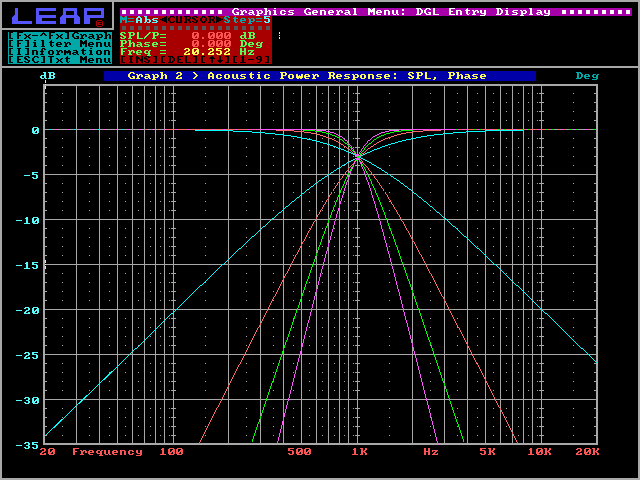
Hopefully this picture will sort of pull all of these terms together for you into one simple, easy to visually see image:
As you can see, the "crossover frequency" is 1khz (the point at which the signal is attenuated by 3db). The lines "sloping" downward to the left are highpass crossovers, the lines "sloping" downward to the right are lowpass crossovers. And obviously the different colored lines indicate different decibel per octave slopes.
Cyan = 6dB/octave
Red = 12dB/octave
Green = 18dB/octave
Violet = 24dB/octave
Basic electrical term;
http://dictionary.reference.com/search?q=voltage
http://www.bcae1.com/volt.htm
Clear as mud? Right now you either have a firm grasp on how crossovers, gain and voltage work....or are completely and utterly lost. I'm hoping for the former //content.invisioncic.com/y282845/emoticons/smile.gif.1ebc41e1811405b213edfc4622c41e27.gif
As for actually setting them.....follow the gain setting tutorial that's sticky'd for setting the gain. There's no right or wrong answer for setting the lowpass frequency (and slope if it's adjustable, but it's not on most amplifiers)....just set it to where ever sounds best in your system. Lowpass frequency will likely be somewhere between 50hz and 85hz, just to give you somewhere to start. Don't bother with the SSF unless you are using a ported enclosure. If you are using a ported enclosure, set it to 1/2 octave below the tuning frequency.