Can an LOC be used in reverse?

Here's why you need to know if the HU output is balanced (I.e. bridged):

Most standard EQ's have unbalanced inouts and outputs and will treat the shield as ground, which are tied together in the EQ. If the HU output is balanced then the EQ will essentially short the HU "negative" speaker wires. If you go this route, I recommend a LOC between the HU and the EQ to ensure you don't have an impedance load issue.

The output of the EQ will be lower than that of the HU, and the output impedance of the EQ will be different than that of the HU. You care about the relationship of output impedance to input impedance since that determines voltage gain (how much signal is transferred). We don't even know the input impedance of the factory amp. We can assume the input impedance of the EQ is 10k ohm and the output impedance is 50 ohm as those are typical values for line level gear. The manual will tell you.

A JBL MS-8 is the correct solution for your needs/expectations. If you want to introduce an EQ you should also bypass the factory amp with an aftermarket amp. The MS-8 gives you both and is specifically made to sum the factory amp outputs, balanced or unbalanced, then power speakers.

When it comes to the Bose system, I do not recommend getting between the HU and factory amp unless you can somehow get access to a schematic of that system so you know what each wire does and what load it sees. I also don't recommend powering the Bose speakers from an MS-8 without first verifying their impedance. I wouldn't expect you will improve on a Bose system without a full upgrade.

The math by dragonrage appears to be based on guesses and generalities and not based on actual data for your specific vehicles. Use it with caution. No offense dude, but recommendations like this should be more accurate as he can damage his gear.


 
We are (according to the OP and to my understanding, anyway) talking about driving an amp, not powering speakers. Calm down. It doesn't matter if you drive a stock amp or aftermarket amp from the MS-8. Just that a stock amp will have an unknown gain that is either fixed or that will have a gain knob that is hidden somewhere and it could have equalization in it which the MS-8 actually WOULD account for in its autotune because it does play through the amp when it listens to the test sound when it tests so the amp's sound is accounted for.

 
For the record, not all LOCs are passive. Plenty are active. If it has a power wire, it is active.
Actually, I think the LOC that I use (which is active), PAC SOEM-T, will go either way.
I am Well aware of active LOCs but they use op amps or transistors and are not reversible. The PAC SOEM-T is not reversible either, they just simplify the installation diagram by using the same wire colors and use harnesses to allow for more flexible wiring options.

http://www.pac-audio.com/PACProductData/SOEM-T/1_Instructions/soem-t_instructions_091709.pdf

I can see how it can confuse you since you can put a speaker harness on the output and a RCA harness on the input. But that doesn't change the direction of attenuation.

There is no reason to make a reversible LOC since it can't source enough current for a low impedance load and the output impedance would be a wrong match A line driver is used to increase line level signals. Never forget to consider input and output impedance matching when connecting equipment.

 
I am Well aware of active LOCs but they use op amps or transistors and are not reversible. The PAC SOEM-T is not reversible either, they just simplify the installation diagram by using the same wire colors and use harnesses to allow for more flexible wiring options.http://www.pac-audio.com/PACProductData/SOEM-T/1_Instructions/soem-t_instructions_091709.pdf

I can see how it can confuse you since you can put a speaker harness on the output and a RCA harness on the input. But that doesn't change the direction of attenuation.

There is no reason to make a reversible LOC since it can't source enough current for a low impedance load and the output impedance would be a wrong match A line driver is used to increase line level signals. Never forget to consider input and output impedance matching when connecting equipment.
Are you trying to make me look bad or something? The input has a high/low level switch and the output has a high/low level switch. I am correct. I never claimed that transistors or op amps are reversible. I never explained transistors or op amps. I'm trained as an electronics technician (it's just a side job though). You don't need to try to one-up me here.

 
We are (according to the OP and to my understanding, anyway) talking about driving an amp, not powering speakers. Calm down. It doesn't matter if you drive a stock amp or aftermarket amp from the MS-8. Just that a stock amp will have an unknown gain that is either fixed or that will have a gain knob that is hidden somewhere and it could have equalization in it which the MS-8 actually WOULD account for in its autotune because it does play through the amp when it tests so the amp's sound is accounted for.
We ARE talking about powering speakers. We are considering using the factory amp but inserting an EQ in line to allow for sound shaping. the end goal is powering speakers. The OP asked about an MS-8 and it would be the right choice.

You know enough to be dangerous, but not enough to be accurate. Be more careful when making recommendations that can damage someone's equipment. Some of what you have said is inaccurate or a flat out guess you present as fact.

 
We ARE talking about powering speakers. We are considering using the factory amp but inserting an EQ in line to allow for sound shaping. the end goal is powering speakers. The OP asked about an MS-8 and it would be the right choice.
You know enough to be dangerous, but not enough to be accurate. Be more careful when making recommendations that can damage someone's equipment.
No, I know EXACTLY what I'm talking about. I build amplifiers, follow more advanced forums like DIYMA, DIYAudio, HTGuide, etc. Read ZaphAudio's stuff, interested in Linkwitz's "teachings"...

Don't assume you know me, because you don't. You are incorrect and I am correct. The factory amplifier takes an input voltage, applies a gain to it, backs it up with some current and uses that output stage to drive speakers... just like an aftermarket amp does. The voltage input could be as high as 8v as my math showed. It could be lower. It could be a peak 4v or 2v before clipping. He'll just have to figure that out by starting out with a low volume. That's how you set your gains on any amp. He just probably will have to set his gains with something other than the amp, unless his factory amp does have a gain knob.

Of course, only analog audio signals should be touched as far as the amp goes.

 
dragonrage - sorry for my attitude earlier. i just stepped back and reread my posts. i had a stressful day, some bad news, and i wasn't in the right mood to be answering posts. you're trying to be helpful and you do know what you're talking about.

 
No, I know EXACTLY what I'm talking about. I build amplifiers, follow more advanced forums like DIYMA, DIYAudio, HTGuide, etc. Read ZaphAudio's stuff, interested in Linkwitz's "teachings"...
Don't assume you know me, because you don't. You are incorrect and I am correct. The factory amplifier takes an input voltage, applies a gain to it, backs it up with some current and uses that output stage to drive speakers... just like an aftermarket amp does. The voltage input could be as high as 8v as my math showed. It could be lower. It could be a peak 4v or 2v before clipping. He'll just have to figure that out by starting out with a low volume. That's how you set your gains on any amp. He just probably will have to set his gains with something other than the amp, unless his factory amp does have a gain knob.

Of course, only analog audio signals should be touched as far as the amp goes.
my only real concern is at no point do you address input and output impedance nor dealing with balanced signals. i feel we should know the answers to those before we make further recommendations to use an EQ that is strictly designed for line level inputs/outputs.

of course, using the MS-8 we are fine because it has both line and speaker level inputs and outputs. it's just an issue of cascading gain and distortion. the best solution is to use the MS-8 to intercept the audio signal before the amplifier and power the speakers from it directly - bypassing the factory amp and any filters it may contain. but only an experienced installer should undertake this task since you need to understand the operating range of each speaker. we know very little about the vehicles mentioned so we don't know if the factory amp employs active filters to power each speaker directly.

 
So the ms8 should be used to bypass the factory amp or simply in-line between the hu and factory amp? At least we have figured out that the ms8 and not the dql8 or other combo is what should be used.

 
it is preferred to use the MS-8 to bypass the factory amp. it comes with 8 channels of amplification for a good reason. //content.invisioncic.com/y282845/emoticons/smile.gif.1ebc41e1811405b213edfc4622c41e27.gif

factory amplifiers are usually the weak link in the system. i wouldn't spend any effort trying to reuse them. plus, the factory amp may contain other filters that the MS-8 will have to work against. the fewer filters the MS-8 has to fix, the better.

just take note of the factory speaker impedance values and make sure the MS-8 can run them. Don't be afraid to upgrade the speakers while you are at it. //content.invisioncic.com/y282845/emoticons/smile.gif.1ebc41e1811405b213edfc4622c41e27.gif when you decide what vehicle this is going in - we can discuss what filters you should use on each speaker.

 
Now that I can agree with. While I stick to my guns that you could reuse the factory amp if you wanted to, I by no means think it is the best possible option. By the way, amplifiers always have high input impedance to keep current from source components low.

 
Now that I can agree with. While I stick to my guns that you could reuse the factory amp if you wanted to, I by no means think it is the best possible option. By the way, amplifiers always have high input impedance to keep current from source components low.
the reason for a high input impedance and low output impedance is to ensure very little signal is lost due to the voltage divider that is created between Zout and Zin. yes, output current is kept low - but that is to reduce the voltage drop across the output resistance of the source. when we use Y-splitters we double current and thus double voltage drop - reducing the overall signal amplitude. that relationship is also referred to as voltage gain (by some of us EE's), the industry also calls it impedance matching. the equation is the same regardless.

a "high impedance input" may be relative. if the stock HU has a very low output resistance in order to drive speakers, then the input impedance at the factory amp may be lower than the industry standard 10k ohm. I don't know the answer to this. I have seen very little information on factory "premium" systems, very few schematics. the less i know about something, the less i want to re-purpose it. //content.invisioncic.com/y282845/emoticons/smile.gif.1ebc41e1811405b213edfc4622c41e27.gif

I believe you understand exactly what i'm talking about so no further explanation is needed.

For the others reading this, let's give them a quick tutorial of the subject:

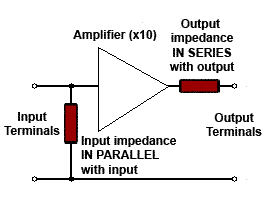
An amplifier can be considered to have two impedance paths that affect the way it can be connected to other amplifiers, one impedance is considered to be connected across the input terminals in parallel with the input. At the output there is another impedance, this time connected in series with the output. The effect of this output impedance is to reduce the voltage at the output terminals, and the more current drawn from the output, the more the terminal voltage is reduced, therefore there must be an impedance across which the voltage is being dropped. The input and output impedance of an amplifier are illustrated below
ip-op-impedances.gif


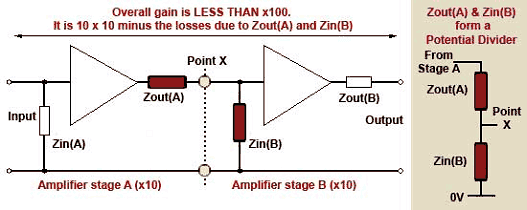
Impedance matching of inputs and outputs is necessary inside components because the gain of a single amplifier is often insufficient for a given purpose. For this reason several stages of amplification are used, which involves feeding the output of one amplifier into the input of another. This is called connecting the amplifiers in "Cascade". It is then important that the output impedance of the first amplifier and the input impedance of the second amplifier form a potential divider as shown below.
This same concept is important when we are discussing connecting power amplifiers in series.

If the amplifiers are voltage amplifiers, i.e. amplifier stages whose voltage gain is greater than either their current or power gains, the voltage waveform needs to be coupled from one stage to the next with as little reduction in amplitude as possible. Notice that the output impedance of the first stage and the input impedance of the second stage form a potential divider, and the voltage available at the junction of the two impedances will depend on the relative values of Zin (B) to Zout (A). The higher the value of an impedance, the more voltage will be developed across it for a given current flow. Provided that Zin (B) is much greater than Zout (A), the majority of the available voltage at point X (the input to stage B) will be developed across its input impedance Zin (B), and so across stage B input terminals rather than across the first amplifier´s output impedance.
In the case of power amplifiers, the maximum power is transferred from output to input if both impedances are the same.

The values of input and output impedance have a considerable effect on the gain of multi stage amplifiers and there is always some loss of signal amplitude that occurs due to the coupling of successive amplifier stages. In calculating the overall gain of a multi stage amplifier, the overall gain is equal to the product of the individual gains of each amplifier. i.e if each stage of a two stage amplifier has a gain of 10, then the overall gain should be 10 x 10 = 100. In practice however, this is not achievable due to the coupling losses incurred in matching the amplifiers, and a slightly lower gain results. The value of input and output impedance can be arranged to an appropriate value by the choice of amplifier design.

Although the above description refers to coupling amplifiers together, the same considerations apply when an amplifier is driving a power device such as a loudspeaker, a current operated device such as a motor, or in matching an input device such as a microphone to the input of a voltage amplifier.
impedance-matching.gif


Yes I am aware of this and that is quite the explanation, more than I would be willing to type out on here, heh. Anyway, my assumption is more that in most cars, the head unit is a shelf unit that can be used with or without the amp, because otherwise, it should have "line-level" outputs. I suppose there is no reason that assumption HAS to be true, but perhaps it helps you understand why I was explaining things the way I was.

 
No, they do not. That would make them Class A which would be incredibly inefficient and if they were to drive speakers directly, the HU would be providing 36/Z (Z is impedance) watts of continuous power to each speaker which would make them handle less musical power (since they would be using up a good amount of their thermal capacity on this stupid DC offset) and also give them a horrendous coil offset.
Head units are essentially bridged internally, yes, but there is no DC offset involved.
Head unit speaker outputs are two class AB drivers per channel, with one driver inverted (bridged). If you measure voltage from either speaker wire to ground you will see half battery voltage, about 6V DC. Signal sensing self-turn-on amps use that offset as their remote.

From R-F's PBR300X4 amp specs:

Auto Turn-on: When using speaker-level inputs the amp will automatically turn on when it senses an input signal (4 volt minimum). The threshold voltage (DC offset) for auto turn-on is adjustable from 4 volts to 6 volts.
Most factory amps do the same thing. It seems the OP has a new plan, which is probably a good thing...

 
Activity
No one is currently typing a reply...
Old Thread: Please note, there have been no replies in this thread for over 3 years!
Content in this thread may no longer be relevant.
Perhaps it would be better to start a new thread instead.

About this thread

tooshort_128

10+ year member
CarAudio.com Elite
Thread starter
tooshort_128
Joined
Location
Sterling, VA
Start date
Participants
Who Replied
Replies
47
Views
2,593
Last reply date
Last reply from
keep_hope_alive
IMG_20260516_193114554_HDR.jpg

sherbanater

    May 16, 2026
  • 0
  • 0
IMG_20260516_192955471_HDR.jpg

sherbanater

    May 16, 2026
  • 0
  • 0

New threads

Top