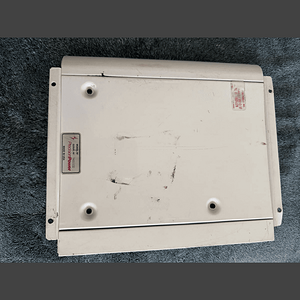
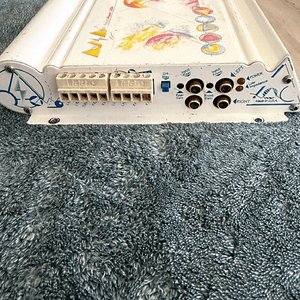
Amp/Sub question

you scare me when you say, "with the gains turned up to handle the load", but I get what you're saying. I don't know if a bigger amp in this case would necessarily be less draw, but it should be more efficient. It's going to run cooler and therefore less energy is wasted in heat. If that makes sense.

 
If both amps are class A/B - both amps will draw very close to the same current from the cars electrical system.

So if you have a 500Wrms amp running at 500w, and for the sake of the argument lets say this amp is 50% efficient - 1000w will be drawn from the cars electrical system.

if you have a 1000Wrms amplifier and adjust the volume so that it's outputing the same as the 500w amp above, and lets say this amp is also 50% efficient, the draw on the electrical system will still be 1000w..

The difference is, the 1000Wrms amp will never get as hot, as it will have a heatsink designed to dissapate more heat, but the electrical load will still remain the same when the output volumes (or output wattage) remains the same when comparing both amps.

*that's assuming both amps are 50% efficient.

if you start comparing class A/B amps with class D amps - everything changes of course.

Amplifier - Wikipedia, the free encyclopedia

 
you scare me when you say, "with the gains turned up to handle the load", but I get what you're saying. I don't know if a bigger amp in this case would necessarily be less draw, but it should be more efficient. It's going to run cooler and therefore less energy is wasted in heat. If that makes sense.
Assuming all external factors are equal, and the amps being compared are of similar efficiency ratings... they would both waste the same amount of energy in heat, but the smaller one would be hotter than the bigger one.

And yes... he scares us all when he says "with the gains turned up to handle the load"

 
Thanks for the information. Don't mean to scare anyone. I know you would need to turn up the gains on an amp 1/2 the size to acheive the same sound output of a larger sized amp. This completely answers my question.

 
Thanks for the information. Don't mean to scare anyone. I know you would need to turn up the gains on an amp 1/2 the size to acheive the same sound output of a larger sized amp. This completely answers my question.
That statement is not correct.

Gains should be set to match the input signal - you are looking at gains as a volume control.

 
Djltoronto,

That statement is not correct.
Gains should be set to match the input signal - you are looking at gains as a volume control.
Please help me understand. In my own system I have two amps. An Alpine 3553 (4 x 35 watt) which powers 2 sets of Polk db651s door speakers and a PPI PC275 (2 x 75 watt) that powers a subwoofer with dual voice coil (Bazooka 6.5" sub part number BT6024DVC) the RCA's come directly from an MTX re-Q5 which is connected to my Pontiac G8 radio speaker wires. What do you mean by matching the gains to the input signal, how is this accomplished? I use the gains to balance the sound from front to rear for the door speakers and on the sub to provide just enough bass to balance the sound in my cabin. Please tell me how I should better set up my sound system. This really interests me. Thanks for your help.

picture.php


picture.php


Last edited by a moderator:
Here's some reading for you. If you don't understand gains after reading these, you don't deserve to have this hobby. It's a lot but you'll learn a lot:http://www.caraudio.com/forums/amplifiers/206351-why-gain-setting.html

gain setting tutorial 2010 - Realm of Excursion

Everything You Need to Know About Amplifiers: - Realm of Excursion

Bass Boost & Clipping - Realm of Excursion

Some of them may be repetitive, haven't looked through these in a long time.
Thank you. I have spent an hour reading this material and have a lot of work to do. With all the settings on the MTX re-Q5 feeding both amps I will have to figure out all the proper settings before I start adjusting the gains with my Digital Multi Meter. I spent time and wrote down all the specifications for all my components so they are on one page. I am really looking forward to this process. Thanks again for the information.

 
Thank you. I have spent an hour reading this material and have a lot of work to do. With all the settings on the MTX re-Q5 feeding both amps I will have to figure out all the proper settings before I start adjusting the gains with my Digital Multi Meter. I spent time and wrote down all the specifications for all my components so they are on one page. I am really looking forward to this process. Thanks again for the information.
No problem.

 
A couple of questions...

1. Below is a list of Test Tones I found on the internet none of which are (-5db 60hz test tone) as described by the author. Which one should I use for my test?

2. How does this mathimatical equation enter the process... Multiply the maximum watts you want going to your speakers by the ohms of the speakers. The square root of that result is the voltage you want going to your speakers. So, the formula is: SQRT (watts x ohms). In my case 35W (amp rating) x 4 Ohm = 140, SqRt = 11.83? Does this equation replace what is measured from the RCA's with your meter when used to adjust the gain on the amp while connected to the speaker outputs?

TRACKLIST

All tracks are recorded at 0dB Full Scale ( 0dBFS ) unless otherwise noted.

Track Description Length

1 30 hz in phase 1:00

2 30 hz out of phase 1:00

3 60 hz in phase 1:00

4 60 hz out of phase 1:00

5 100 hz in phase 1:00

6 100 hz out of phase 1:00

7 1k hz in phase 1:00

8 1k hz out of phase 1:00

9 10k hz in phase 1:00

10 10k hz out of phase 1:00

11 sweep 30hz to 3k hz in phase 1:00

12 sweep 30hz to 3k hz out of phase 1:00

13 sweep 100hz to 5k hz in phase 1:00

14 sweep 100hz to 5k hz out of phase 1:00

15 sweep 1k hz to 10k hz in phase 1:00

16 sweep 1k hz to 10k hz out of phase 1:00

17 sweep 3k hz to 15k hz in phase 1:00

18 sweep 3k hz to 15k hz out of phase 1:00

19 10 band eq test

Bands: 32, 64, 125, 250, 500, 1k, 2k, 4k, 8k, 16k

5:00

20 15 band eq test

Bands: 25, 40, 63, 100, 160, 250, 400, 630, 1k, 1.6k, 2.5k, 4k, 6.3k, 10k, 16k

5:00

21 31 band eq test

Bands: 20, 25, 31.5, 40, 50, 63, 80, 100, 125, 160, 200, 250, 315, 400, 500, 630, 800, 1k, 1.25k, 1.6k, 2k, 2.5k, 3.15k, 4k, 5k, 6.3k, 8k, 10k, 12.5k, 16k, 20k

5:00

22 Stereo Imaging Test - Human Voice Identifies LEFT and RIGHT channels. Useful for tracking down miswired systems. 5:00

23 pinknoise 5:00

24 whitenoise 5:00

25 10 hz sub low tone in phase 1:00

26 20 hz sub low tone in phase 1:00

27 Looping Sweep:

20 hz - 1 khz in phase 1:00

28 Looping Sweep:

20 hz - 20 khz in phase 1:00

 
2. How does this mathimatical equation enter the process... Multiply the maximum watts you want going to your speakers by the ohms of the speakers. The square root of that result is the voltage you want going to your speakers. So, the formula is: SQRT (watts x ohms). In my case 35W (amp rating) x 4 Ohm = 140, SqRt = 11.83? Does this equation replace what is measured from the RCA's with your meter when used to adjust the gain on the amp while connected to the speaker outputs?
You measure the speaker outputs from the amp when setting the gain - not the RCA's. Not sure what you mean by "replace" - but what you wrote is correct RE: the measuring process.

 
You measure the speaker outputs from the amp when setting the gain - not the RCA's. Not sure what you mean by "replace" - but what you wrote is correct RE: the measuring process.
Okay, so really you don't need to measure any value from the RCA's for this proceedure. Any recommendation on which test tone to use?

 
Activity
No one is currently typing a reply...
Old Thread: Please note, there have been no replies in this thread for over 3 years!
Content in this thread may no longer be relevant.
Perhaps it would be better to start a new thread instead.

About this thread

bobmG8

10+ year member
Junior Member
Thread starter
bobmG8
Joined
Location
Milford, MI
Start date
Participants
Who Replied
Replies
18
Views
1,413
Last reply date
Last reply from
daboyfrumdabx
IMG_0710.png

michigan born

    May 14, 2026
  • 0
  • 0
IMG_0709.png

michigan born

    May 14, 2026
  • 0
  • 0

New threads

Top