Alternatives to sound absorbing materials?

[quote name='av83']For the love of everything holy, Jaguar, STOP GIVING OUT ADVICE WHEN YOU DON'T KNOW WHAT THE FUCK YOU ARE TALKING ABOUT! You keep saying that you are here to learn.... wtf, man? I've said it before, and this is a great example... you are going to mess someones car/system/life up with bad advice. Peal n seal will not help anyone who gives 2 shits about their vehicle. Just because some idiot made a youtube vid that says its ok, doesn't make it ok. Please don't use this stuff, op. The aluminum layer is extremely thin, and the adhesive is tar based and smells your car up. If you need a low-buck option for sound deadening get some AudioTechnix b-stock. @cthedinger ;[/QUOTE]
I couldn't care less for your opinions if I tried, but to the OP, the title of your thread was ''alternatives to sound absorbing materials'', and you wrote
specifically you needed it done before monday. Some people disagree with my suggestion, that's understandable, but, under the circumstances, I
thought what I wrote would help. I posted two videos reviewing said material as well, they were deleted. I have no idea how much the people here
hate or love Exo, but, the reason I posted those videos is because well, if you know Exo you know his life is car audio. Personally I trust his opinion
as any advanced member here. He has 40,00 subscribers one channel, 20,00 on another. Someone recommended AudioTechnix b-stock, It's likely
a way better option, but, I could not find any unless it were bought online, the problem with that is, you specifically wrote ''your deadline was before
monday'' and I can't see you being able to get AudioTechnix b-stock as the only choice to get any I saw was to order it online. If you have no deadline,
heck I would probably told you they sell Dynamat by the sheet on eBay, but, according to what you wrote you did not have that kind of time. Good Luck.
 
Could we get some opinions on what he ended up buying as an alternative to sound deadener. Thanks, Interested in the feedback of some advanced of the advanced members here.
I won't be able to give much of an opinion. I am the worst person when it comes to being observational. I don't pay attention very well. Thats why I don't run mids/high amps. Because I don't notice a difference in "quality". I doubt I will notice any difference with putting this foam in the car. But I just did because its the right thing to do.

 
I won't be able to give much of an opinion. I am the worst person when it comes to being observational. I don't pay attention very well. Thats why I don't run mids/high amps. Because I don't notice a difference in "quality". I doubt I will notice any difference with putting this foam in the car. But I just did because its the right thing to do.
If you felt it was "the right thing to do" then you should have done it correctly to start with. Halfazzed work yields halfazzed results, especially when one attempts to "go cheap" or use products not specifically engineered for the desired purpose.

So I doubt you notice much difference, either.

Hopefully you will go back and follow this advice:

Deadener works in 2 ways. The first is by adding mass to the panel changing the resonant frequency. The second is the rubber based backing (Peel & Seal is Tar Based) absorbs vibrations and expands and converts that energy to heat that it eliminates through the aluminum layer. Tar based products dont do that.
In order to do a proper job 3 products are needed. Deadener to reduce vibrations, closed cell foam to go between panels that rub on each other, and mass loaded vinyl to keep road noise out and the music inside.

The best products on the market are Second Skin Damplifier Pro and SDS (Sound Deadener Showdown). Both have the price tag to boot.

SDS is your one stop shop for all 3 products to do the job right.
 
Close to half the vibration damping/noise mitigation threads on other forums are debates about using asphalt based materials as a vibration damper. I’ve spent way too much time during the last 5 years typing and re-typing responses to these questions. Let’s keep it in one place to reduce litter and redundancy.

This topic was my introduction to aftermarket “sound deadening”. I had a noisy car, wanted to quiet it down and started to do research. This was 2005. Several respected “authorities” were vocal advocates for asphalt. Part of this came from the belief that products like Dynamat Xtreme were part of a conspiracy to fleece consumers. Part of it was the often repeated “fact” that roofing materials and vibration dampers sold specifically for aftermarket automotive use were exactly the same thing. One cost pennies per ft² and the other dollars so it was worth investigating.

Some of you may remember that Sound Deadener Showdown used to be a testing and review site. Since I wasn’t able to find any conclusive answers on the forums, I decided to buy small quantities of every product I could. Two things were immediately apparent:

Nobody had ever had their hands on all of these products at the same time or they would have seen the obvious differences.

The people claiming that Dynamat Xtreme and roofing materials were exactly the same thing didn’t know what they were talking about.

I discovered a few other things very quickly. Many sellers were making outrageous claims. Some were wildly overstating obvious physical characteristics like thickness and mass/area. Others were either claiming outright that their asphalt products were butyl or were using intentionally deceptive descriptions like “rubberized compound” to describe their adhesive layer. Nobody seemed to be drawing the right conclusion from sellers’ attempts to hide the fact that they were selling asphalt.

For several years the argument was about durability. Asphalt had an unhappy tendency to melt or fall off. At the time, there were no reports of butyl adhesive failure – that had to wait a few years until one seller decided to re-purpose some low quality butyl roofing material. I spent a lot of time trying to figure out why this was happening. All of these materials are asphalt with some sort of rubber added to increase heat tolerance. The generally accepted melting point for these compounds is 180°F. That seemed high enough for use in a vehicle, so what was going on?

Our perception of the heat these products are subjected to was wrong. We thought in terms of air temperature inside the vehicle, maybe 140°F-150°F? It turns out things are very different at the sheet metal. Park a car in the sun during the summer, south of the Mason-Dixon line and you can easily get to 180°F+. That explains immediate failures in hot climates.

An insidious part of this problem is that many failures were reported during the second or third summer, many in fairly mild regions. The explanation was pretty simple. The rubber added to asphalt deteriorates over time when exposed to temperatures much lower than those required to melt the fresh material. As the rubber deteriorates, the melting temperature drops. Suddenly it doesn’t take much heat anymore.

The durability question has been answered to my satisfaction. Many high profile asphalt devotees, including some who went to almost insane extremes to install the material “properly” have had their installations fail over the years. A few of the brave ones have come forward and made their results public.

The pennies vs. dollars argument still nags. What if you plan to junk your vehicle after a few years (worse, plan to trade it in and don’t care what problem you are passing on)? Is asphalt a reasonable choice when durability isn’t a factor? Nope.

There are two main reasons people believe they can substitute asphalt roofing materials for CLDs:

They look alike – shiny on one side, black and gooey on the other.

They don’t understand how a constrained layer vibration damper works.

See: Caddy Shack, swimming pool scene for all you need to know about point 1. Point 2 needs more consideration. I used to believe that vibration dampers work by adding mass to a panel and lowering its resonant frequency below the audible range. This is completely wrong. They work through a fairly complex sequence of events that occur in the adhesive layer and between the adhesive layer and the constraining layer and substrate. I won’t go into the details here, please see:

Vibration Damping

By Ahid D. Nashif, David I. G. Jones, John Phillips Henderson

The important point is that everything depends on the material property viscoelasticity. Basically this describes something that can be deformed and will then return to its original shape more slowly than it was deformed. The strains created during these events account for the conversion of vibration to heat that we’ve all heard about. Butyl adhesives formulated for vibration damping are viscoelastic. Asphalt isn’t – it doesn’t need to be to seal a roof.

Asphalt adds mass to a panel. It may stiffen the panel, but since stiffening raises resonant frequency, the two mechanisms are offsetting and reduce effectiveness even further. Those who claim to have used it and had good results aren’t giving you the full picture. These claims can be better stated as:

I used asphalt. It was better than nothing. I haven’t used a proper purpose designed vibration damper so I have no basis for comparison. It hasn’t failed yet.

Sometimes the endorsement is explicitly stated:

I used asphalt and it hasn’t fallen off.

Not falling off is a pathetically low standard of performance. Testing I’ve done has convinced me that it takes between 6 and 10 times as much asphalt to achieve something approaching the same result you will get with a real vibration damper. This puts the pennies/dollars question on its head. Add the durability concerns and the huge amount of extra work required and the answer is pretty obvious.

I’m sure some will want to argue the points I’ve made here. If that’s you, please stay away from “I used it and it worked for me”. That’s how we got into trouble in the first place and doesn’t make any more sense than concluding that cigarettes are good for you because your grandfather smoked a pack a day and lived to be 90. If you want to go there, please show us some evidence.

Just ******* read it

 
I couldn't care less for your opinions if I tried, but to the OP, the title of your thread was ''alternatives to sound absorbing materials'', and you wrote specifically you needed it done before monday. Some people disagree with my suggestion, that's understandable, but, under the circumstances, I

thought what I wrote would help. I posted two videos reviewing said material as well, they were deleted. I have no idea how much the people here

hate or love Exo, but, the reason I posted those videos is because well, if you know Exo you know his life is car audio. Personally I trust his opinion

as any advanced member here.
 

Exo does not use Peel & Seal. He uses a real deadener, Second Skin Alpha Damp. His P&S days are loooong over. You would know this if you really watched his videos.

 
Exo does not use Peel & Seal. He uses a real deadener, Second Skin Alpha Damp. His P&S days are loooong over. You would know this if you really watched his videos.
I couldn't care less what you have to say, even if I tried like real hard, sorry. For anyone else who sort of stumble on this thread in the future,

Exo is the one who still has videos up suggesting ''Peal & Seal'' as a great alternative. We all know NOW because of the comments made by

whitedragon, it's basically a poor substitute, but I was only passing along information I saw, I thought would help. Bottom line,


Stay away from Peal & Seal.

 
I couldn't care less what you have to say, even if I tried like real hard, sorry. For anyone else who sort of stumble on this thread in the future, Exo is the one who still has videos up suggesting ''Peal & Seal'' as a great alternative. We all know NOW because of the comments made by

whitedragon, it's basically a poor substitute, but I was only passing along information I saw, I thought would help. Bottom line,


Stay away from Peal & Seal.
Fudge that shirt. I went out and bought like one thousand dollars worth of that p&s

 
I couldn't care less what you have to say, even if I tried like real hard, sorry. For anyone else who sort of stumble on this thread in the future, Exo is the one who still has videos up suggesting ''Peal & Seal'' as a great alternative. We all know NOW because of the comments made by

whitedragon, it's basically a poor substitute, but I was only passing along information I saw, I thought would help. Bottom line,


Stay away from Peal & Seal.
For the love of god PLEASE stop posting in bold.

 
Just ******* read it
i read it. i agree.

but people are cheap when it comes to this kind of thing. They can't justify spending upwards of $400 on good damping material to properly treat a vehicle. there will always be an argument for asphalt from those wanting to justify not spending money on true damping materials.

 
you should know that that product is merely acting as a cushion to increase Impact Insulation Class (IIC) ratings of floor/ceiling systems by reducing "foot fall" noise to the room below. It also increases Sound Transmission Class (STC) but only because it decouples the floor from the joists/subfloor.

the benefit this would have in the car would be to decouple the dense flooring/carpet from the metal floor. but it won't act as a true damping product because there are no viscoelastic properties inherent in materials. and it won't add substantial transmission loss because it has very little mass.

 
i read it. i agree.
but people are cheap when it comes to this kind of thing. They can't justify spending upwards of $400 on good damping material to properly treat a vehicle. there will always be an argument for asphalt from those wanting to justify not spending money on true damping materials.
True that

Also weather stripping will help give better seals around the speakers and expanding foam goes a long way.

 
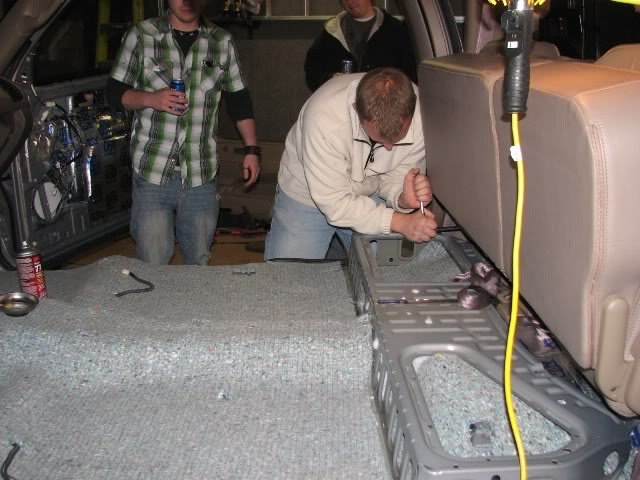
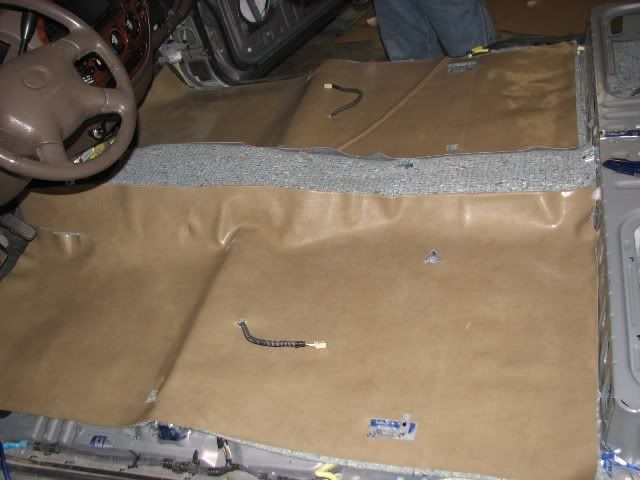
here is how i made substantial improvements in reducing road noise while spending very little money. (friend's truck)

Tundradeadening028.jpg


Tundradeadening029.jpg


we also sealed up the doors and used Fatmat for added mass on the sheet metal. That was as much as he wanted to spend.

http://www.caraudio.com/forums/car-audio-build-logs-cars-trucks-suvs/531921-2002-toyota-tundra-access-cab-center-console-sub.html

 
Activity
No one is currently typing a reply...
Old Thread: Please note, there have been no replies in this thread for over 3 years!
Content in this thread may no longer be relevant.
Perhaps it would be better to start a new thread instead.

About this thread

jockhater2

10+ year member
CarAudio.com Veteran
Thread starter
jockhater2
Joined
Location
Saukville, WI
Start date
Participants
Who Replied
Replies
51
Views
6,119
Last reply date
Last reply from
keep_hope_alive
IMG_20260506_140749.jpg

74eldiablo

    May 22, 2026
  • 0
  • 0
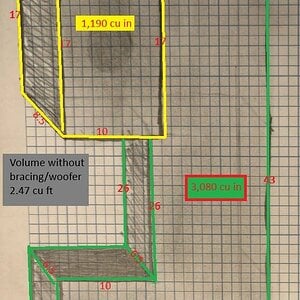
design.jpeg

WNCTracker

    May 22, 2026
  • 0
  • 0

New threads

Top