Here are some examples of why not to think they are fragile-
IE.1-
User has always ran 1ohm stable amps their whole life and now there's a new amp on the block. It's getting awesome reviews on performance. He buys it and damages it.. This particular amp was 2ohm stable only. Not knowing that would be the case, he assumed it was 1ohm stable without doing research.
Many companies do not make 1ohm stable amps and many do not make amplifiers capable of being used continuously below 1ohm either.
IE.2-
User has always ran 18v because all the big amplifiers are 18v capable. He gets a large amplifier and cooks it instantly! This particular amplifier was no where near 18v capable. There are operating conditions users must understand prior to installation!
IE.3-
User has always mounted his amplifier(s) on his speaker box without issue. His new amp he got damaged within days of doing the same... Not every amplifier is (over)built to withstand cyclic vibrational abuse. No amplifier is completely resistant of it but some are more susceptible of damage from it.
Ok, now that I have the definition laid out for Proper Operating Conditions, lets look at them now-
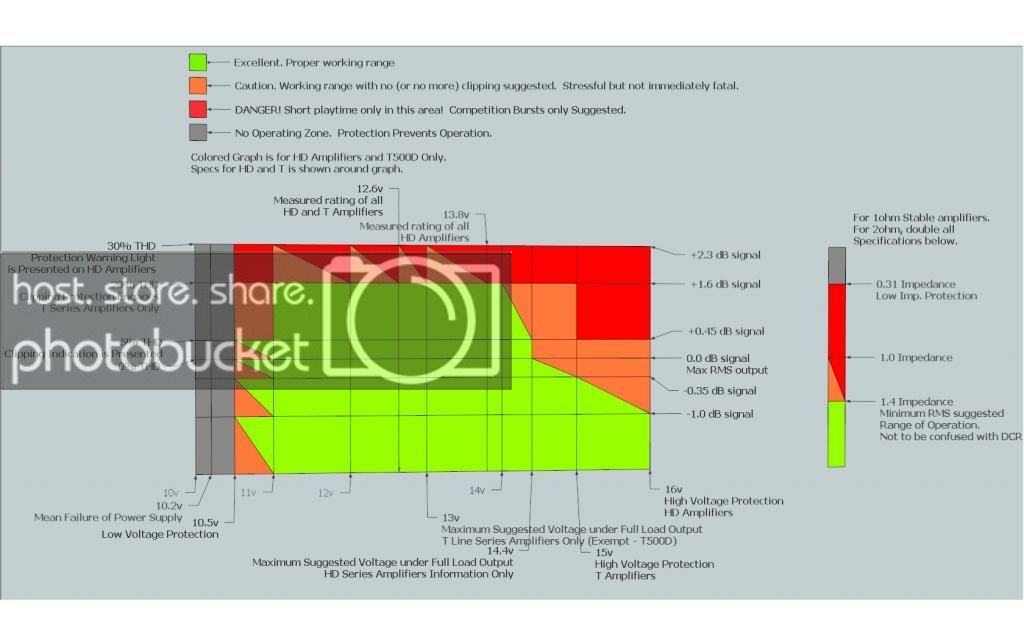
This is for HD amplifiers first, then i'll show the picture.
HD amplifiers-
Ohm Stability capability-
Do not wire Below the Nominal(Impedance, not resistance) ohm value the amplifier is rated for.
For competition, this is fine for BURPS only. Sustained or repetitive burps are not suggested!
Reason- These amplifiers are not overbuilt to withstand that kind of abuse hence the radical low price for high power.
DC Voltage working range-
Power Supply- 10.2v - 16.0v
Protection Range- 10.5v - 16.0v)
(That means physical range is 10.5 - 16.0v)
Operating Working Range under 100% signal output-
(this is maximum output until clipping and any % of distortion afterwords)
10.5v- 14.4v
Reason-
These amplifiers use what you could call a rail booster which ramps up the voltage internally to provide enormous amount of power and efficiency below 14.4v. This works wonders for people who cannot sustain alternator voltage who always charge higher than 14.4v.
The only downside to that, in a sense, is if the user CAN sustain charging voltage higher than 14.4v to power the entire amplifier system under maximum load, then it will put too much added stress to the amplifier overtime and eventually damage it.
There are only about 10,000 ways to lower voltage a few tenths even if charging sustained at 15.5v once power gets to the amplifier at full load!
Remember, we are not talking about DC voltage above 14.4v at all times. ONLY when the signal is at maximum potential and especially clipping over 14.4v. More detailed illustration below in graph.
Cyclic Vibrational Capabiity(mounting amp on box or wall)-
Poor
Reason- The weight of the amplifier is very light, for one, making is susceptible to not have a way to resist cyclic resonances and cyclic vibrations. Another reason is the single large transformer. This puts much added weight to the board compared to many smaller ones.
We get asked sometimes if the amplifier can't accept vibrations then how will it ever survive in a car driving down the road?
Simple answer- That is NOT cyclic!
We have never seen mirrors fall off, panels crack, wood split, steel bend, glass shatter, etc from driving down the road. But what does cause that is cyclic resonances and vibrations. Do not mount these amplifiers onto a surface or one attached to the box or wall to resist these problems.
What does the impedance graph on the right actually mean?
Answer-
Do not wire speaker setup to an amplifier where it's Nominal rated impedance is lower than the rating of the amplifier.
IE- Dual 2ohm may typically be dual 1.4(1.4 being Resistance, not impedance)
Dual 2ohm in this case is 1ohm nominal or also 0.7 DCR(Direct Current Resistance)
The graph above indicates ACTUAL Impedance the amplifier sees during play!
That means it's suggested to maintain above 1.4ohms actual Impedance(not resistance) for longterm output. Sometimes a or more frequencies can dip below 1.4 but this is fine because when wiring to a proper nominal load, Actual impedance below 1.4ohms will not be sustained or in the range of your average impedance curve.





 most i will ever try to get out of it is 3200w and my electrical will be 275ah in battery and a 270a alt //content.invisioncic.com/y282845/emoticons/biggrin.gif.d71a5d36fcbab170f2364c9f2e3946cb.gif






