hockeytoker
10+ year member
Senior VIP Member
Most audio equipment dies for one simple reason. Most people push their equipment beyond its limits. Whether it is the amplifier, subwoofer or full range speakers, clipping is the number one cause of failure. To prevent clipping, use this tutorial.
To figure out what voltage you should set the gains to, multiply the RMS power of the amplifiers output by the impedance of the speaker, then find the square root of that number. If you are using an amplifier that has an RMS rating of more than your speaker(s) can handle/rated for, then use the RMS rating of the speaker (instead of the RMS of the amplifier) to determine the voltage to set your amp to. This is also referred to as gaining down.
Gain Setting Equation
Voltage of the output = sqrt(RMS Power X impedance of the speaker)
Example
Say the amp provides 100WRMS into a 4 ohm speaker:
Voltage = sqrt(100W X 4 ohms)
Voltage = sqrt(400W*ohms)
Voltage = 20V
Again, that was only an example, use the ratings of your amp to figure that out.
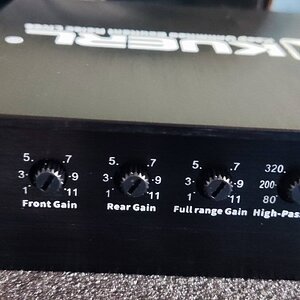
Setting the Gain(s)
To set the gain(s), you need two things:
1. A DMM (digital multi-meter) that is capable of measuring AC voltage (needs to be able to measure up to a range of 200V).
2. A test tone CD to use to set the gains at the correct setting.
Now, to set the gain(s):
1. Start the vehicle, and pop the test tone CD in the head unit.
2. DO NOT hook up the sub(s) or speaker(s) to the amplifier while doing this, just leave the outputs unused at this time.
3. Now, time to set up the head unit.
a. If the loudest you listen to your music at on a regular basis is 22/35 with bass @ +3 and treble @ 0 with MX (or any other sound processor) on, use those settings. NEVER turn the headunit above 3/4 of the maximum volume.
b. Remember to have the car turned on.
c. If you want to use bass boost on a sub amp, set it prior to setting the gains on the amp and use the center frequency of the bass boost (45 Hz for most amps) as your test tone.
d. Please remember that if you have a subwoofer volume control on the headunit and/or a bass knob for the amplifier, set it to the maximum before you set the gains on the sub amp.4. Take the leads from the DMM and but them on the outputs from the amp.
5. Set the gain so that the outputs of the amplifier equal the voltage you found above. This is a MUST.
Here is where you can download some test tones for system testing/gain setting:
http://www.ronelmm.com/tones/
http://www.eminent-tech.com/music/multimediatest.html
For test tones higher than 80Hz, download this program and you can create your own:
Adobe Audition Trial Version
It is best to use 50 Hz tone for a sub amp (unless you have bass boost, use the frequency that is boosted as the tone), and a 1kHz tone for a full-range amp.
This is a good way to set the gains, but if you have access to an oscilloscope, by all means use it. Then you can set the gains to their absolute maximum as you can see when the amplifier clips.
If you are wondering what exactly clipping is, and what it looks like, read this:
http://www.bcae1.com/2ltlpwr.htm
If you have any questions about this, post up, I'll try my best to answer them.
Also, remember a sub can only handle what it can, if you set the amp to its RMS you have to remember that the sub can handle only so much. It is box dependant, but it is best if you are not experienced to follow the manufacturers recommendations.
hope this helps all u guys.
To figure out what voltage you should set the gains to, multiply the RMS power of the amplifiers output by the impedance of the speaker, then find the square root of that number. If you are using an amplifier that has an RMS rating of more than your speaker(s) can handle/rated for, then use the RMS rating of the speaker (instead of the RMS of the amplifier) to determine the voltage to set your amp to. This is also referred to as gaining down.
Gain Setting Equation
Voltage of the output = sqrt(RMS Power X impedance of the speaker)
Example
Say the amp provides 100WRMS into a 4 ohm speaker:
Voltage = sqrt(100W X 4 ohms)
Voltage = sqrt(400W*ohms)
Voltage = 20V
Again, that was only an example, use the ratings of your amp to figure that out.
Setting the Gain(s)
To set the gain(s), you need two things:
1. A DMM (digital multi-meter) that is capable of measuring AC voltage (needs to be able to measure up to a range of 200V).
2. A test tone CD to use to set the gains at the correct setting.
Now, to set the gain(s):
1. Start the vehicle, and pop the test tone CD in the head unit.
2. DO NOT hook up the sub(s) or speaker(s) to the amplifier while doing this, just leave the outputs unused at this time.
3. Now, time to set up the head unit.
a. If the loudest you listen to your music at on a regular basis is 22/35 with bass @ +3 and treble @ 0 with MX (or any other sound processor) on, use those settings. NEVER turn the headunit above 3/4 of the maximum volume.
b. Remember to have the car turned on.
c. If you want to use bass boost on a sub amp, set it prior to setting the gains on the amp and use the center frequency of the bass boost (45 Hz for most amps) as your test tone.
d. Please remember that if you have a subwoofer volume control on the headunit and/or a bass knob for the amplifier, set it to the maximum before you set the gains on the sub amp.4. Take the leads from the DMM and but them on the outputs from the amp.
5. Set the gain so that the outputs of the amplifier equal the voltage you found above. This is a MUST.
Here is where you can download some test tones for system testing/gain setting:
http://www.ronelmm.com/tones/
http://www.eminent-tech.com/music/multimediatest.html
For test tones higher than 80Hz, download this program and you can create your own:
Adobe Audition Trial Version
It is best to use 50 Hz tone for a sub amp (unless you have bass boost, use the frequency that is boosted as the tone), and a 1kHz tone for a full-range amp.
This is a good way to set the gains, but if you have access to an oscilloscope, by all means use it. Then you can set the gains to their absolute maximum as you can see when the amplifier clips.
If you are wondering what exactly clipping is, and what it looks like, read this:
http://www.bcae1.com/2ltlpwr.htm
If you have any questions about this, post up, I'll try my best to answer them.
Also, remember a sub can only handle what it can, if you set the amp to its RMS you have to remember that the sub can handle only so much. It is box dependant, but it is best if you are not experienced to follow the manufacturers recommendations.
hope this helps all u guys.