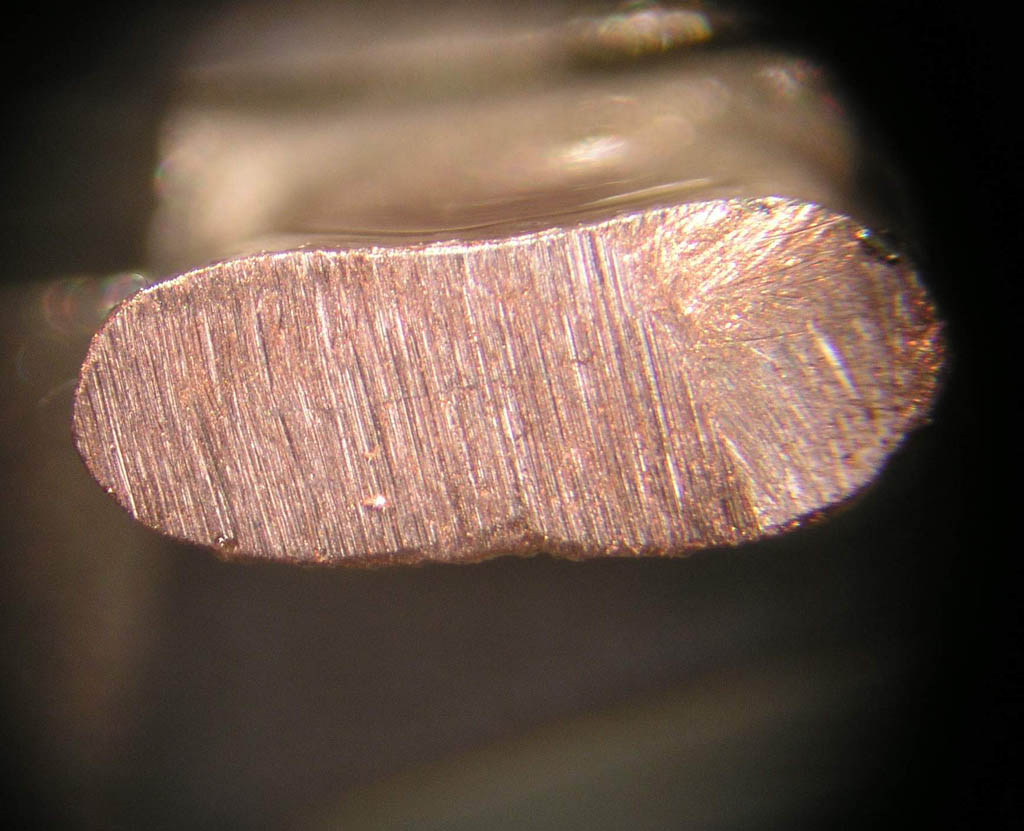
Cutting Knu 1/0 gauge

My razor/knife combo works well on all wires.... I can cut through some hyperflex in a few seconds. When you put the terminal on the wire, try to twist and force every little wire into the bottom of the terminal, then twirl it until all the wires are in. Then you take a hammer and crimp one side at a time, making sure they dig into the wires, then you can solder/tape/ etc.
I had tried this and it was ok but I had to make more than one cut instead of a flush slice although the cut copper comes out with the straightest edge. I have had the best luck slightly twisting a small portion of the wire just before the stripped section, it tightens the strands up nice and even, just enough to slip in the terminal. One idea I had was to dull out the cutting edges of an old pair of bolt cutters, just enough so that it is able to crush the metal without cutting or indenting it. I crimp just enough to get a non-slip grip on the wire, few taps with a hammer, then flux and solder. I hate shitty solder joints, drives me //content.invisioncic.com/y282845/emoticons/crazy.gif.c13912c32de98515d3142759a824dae7.gif

 
from this thread:http://www.caraudio.com/forum/showthread.php?t=383831&highlight=cutting

40507.gif
cool im about to get one of thoose. i need to cut 50+ ft of it and crimp and all that good shit. will be allot easier then the knife i use. there is a harbor freight kinda close to me. ill just go pick it up.

 
Harbor freight sells nothing but JUNK!!! I was dumb enough to buy a wheel puller (bent the first time I used it) and a ball joint fork (when I was using it for the first time, the end that I was hitting with the hammer was mushrooming at an amazing rate, and not only that, but the steering parts on my truck were putting groves in the fork end.) I will never go back there again. Do yourself a favor and go buy a decent pair of cutters and you will be able to use them more than once. Unless you don't mind buying throw away tools.

 
Harbor freight sells nothing but JUNK!!! I was dumb enough to buy a wheel puller (bent the first time I used it) and a ball joint fork (when I was using it for the first time, the end that I was hitting with the hammer was mushrooming at an amazing rate, and not only that, but the steering parts on my truck were putting groves in the fork end.) I will never go back there again. Do yourself a favor and go buy a decent pair of cutters and you will be able to use them more than once. Unless you don't mind buying throw away tools.
a lot of their shit is just that....shit. but from my experience the pittsburg wrench set and this cutter i have work just fine. i have gotten some shit *** tools from there, but you have to make a decision on quality before you buy. but like i said, the $5 cutters i have work great.

zomg. $5 pair of cutters and SOLDERING IS A BAAADDDD way of making the connection. period.
why is that?

 
zomg. $5 pair of cutters and SOLDERING IS A BAAADDDD way of making the connection. period.
ide like to know why as well . im no rocket scientist but wouldn't soldering provide you with the best connection possible between the with and the terminal .therefore creating less resistance between the terminal and the wire.

 
i love this part! i worked in wire manufacturing plans and the NPI department so understand i may know more about this specific aspect of CA then some honkey ca installer. Also i'd love someone to prove me wrong //content.invisioncic.com/y282845/emoticons/wink.gif.608e3ea05f1a9f98611af0861652f8fb.gif

A properly crimped connection will NOT be flexible in the area of electrical contact. The wire within the crimp should form a "gas tight" seal between the strands and the connector. Solder will not flow into this area so it will not enhance the connection mechanically or electrically. Solder will NEVER form a 100% gas tight connection unlike a crimp. Another problem with solder is that is will bond the wire strands outside the crimp and lead to premature mechanical failure unless it is supported. Capillary action will draw solder quite a distance up the stranding of the wire and turn it into solid wire, which is a no-no in any environment, especially a car. Yes you can "support" it, but what does that mean - the support would have to consist of something that would prevent the stranded part of the wire from flexing at the point where it becomes "solid" due to entrained solder. where is that point exactly? no one knows unless you open up the wire. Then you need a heavy piece of heavy rubber to be a strain relief as heart shrink sure isn't a stress reliever. soldering just adds problems into the equation as well as being slower, harder, and more unreliable.

Since it will not enhance the connection in any way shape or form I see no reason to solder as it only can make the wire more prone to failure, takes longer, worse connection, etc.

ABYC standards:

(E-11.16.3.7), “Solder shall not be the sole means of mechanical connection in any circuit”.

"Solderless crimp on connectors shall be attached with the type of crimping tools designed for the connector used, and that will produce a connection meeting the requirements of E-11.16.3.3.” 11.16.3.8."

The reason why crimping is by far the superior method of making a good electrical connection is that a properly compressed connection (that means, the right tool, for the right size connector and the right pressure applied to the crimp) will make the wires & connector pretty much become one. Some people refer to this as a "cold weld"

This is what a proper crimp looks like if you cut it in half

http://www.aeroelectric.com/articles/CrimpTools/GL.jpg

GL.jpg


Note that there are no voids in the wire grip area for either terminal. If I had a better polishing tool, you would be able to see individual strands captured in the terminal wire grip barrel. The 500 microinch or so thickness of tin plating on each strand would be visible as squashed ovals traced in the copper surface. As you can see, the wires & connector become one. It eliminates all voids between wires, thus keeping any air out. This prevents corrosion, which is the #1 problem in electrical connections. Corrosion increases the resistance of the connection, which obviously is BAD.

Check out this article "This is NOT a crimper"...good information

http://www.terminaltown.com/Pages/Page7.html

This one also has a lot of good information.

http://www.aeroelectric.com/articles...rimptools.html

While soldering does "seal" most of the connection area, mechanically, it is a fairly weak connection, especially with all the vibrations of a car, which add to crimping being better. Another real problem with soldering and why the ABYC code recommends crimping over it is that in the case of a circuit or wire with high electrical loads, the solder can often heat up enough to soften... combine that with wires that are vibrating... you can get a loose hot live wire inside a car... that's bad. A crimped connection, done properly, isn't ever going to come apart.

At the end of the day, there is 0 advantage to soldering, as a crimped connector is better electrically and mechanically, oh and easier and quicker to do to boot.

also most shops use the wrong kind of solder which makes it even worse to use it. again no reason at all to solder.

any shop that doesn't crimp their connectors or fuse their big 3 stay the **** away from as they are hacks and don't know even the basics of car audio. let alone anything advanced.

edit: For anyone who doesn't want to believe all the info i posted above chew on this: look at how high end manufacturers make their connections, Bentley, Ferrari, Mercedez, etc. all crimped. period. How connections on boats or planes are made, again ALL CRIMPS. no exceptions. go ask any ME/EE what is better. I come from a background of Wire Manufacturing for one of the largest at the time, companies in that field. Everything was crimped. Before anyone says soldering is fine try and back it up with some facts which dispute what i posted above. otherwise QFT. I don't mean to be a jerk but this is basic 101 shit. I'm no car audio guru but i know how to make a simple connection the RIGHT way.

 
very informative i guess you learn some thing new every day. but as far a terminals i always use the copper terminals i think their made by bussman or some thing like that

 
Somebody should start a debate thread or sticky this guy's post if it's true.

i love this part! i worked in wire manufacturing plans and the NPI department so understand i may know more about this specific aspect of CA then some honkey ca installer. Also i'd love someone to prove me wrong //content.invisioncic.com/y282845/emoticons/wink.gif.608e3ea05f1a9f98611af0861652f8fb.gif
A properly crimped connection will NOT be flexible in the area of electrical contact. The wire within the crimp should form a "gas tight" seal between the strands and the connector. Solder will not flow into this area so it will not enhance the connection mechanically or electrically. Solder will NEVER form a 100% gas tight connection unlike a crimp. Another problem with solder is that is will bond the wire strands outside the crimp and lead to premature mechanical failure unless it is supported. Capillary action will draw solder quite a distance up the stranding of the wire and turn it into solid wire, which is a no-no in any environment, especially a car. Yes you can "support" it, but what does that mean - the support would have to consist of something that would prevent the stranded part of the wire from flexing at the point where it becomes "solid" due to entrained solder. where is that point exactly? no one knows unless you open up the wire. Then you need a heavy piece of heavy rubber to be a strain relief as heart shrink sure isn't a stress reliever. soldering just adds problems into the equation as well as being slower, harder, and more unreliable.

Since it will not enhance the connection in any way shape or form I see no reason to solder as it only can make the wire more prone to failure, takes longer, worse connection, etc.

ABYC standards:

(E-11.16.3.7), “Solder shall not be the sole means of mechanical connection in any circuit”.

"Solderless crimp on connectors shall be attached with the type of crimping tools designed for the connector used, and that will produce a connection meeting the requirements of E-11.16.3.3.” 11.16.3.8."

The reason why crimping is by far the superior method of making a good electrical connection is that a properly compressed connection (that means, the right tool, for the right size connector and the right pressure applied to the crimp) will make the wires & connector pretty much become one. Some people refer to this as a "cold weld"

This is what a proper crimp looks like if you cut it in half

http://www.aeroelectric.com/articles/CrimpTools/GL.jpg

GL.jpg


Note that there are no voids in the wire grip area for either terminal. If I had a better polishing tool, you would be able to see individual strands captured in the terminal wire grip barrel. The 500 microinch or so thickness of tin plating on each strand would be visible as squashed ovals traced in the copper surface. As you can see, the wires & connector become one. It eliminates all voids between wires, thus keeping any air out. This prevents corrosion, which is the #1 problem in electrical connections. Corrosion increases the resistance of the connection, which obviously is BAD.

Check out this article "This is NOT a crimper"...good information

http://www.terminaltown.com/Pages/Page7.html

This one also has a lot of good information.

http://www.aeroelectric.com/articles...rimptools.html

While soldering does "seal" most of the connection area, mechanically, it is a fairly weak connection, especially with all the vibrations of a car, which add to crimping being better. Another real problem with soldering and why the ABYC code recommends crimping over it is that in the case of a circuit or wire with high electrical loads, the solder can often heat up enough to soften... combine that with wires that are vibrating... you can get a loose hot live wire inside a car... that's bad. A crimped connection, done properly, isn't ever going to come apart.

At the end of the day, there is 0 advantage to soldering, as a crimped connector is better electrically and mechanically, oh and easier and quicker to do to boot.

also most shops use the wrong kind of solder which makes it even worse to use it. again no reason at all to solder.

any shop that doesn't crimp their connectors or fuse their big 3 stay the **** away from as they are hacks and don't know even the basics of car audio. let alone anything advanced.

edit: For anyone who doesn't want to believe all the info i posted above chew on this: look at how high end manufacturers make their connections, Bentley, Ferrari, Mercedez, etc. all crimped. period. How connections on boats or planes are made, again ALL CRIMPS. no exceptions. go ask any ME/EE what is better. I come from a background of Wire Manufacturing for one of the largest at the time, companies in that field. Everything was crimped. Before anyone says soldering is fine try and back it up with some facts which dispute what i posted above. otherwise QFT. I don't mean to be a jerk but this is basic 101 shit. I'm no car audio guru but i know how to make a simple connection the RIGHT way.
 
Activity
No one is currently typing a reply...
Old Thread: Please note, there have been no replies in this thread for over 3 years!
Content in this thread may no longer be relevant.
Perhaps it would be better to start a new thread instead.

About this thread

MkKin420

10+ year member
Senior VIP Member
Thread starter
MkKin420
Joined
Location
Ohio
Start date
Participants
Who Replied
Replies
40
Views
5,928
Last reply date
Last reply from
MustangGT25YRS
IMG_20260513_214311575.jpg

ThxOne

    May 13, 2026
  • 0
  • 0
IMG_20260513_213956814.jpg

ThxOne

    May 13, 2026
  • 0
  • 0

New threads

Top