Big 3 Wire question??

ohh ok so that would be considered the chassis to engine block? and the battery negative to engine block can they use the same grounding point? or do i have to find a different ground point for each?

 
I might have screwed up mine then. I did battery + to alt +, battery negative to chassis, and engine block to chassis/frame. From my research it seems there is more than one way.
YouTube video of mine...

Big three upgrade, 03 grand marquis:


Thats what I was thinking of doing at the beginning but then people mentioned the batt - to alt - and then I got confused .. Im thinking of just doin batt+ to alt+, batt- to chassis, and engine block to chassis .. Did that help your car?

 
the alternator is what generates electricity on your viechle. that single piece is what is important to get the best ground possible to.

the alternator is attached to the engine by brackets and bolts so it is perfectly acceptable to ground the engine to the frame of the car - the alternator is attached to the engine and will benefit from this connection

BUT

it is in my opinion that it is better to use a negative 1/0 ground wire attachment directly to the alternator casing itself to provide the most direct route of negative electrical flow with the least amount of restrictions possible.

if you ground your engine block to the frame of the car - then for the negative ground electrical current from your alternator must travel thru the bolts that hold the alternator in place - thru the brackets that hold the alternator to the engine block - thru those bolts going thru the bracket in to the engine block - and then finaly thru the engine block itself to the copper 1/0 wire you added to frame or battery negative ground. then thru the frame it self to your other connection of 1/0 wire going up to your battery negative terminal = that right there is alot of diffrent pieces and connections that need to flow the negative electrical to make it back to battery negative

think of your self as the negative electrical flow in your viechle. now find and travel the path you must take starting at your alternator casing and finaly end up at the battery negative terminal. wouldnt it be so much eazier nicer and less restrictive if you had a nice 1/0 copper wire directly attaching the alternator casing and ending up at battery negative ? thats only 2 connections to flow thru and a nice conductive piece of large guage wire....

idk maby im silly with it - but thats just me... and my theory and opinions on it.

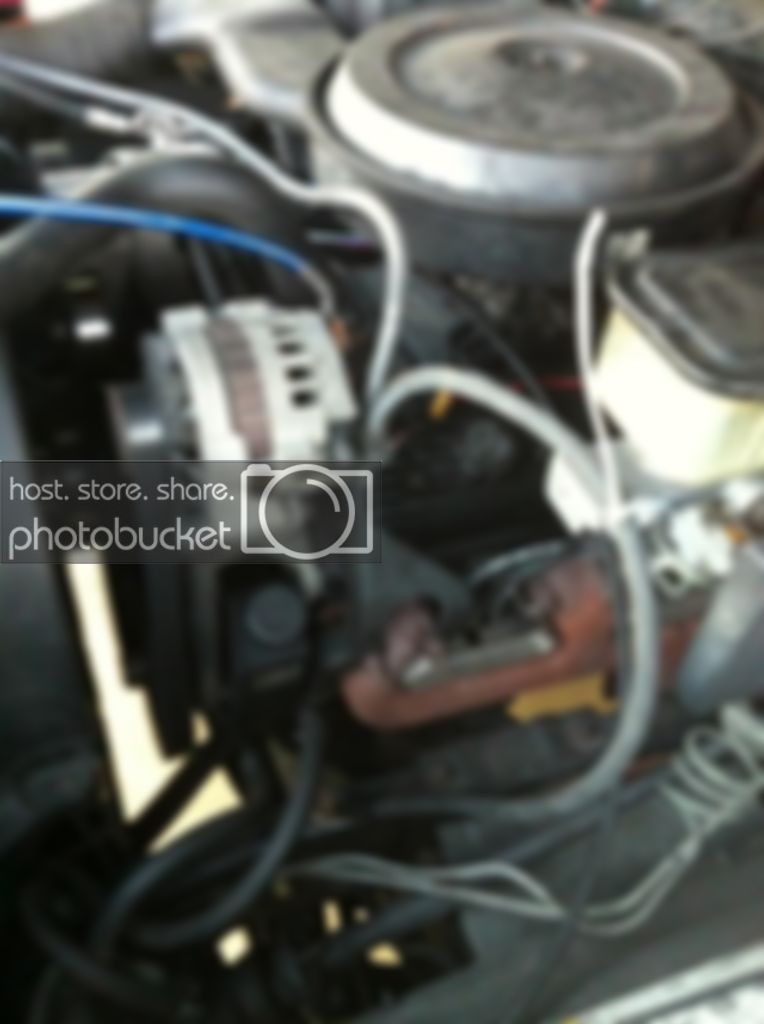
ignore the 4 guage blue power wire on this photo - i replaced it with red 1/0 when i finaly got the propper size anl fuzes and fuze blocks...

but this picture shows my negative run. starting at the battery negative - it runs over to a bolt that holds the alternator in place - and since im using the dual 1/0 wire terminal blocks - i used the other wire coming directly off of that to jump over and down and mount directly on my frame rail.


 
Thats what I was thinking of doing at the beginning but then people mentioned the batt - to alt - and then I got confused .. Im thinking of just doin batt+ to alt+, batt- to chassis, and engine block to chassis .. Did that help your car?
Yeah it helped at first when I was still running two amps. My sub amp really "woke up"

But since I added a third amp my headlights dim with the volume anywhere above 1/3 of max volume. Now I'm just gonna add matching batteries. One under hood and one in trunk. My car has a stock 130 amp alternator already, and I'm only running about 1300 watts RMS.

 
the alternator is what generates electricity on your viechle. that single piece is what is important to get the best ground possible to.the alternator is attached to the engine by brackets and bolts so it is perfectly acceptable to ground the engine to the frame of the car - the alternator is attached to the engine and will benefit from this connection

BUT

it is in my opinion that it is better to use a negative 1/0 ground wire attachment directly to the alternator casing itself to provide the most direct route of negative electrical flow with the least amount of restrictions possible.

if you ground your engine block to the frame of the car - then for the negative ground electrical current from your alternator must travel thru the bolts that hold the alternator in place - thru the brackets that hold the alternator to the engine block - thru those bolts going thru the bracket in to the engine block - and then finaly thru the engine block itself to the copper 1/0 wire you added to frame or battery negative ground. then thru the frame it self to your other connection of 1/0 wire going up to your battery negative terminal = that right there is alot of diffrent pieces and connections that need to flow the negative electrical to make it back to battery negative

think of your self as the negative electrical flow in your viechle. now find and travel the path you must take starting at your alternator casing and finaly end up at the battery negative terminal. wouldnt it be so much eazier nicer and less restrictive if you had a nice 1/0 copper wire directly attaching the alternator casing and ending up at battery negative ? thats only 2 connections to flow thru and a nice conductive piece of large guage wire....

idk maby im silly with it - but thats just me... and my theory and opinions on it.


wow you beat me to it.

guys read this^^^^^^^^^^^^ great right up...

and thats how i do it also. all my grounds go to the BACK OF THE ALT. not the engine itself.

so battery to back of alt.

back of alt. to frame or body or both. i did both. but if your car is a unibody well you have no frame.

 
the alternator is what generates electricity on your viechle. that single piece is what is important to get the best ground possible to.the alternator is attached to the engine by brackets and bolts so it is perfectly acceptable to ground the engine to the frame of the car - the alternator is attached to the engine and will benefit from this connection

BUT

it is in my opinion that it is better to use a negative 1/0 ground wire attachment directly to the alternator casing itself to provide the most direct route of negative electrical flow with the least amount of restrictions possible.

if you ground your engine block to the frame of the car - then for the negative ground electrical current from your alternator must travel thru the bolts that hold the alternator in place - thru the brackets that hold the alternator to the engine block - thru those bolts going thru the bracket in to the engine block - and then finaly thru the engine block itself to the copper 1/0 wire you added to frame or battery negative ground. then thru the frame it self to your other connection of 1/0 wire going up to your battery negative terminal = that right there is alot of diffrent pieces and connections that need to flow the negative electrical to make it back to battery negative

think of your self as the negative electrical flow in your viechle. now find and travel the path you must take starting at your alternator casing and finaly end up at the battery negative terminal. wouldnt it be so much eazier nicer and less restrictive if you had a nice 1/0 copper wire directly attaching the alternator casing and ending up at battery negative ? thats only 2 connections to flow thru and a nice conductive piece of large guage wire....

idk maby im silly with it - but thats just me... and my theory and opinions on it.

ignore the 4 guage blue power wire on this photo - i replaced it with red 1/0 when i finaly got the propper size anl fuzes and fuze blocks...

but this picture shows my negative run. starting at the battery negative - it runs over to a bolt that holds the alternator in place - and since im using the dual 1/0 wire terminal blocks - i used the other wire coming directly off of that to jump over and down and mount directly on my frame rail.

So batt pos to alt pos, batt neg to chassis, batt neg to alt neg, and alt neg to chassis??

 
Yeah it helped at first when I was still running two amps. My sub amp really "woke up"
But since I added a third amp my headlights dim with the volume anywhere above 1/3 of max volume. Now I'm just gonna add matching batteries. One under hood and one in trunk. My car has a stock 130 amp alternator already, and I'm only running about 1300 watts RMS.
Oh ok thanks man, do you think my car could handle 1100rms with the stock 80 amp alt? Im thinking of just running 800 rms instead

 
There's a reason thousands of people and all the auto makers do alt + to Battery +, Battery- to motor and motor to chassis. I' am just saying...I also think that you might need an alt upgrade even at 800 rms.

 
simple drawing for anyone still not 100% shure what to do


and why not - my singer 320amp hairpin /6phase alternator came in today yay ! expecting 200 to 220 amps at engine idle speed

and the bench test says 328amps at 1800 rmp HOT //content.invisioncic.com/y282845/emoticons/smile.gif.1ebc41e1811405b213edfc4622c41e27.gif so thats a pretty realistic number for what to expect under the hood.


im running 360 amp hours worth of reserve batterys - and this 320 alt my system can handle 4000 watts total no sweat all day every day

if swap out my ddm2a amp and put in the ddm3a then my total system capacity raised to about 5500 watts total with mids n highs amps thats right about the borderline of what i can do with my current battery reserve bank - and teetering on the edege of needing another 100 amp hour agm battery in the back for that amount of wattage.

just cool food for thoughts... most people dont plan out systems before building them / total math / calculations / requirments of this vs that vs efficency and loss

everything can be mapped out and plotted on a graph for requirments and real world needs. its not terrible to figure out

 
simple drawing for anyone still not 100% shure what to do

and why not - my singer 320amp hairpin /6phase alternator came in today yay ! expecting 200 to 220 amps at engine idle speed

and the bench test says 328amps at 1800 rmp HOT //content.invisioncic.com/y282845/emoticons/smile.gif.1ebc41e1811405b213edfc4622c41e27.gif so thats a pretty realistic number for what to expect under the hood.


im running 360 amp hours worth of reserve batterys - and this 320 alt my system can handle 4000 watts total no sweat all day every day

if swap out my ddm2a amp and put in the ddm3a then my total system capacity raised to about 5500 watts total with mids n highs amps thats right about the borderline of what i can do with my current battery reserve bank - and teetering on the edege of needing another 100 amp hour agm battery in the back for that amount of wattage.

just cool food for thoughts... most people dont plan out systems before building them / total math / calculations / requirments of this vs that vs efficency and loss

everything can be mapped out and plotted on a graph for requirments and real world needs. its not terrible to figure out
Oh ok thats pretty clear now, Ive always thought itd be a bad idea to run the neg from the amp to the batt negative

 
Oh ok thats pretty clear now, Ive always thought itd be a bad idea to run the neg from the amp to the batt negative
copper wire will flow negative electrical current alot nicer than steel frame rails / or unibody structure

nobody wants to spend that money on a long expensive dedicated 1/0 negative wire run when it can be pawned off to a frame rail

but think about it - do you want to feed your amp electricity with a baby spoon or a gigantic soup ladel ?

everyone uses nice thick copper wire for the positive side of things - but then use a crappy unibody structure or a 10+ year old frame rail to carry the negative flow of things all the way back up front to battery negative..... its similar to a pirate with a wooden peg leg trying to run a race. one leg ( + ) of the system is good - the other leg ( - ) of the system is no where near as effective as the first. but to be a complete system they both must function and count on eachother to do work.

your system is only as strong as its weakest link.

also in my system - my runs of positive and negative to the rear go to the back battery bank. then the amps are wired from the back battery bank + and -

please excuse my messy wiring back there - im in the process of moving stuff around still


Activity
No one is currently typing a reply...
Old Thread: Please note, there have been no replies in this thread for over 3 years!
Content in this thread may no longer be relevant.
Perhaps it would be better to start a new thread instead.

About this thread

Thread starter
ThinnestShark11
Joined
Location
Porterville, CA
Start date
Participants
Who Replied
Replies
34
Views
2,961
Last reply date
Last reply from
C1500martin
IMG_20260516_193114554_HDR.jpg

sherbanater

    May 16, 2026
  • 0
  • 0
IMG_20260516_192955471_HDR.jpg

sherbanater

    May 16, 2026
  • 0
  • 0

New threads

Top