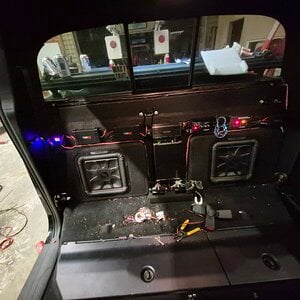
For Those Who Refuse to Fuse:
Now let's see what will happen if excess current is passed through a small conductor. We will assume that some imaginary piece of wire (we don't want to destroy a real piece of wire) has .01 ohms of resistance (e.g. a 15 foot long piece of 8 gauge wire) and that wire is connected directly to the positive terminal of the battery (without a fuse... that should scare you). Now let's say that the other end of the wire is allowed to touch to the chassis of the vehicle (which, in most vehicles, is connected to the negative terminal of the battery). The two battery terminals are basically shorted together by the wire (through the chassis). In this situation, a very large amount of current will flow through the piece of wire.
If we wanted to calculate the current flow through the wire, we would use the Ohm's law formula I=E/R. If we use the ideal automotive battery, which is rated at 12 volts, and divide it by the resistance of the wire which is approximately .01 ohms, we get a current of 1200 amps.
I = E/R
I = 12/0.01
I = 1200 amps
Then plug the current into the formula P=I^2*R. We get:
P = I2*R
P = (1200*1200)*0.01
P = 14,400 Watts
This shows that the wire would dissipate 14,400 watts of heat which would melt the wire's insulation and more than likely ignite everything that comes in contact with the wire (fuel lines, other wires, carpet, plastic, insulation). In comparison, the largest burner on your electric stove will not put out that much heat on high!.........................................................as ummduh stated ALWAYS FUSE A POWER WIRE......END OF DICUSSION.