
WTF??????? Trying to set gain....

honestly... no idea what that means
It means the "1 ohm" you think your amp sees when you are playing a tone could be anywhere from .8 to 20 ohmsin reality so atempting to calculate power with ONLY a voltage measurement is completely inaccurate.

You should try to tune your box a bit higher and you may be happier with the sound. Porting with PVC or sono tube allows you to easily remove the port and cut it down to tune up a bit... just saying for future reference.

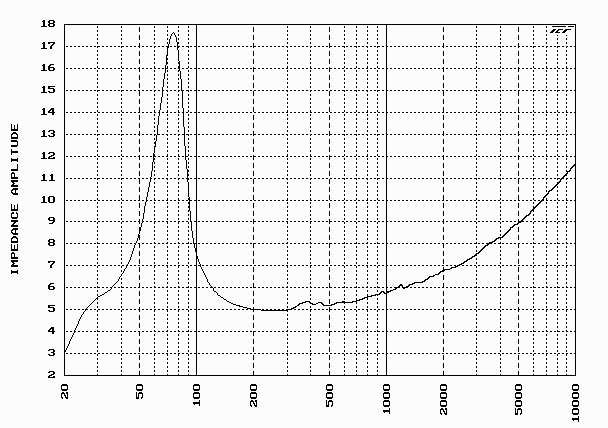
 
The amp may or may not ever even see 1 ohm. Here we see an impedence curve of a woofer (probably 3 ohm DCR coil)
IMAGE1%202.GIF


All subs are different of course, and it'll change depending on the box, but the point is, within useable bandwidth you would never see below 5 ohms. Now this is definitely not to say that you can count on running an amp at half rated impedence and be safe, but to illustrate that ONLY taking into account voltage unless you know precisely the impedence at a given test frequency is a very inaccurate method to set gains. As Wen said, higher frequency will generally put you at a lower impedence...your highest impedence is the Fs of the woofer. In fact if they publish z-max spec you can use that as a known impedence and calculate power at that frequency, but really most amps don't put out gobs of power at 30 or 40 ohms.
Given the fact that we certainly can get a mostly audible flat response with proper box design, impedance rise is not a major concern, not even at resonance. If your box is properly built, and you're hitting close to, or all the way to Xmax, whatever hypothetical or even measured impedance rise is factored into the design demonstrably is not a significant enough impetus to the woofer converting the electrical energy into acoustical energy.

I set my gains via the DMM method, and I also use familiar music with familiar spikes in bass information as I watch for the voltage peaks. So far, the results have been entirely congruent with the theoretic mechanical, electrical, thermal, and acoustical behavior posited by the target RMS power and/or power handling rating of the sub.

If it works every time, why over complicate it with needless factors in the equation, that is, unless you're goals are squeezing every fraction of a decibal out of a particular frequency juxtaposed with a vehicles resonant frequency to get big scores at SPL comps? I'm thinking music reproduction with lots of fun output vs. the science of SPL comps (I wouldn't know where to start with SPL, really).

 
It means the "1 ohm" you think your amp sees when you are playing a tone could be anywhere from .8 to 20 ohmsin reality so atempting to calculate power with ONLY a voltage measurement is completely inaccurate.
You should try to tune your box a bit higher and you may be happier with the sound. Porting with PVC or sono tube allows you to easily remove the port and cut it down to tune up a bit... just saying for future reference.
IMO: With the context here being a single cab truck install, where there is no real cabin gain to boost the first octave, the already terrible sound of a ported box tuned way too high would be all the more exaggerated tuned even higher and would be completely useless as a music playback system. But, that's just me. I stubbornly refuse to tune above 28 hz in any install.

 
Activity
No one is currently typing a reply...
Old Thread: Please note, there have been no replies in this thread for over 3 years!
Content in this thread may no longer be relevant.
Perhaps it would be better to start a new thread instead.

About this thread

JoshC

10+ year member
The Taco MASTA
Thread starter
JoshC
Joined
Location
Houston, tx
Start date
Participants
Who Replied
Replies
32
Views
2,072
Last reply date
Last reply from
Danometal
IMG_20260515_202650612_HDR.jpg

sherbanater

    May 15, 2026
  • 0
  • 0
IMG_20260515_202732887_HDR.jpg

sherbanater

    May 15, 2026
  • 0
  • 0

New threads

Top