RE XXX 15" subs...ANY GOOD????

Above tuning, a ported and a sealed box do not act the same... assuming we are talking about how they affect cone excursion. In a sealed application, as the signal's frequency dips lower, excursion increases. In a vented system, as the signal dips lower, excursion decreases due to getting closer to enclosure tuning.

 
^ Now look an octave above tuning; and consider that ported boxes are typically larger then sealed..

I don't want to make generalizations.. and you really are spot on with what you are trying to convey.. but so is kyle..

 
^ Now look an octave above tuning; and consider that ported boxes are typically larger then sealed..
I don't want to make generalizations.. and you really are spot on with what you are trying to convey.. but so is kyle..
Im not following your point about enclosure size. Yes the ported enclosure is usually about twice the size as its sealed counterpart, but Im not sure what you are meaning to add to the discussion on excursion by mentioning it.

Port efficiency is what gains output for the vented system (obviously), but at the same time is also the force that minimizes cone excursion as the signal frequency comes closer to port tuning. A ported box is twice the size, but the port's air movement is what is adding the resistance to cone motion... again driven by tuning and signal frequency.

 
So if you tune a box for, say, 20 hz, you wouldn't need much cone movement or xmax....right...because cone movement would be minimized....
So is a ported box basically useless for a high excursion driver?
No, because the excursion allows you to 1. play other frequencies above tuning with authority as well, and 2. still is an indicator for the potential for output.

The only way to get louder at a given frequency is to increase cone excursion at that frequency (in a given enclosure). If you are already at your mechanical limits, you obviously cannot do that, so you need more xmax. If you are already at your thermal limits, you can't get louder either (or risk blowing the sub).

If you are reaching your mechanical limits significantly before your thermal limits, your box needs to be smaller (or you need to increase backpressure in some way). If you are reaching your thermal limits before your mechanical limits, you need to increase efficiency by increasing size or decreasing back pressure in some other way. Optimally, you want to be reaching full excursion at the same time you reach the full power handling of the driver, as this is when you are using the full physical potential of the driver.

 
Well, you mentioned that xmax becomes more important with lower and lower frequencies, and less important with higher frequencies. That is a function of the enclosure type it is in not the driver itself, as just the opposite would be true with vented systems, assuming the signal is not allowed to deviate below enclosure tuning.
I take that to be misleading.

the lower you tune your 4th order box, the more displacement the system will ask of the driver at its peak frequency above tuning. If you are arguing about the shape of the displacement curve between sealed and ported, i never said they were the same.

:\

 
Assuming a sealed enclosure type, the speaker will be required to move less in order to reproduce a higher note at a given output level. So as kyle was saying, a speaker with 6mm xmax may very well do better than one with 54mm, at the higher frequencies. Mids and tweeters certainly have less excursion than a XXX, but we know a mid or a tweeter would 'murder' a XXX in the midrange or higher freqs. Clearly other things play a factor besides xmax (which I know you realize, just saying).
There are many home audio and PA speakers whose xmax is appallingly low compared to what we are use to. But they have large cones, are highly efficient, and when mated with the proper enclosure (usually vented to extend LFE) can have outstanding output. People around here ooohhh and awwww when someone mentions that some home audio setups have 18-21" midrange speakers. unheard of to us, obviously. But not that uncommon in other venues. Car audio tends to make the most use of xmax, imo, due to the size limitations of the cone diameters and enclosure sizes expected to fit into a vehicle.

But yes, all other factors being equal, take that same 6mm xmax sub and double its xmax... and its output potential in the lowest octaves increases, in sealed box situations, generally speaking.

Some could argue xbl^2 offers more on paper than in the real world. After all, showing on paper that they produce virtually no audible BL distortion (the distortion type that accounts for the vast majority of distortion a speaker produces) seems VERY impressive. But in the real world, some people actually find they prefer the sound better with the distortion in it. Go figure.

I will argue that XBL^2 or any other linear deign do not have undesirable sound. I dont think anyone here can argue that they like distortion. My theory is that theory like SPL... BIG DIFFERENCE! I mean even in the music industry, CD today are made with very low dynamics because they try to make all the tracks play as loud as possible! people like loud shit.

until someone does a test with identical SP Levels (lower distortion vs higher distortion ) we cant really know that people like distortion because all linear drivers to compromise sensitivity.

 
the lower you tune your 4th order box, the more displacement the system will ask of the driver at its peak frequency above tuning.
I find that to be misleading. //content.invisioncic.com/y282845/emoticons/tongue.gif.6130eb82179565f6db8d26d6001dcd24.gif You make a valid point about tuning comparisons, but that wasn't our topic. Even in your example 4th order box tuned low, as the signal frequency rises, excursion still decreases.
But as you allude to, this is not to say that excursion is meaningless in ported systems (a common misconception). I agree, that's just not the topic we were discussing.

I will argue that XBL^2 or any other linear deign do not have undesirable sound. I dont think anyone here can argue that they like distortion. My theory is that theory like SPL... BIG DIFFERENCE! I mean even in the music industry, CD today are made with very low dynamics because they try to make all the tracks play as loud as possible! people like loud shit.
until someone does a test with identical SP Levels (lower distortion vs higher distortion ) we cant really know that people like distortion because all linear drivers to compromise sensitivity.
"Undesirable" is in the ear of the beholder. //content.invisioncic.com/y282845/emoticons/wink.gif.608e3ea05f1a9f98611af0861652f8fb.gif My comments were simply on the well known fact that many people actually prefer non BL-optimized motor designs. *shrug* Im not one of them, but there are plenty. Alot of people like black licorice too, I cant explain that one either. //content.invisioncic.com/y282845/emoticons/laugh.gif.48439b2acf2cfca21620f01e7f77d1e4.gif
Im not sure what you are posing here Kyle. When you say you think people like SPL rather than dislike distortion, are you suggesting all xbl^2 drivers lack output levels?

"Distortion" comes in more than one form. The even-order distortion exhibited by tube driven amps and pre-amps is often considered pleasing. While the odd-order harmonic distortion we are talking about (BL distortion) is rarely considered as such. Im not seeing the mystery that requires testing.

Usually when someone says they dont like the sound of BL optimized drivers such as xbl^2 enabled units, when questioned deeper they express not a dislike for what they DID hear, but a displeasure for what they DIDNT hear. Its almost always the same, a description that the 'edge' was removed from the sound. Not as 'raw' or 'real', sometimes even called 'unrealistic' sounding (even though technically its more realistic). Hardly anyone is or would say "yeah I like the sound of distortion"... but plenty of people do say something seems missing when a certain amount of it is not present. I lend this to the fact that we so rarely hear music acoustically any more. Think about it, even live concert's are dominated by speakers on both sides of the stage. How often do we hear music that is not being broadcast through speakers? Not very often at all. And certainly not the electrically based instruments used in most popular music today. So our whole lives our ears have been trained to think that distortion should be there. When technology comes along that removes it, our brain tells us it should be there, and that it sounds wrong. Perception over-riding reality.

 
there may be a lot of truth to what you said, this is truly a psychology experiment, rather than a physics experiment, but my guess (theory) whatever you want to call it, is that there are two variables with linear drivers, one the lack of distortion as you suggest, but two, the general lack of sensitivity that is attributed to the linear design. All linear designs are less sensitive in one way or another. Without diving into the math behind that (mind you, i have) You can simply look at the high xmax linear drivers on the market XBL^2 LMS Split Coil, MMAG it doest not matter, they are are pretty pitiful when it comes to sensitivity with a few exceptions that are in the upper 80's. But many of the SPL drivers out there are very efficient so they can often times simply "get louder." Its hard to tell how much of what people like is distortion vs simply higher dB levels. This is why i would encourage for a formal test on the subject.

 
there may be a lot of truth to what you said, this is truly a psychology experiment, rather than a physics experiment, but my guess (theory) whatever you want to call it, is that there are two variables with linear drivers, one the lack of distortion as you suggest, but two, the general lack of sensitivity that is attributed to the linear design. All linear designs are less sensitive in one way or another. Without diving into the math behind that (mind you, i have) You can simply look at the high xmax linear drivers on the market XBL^2 LMS Split Coil, MMAG it doest not matter, they are are pretty pitiful when it comes to sensitivity with a few exceptions that are in the upper 80's. But many of the SPL drivers out there are very efficient so they can often times simply "get louder." Its hard to tell how much of what people like is distortion vs simply higher dB levels. This is why i would encourage for a formal test on the subject.
People can't hear sensitivity, but they can hear distortion, or a lack there of. Who here could sit in a vehicle, listen to a system, and then conclude the sensitivity of the sub? Even just simply that it is high, or low? Nobody, without guessing.
If we are going to get into sensitivity differences, we must consider hoffmans iron law. If we are concluding all BL optimized drivers are inefficient, should we also conclude they all have superior LFE? Or that they all require smaller boxes?

Can you explain what exactly about a BL optimized motor means it must be inefficient. You seem to be implying there is some direct connection between linear excursion, and low efficiency. Since Ive seen Dan Wiggins himself say there is nothing about an xbl^2 motor design that requires it be inefficient, Im curious how you have come to the opposite conclusion.

 
Im not following your point about enclosure size. Yes the ported enclosure is usually about twice the size as its sealed counterpart, but Im not sure what you are meaning to add to the discussion on excursion by mentioning it.
The point is that excursion will only be reduced around tuning for the ported box; and above tuning it could be considerably greater then a sealed box at the same frequency.. (depending on the woofer and box)

Moreover, the statement that Kyle initially made does not only apply to sealed boxes.. //content.invisioncic.com/y282845/emoticons/fyi.gif.9f1f679348da7204ce960cfc74bca8e0.gif

 
The point is that excursion will only be reduced around tuning for the ported box; and above tuning it could be considerably greater then a sealed box at the same frequency.. (depending on the woofer and box)

Moreover, the statement that Kyle initially made does not only apply to sealed boxes.. //content.invisioncic.com/y282845/emoticons/fyi.gif.9f1f679348da7204ce960cfc74bca8e0.gif
I dont believed Ive ever said sealed setups will always have more excursion than ported ones. I said that in a ported setup, the further you deviate from tuning (higher), the more cone excursion you will have. That would seem to dispute Kyle's initial comment about low freqs requiring greater excursion. He's right, if he's talking about a sealed application. For vented systems, just the opposite is true.
If you feel his initial statement also applies to vented systems, contrary to what Ive said, Im listening. //content.invisioncic.com/y282845/emoticons/wink.gif.608e3ea05f1a9f98611af0861652f8fb.gif

 
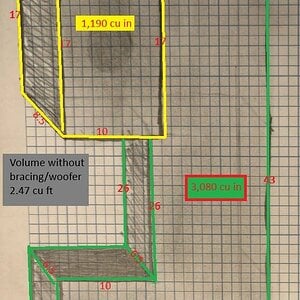
Ive been telling people for a while that RE's enclosure recommendation sizes on the new XXX's are not practical. They are way too small, to fool people into believing these things are more practical for car audio than they really are. Dont get me wrong, they have tons of potential, but not in 4 cubes. I think you would be much happier with a single 15" XXX in 8 cubes than you would two in 4 cubes each.
Their coils cannot handle 10kw. //content.invisioncic.com/y282845/emoticons/biggrin.gif.d71a5d36fcbab170f2364c9f2e3946cb.gif Not even close. Yet another reason you really need to go with a bigger box.
Looks good to me, it's not poppin somke:laugh:


Activity
No one is currently typing a reply...
Old Thread: Please note, there have been no replies in this thread for over 3 years!
Content in this thread may no longer be relevant.
Perhaps it would be better to start a new thread instead.

About this thread

62caddy

10+ year member
Junior Member
Thread starter
62caddy
Joined
Location
Minneapolis
Start date
Participants
Who Replied
Replies
42
Views
17,636
Last reply date
Last reply from
stl_style
design.jpeg

WNCTracker

    May 22, 2026
  • 0
  • 0
IMG_2118.jpeg

WNCTracker

    May 22, 2026
  • 0
  • 0

New threads

Top