OHMs whats it about?

stones
10+ year member

Senior member
For you noobs who don't know heres an explaination.

(In plain english)

An OHM is a measure of resistance/impedance for an electronic device. Every electronic device has a given amount of resistance.

A rating of zero OHMs is a dead short, take a wrench and bridge the + and - terminals on your cars battery to see a dead short in action, lots of sparks and possible damage to your battery. A dead short is when the electrons in the power wire flow with no resistance/impedance, this is bad because it can damage your power supply (and start a fire). The higher the resistance/impedance the fewer electrons will flow.

An electron is what makes up electricity just like water molecules make up water, the speed and volume of the electrons determine the voltage and amperage of the electric current(current = flow of electricity).

A power supply is an object that powers that electronic device. Power supplies don't have OHMs, they rely on the ohms of the electronic divice they power to give them the right amount of resistance/impedance. If you connect your power supply to a device with too little resistance/impedance you overload its capacity of the amount of electrons it can handle at a given time. this is why a 1ohm speaker will not work with an amp that is rated to handle a 4ohm load, it simply demands too much current.

What is a power supply- anything that provides the source of power in the chain EG- Battery, alternator, amplifier these are the power supplys in your car stereo.

In the home- wall outlet, voltage converter in your HT reciever, amplifier in the reciever-those are the power supplies there.

Resistance/Impedance whats the difference?- depends on the way the electronic device uses the current, speakers are rated in impedance because of the way the voice coil works. All in all its not somthing you need to worry about.

Now that you now this you need to learn how to wire up the subs in a such way that they will work within the amplifiers abilities.

Thats called series and parallel wiring.

This is like plumbing, you set up the pipes for the water to flow in certain ways.

If you wire a 2 voicecoils in series you pipe the electrons into one voice coil then out the negative to the other voice coils positive and out its negative before returning to the amps negative terminal. This results in the impedance doubling because the electrons travel through two coils before returning to the negative terminal, if you wire 3 voicecoils in series you triple the impendance, 4 voice coils equal quadruple, see what i mean.

If you parallel 2 voicecoils together you split the flow of electrons between each speaker. This make it twice as easy for the electrons flow from the amplifier and in turn halves the impedance (simplified) so 2 eight ohm voicecoils wired in parralel will equal 4ohms, 2 four ohm voice coils equal 2ohms.

For diagrams showing exactly where the wires need to go look at these diagrams.

http://www.caraudio.com/vb/showthread.php?t=31984

 
It gets really interesting once you get out of audio frequencies, up to radio frequencies //content.invisioncic.com/y282845/emoticons/smile.gif.1ebc41e1811405b213edfc4622c41e27.gif

Most transmitters (and therefore antennas and feedlines) are designed for a 50ohm nominal load - it works the same way as in audio where you try to match the load impedance to the source impedance; the only quirks are that amplifiers aren't really designed to operate at higher impedances unless you put a feedline transformer in line. You could run an RF amp that's designed for a 50ohm load at 75ohms...but because there's a mismatch, power would be reflected back instead of being radiated. Get far enough from the source impedance and you have all of the power coming back. In order to go between impedances, you need stuff like matching networks to raise or drop the impedance by a whole number value (like 2:1, 4:1, 9:1...technically you could do the same for audio, but very few are around; the Zero Autotransformer comes to mind).

There are also high impedance feedlines and antennas - 300 and 450 ohms are common values for "ladder line", which is nothing but parallel conductors seperated a certain distance by a dielectric. The high impedance doesn't make it a bad or lossy feedline, but you need something that can convert the 450ohm load to the 50ohm impedance the transmitter is looking for. Huge variable capacitors and inductors are used for that.

[/offtopic]

 
i need to pay attention in physics from now on...

well at least i passed...

this thing's interesting...it's things like this that im interested in...

 
i need to pay attention in physics from now on...well at least i passed...
Just wait four years //content.invisioncic.com/y282845/emoticons/smile.gif.1ebc41e1811405b213edfc4622c41e27.gif I don't know what the universities are like in Guyana, but prepare to be woken up. Especially if you come to the States...

I taught myself most of this shit...don't have the calculus background to hack it as an engineer though //content.invisioncic.com/y282845/emoticons/frown.gif.a3531fa0534503350665a1e957861287.gif at least, not now...//content.invisioncic.com/y282845/emoticons/frown.gif.a3531fa0534503350665a1e957861287.gif

 
i need to pay attention in physics from now on...well at least i passed...

this thing's interesting...it's things like this that im interested in...
Finally! A use for math and physics!! //content.invisioncic.com/y282845/emoticons/smile.gif.1ebc41e1811405b213edfc4622c41e27.gif

 
It gets really interesting once you get out of audio frequencies, up to radio frequencies //content.invisioncic.com/y282845/emoticons/smile.gif.1ebc41e1811405b213edfc4622c41e27.gif
Most transmitters (and therefore antennas and feedlines) are designed for a 50ohm nominal load - it works the same way as in audio where you try to match the load impedance to the source impedance; the only quirks are that amplifiers aren't really designed to operate at higher impedances unless you put a feedline transformer in line. You could run an RF amp that's designed for a 50ohm load at 75ohms...but because there's a mismatch, power would be reflected back instead of being radiated. Get far enough from the source impedance and you have all of the power coming back. In order to go between impedances, you need stuff like matching networks to raise or drop the impedance by a whole number value (like 2:1, 4:1, 9:1...technically you could do the same for audio, but very few are around; the Zero Autotransformer comes to mind).

There are also high impedance feedlines and antennas - 300 and 450 ohms are common values for "ladder line", which is nothing but parallel conductors seperated a certain distance by a dielectric. The high impedance doesn't make it a bad or lossy feedline, but you need something that can convert the 450ohm load to the 50ohm impedance the transmitter is looking for. Huge variable capacitors and inductors are used for that.

[/offtopic]
Wow, now thats where I say "screw it" and just pay someone else to take care of it.

 
I once owned set of really old home audio speakers that were in transmission line enclosures about the size of a computer case just a little norrower, I got them at a garage sale and don't remember the brand.

They were each made up of a single 4" speaker, but they would pound out low bass suprisingly loud, I would love to hear a high power 12 in the same type of enclosure.

 
You couldve just said

OHMs = resistance

The higher the number the more resistance.

hehe //content.invisioncic.com/y282845/emoticons/wink.gif.608e3ea05f1a9f98611af0861652f8fb.gif

 
Ohm's Law

Ohm's law is the most basic and most useful electrical equation. Simply stated Ohm's law is:

E=I*R

Where E is voltage measured in volts, I is current measure in amperes (amps) and R is resistance measured in ohms. Memorize this equation. You'll use it a lot in car audio. For example, if you need to figure out the current (amps) moving through a 12 volt circuit and you know the resistance of the circuit is 4 ohms, the equation would look like this:

E = 12volts

I = unknown

R = 4 ohms

I = E/R or I = 12/4 which is I = 3 amps

Another useful equation to know is the power equation:

P = E*I (power equals voltage multiplied by current or watts = volts * amps). From this we can substitute Ohm's law for any values we don't know. For instance if we need to know power but we only have amperage (I) and resistance ® then we could substitute I*R in the power equation (because according to Ohm's law E=I*R) and get P = I*R*I.

Wiring

There are two ways to wire electrical components. In parallel or in series. Both are important to understand, especially when properly hooking up speakers to amplifiers.

Parallel Wiring

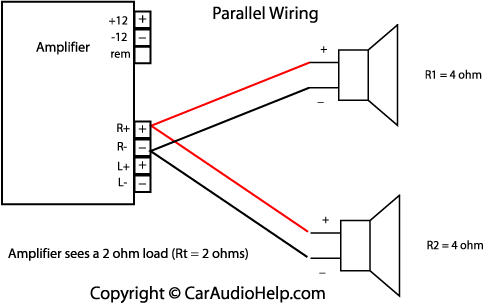
Parallel wiring is connecting components to a source so that they share the same voltage. To put that in a useful way, it would be connecting all of the speaker positive terminals to the positive terminal of the amplifier and connecting all of the speaker negative terminals to the negative terminal of the amplifier.

parallel_wiring.gif


This increases the work load on the amplifier because more current will need to be supplied to this lower resistance (impedance). Parallel resistances (in this case 4 ohm speakers) will combine according to this equation:

1/Rt = 1/R1 + 1/R2 + 1/R3...

Where Rt is the total resistance and R1-R3 are the individual resistances. For our example Rt will be the resistance at the amplifier's speaker outputs and R1-R3 will be the resistances of the individual speakers. If we connect (2) four ohm speakers (R1 and R2) in parallel to an amplifier the total resistance will be:

1/Rt = 1/R1 + 1/R2 or 1/Rt = 1/4 + 1/4 or 1/Rt = 1/2

Inverting the equation we get Rt = 2 ohms.

Similarly if we connect (3) four ohm speakers (R1, R2, and R3) we will get:

1/Rt = 1/R1 + 1/R2 + 1/R3 or 1/Rt = 1/4 + 1/4 + 1/4 or 1/Rt = 3/4

Inverting the equation we get Rt = 4/3 or 1.33 ohms.

Series Wiring

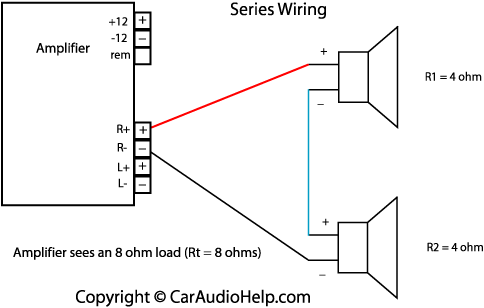
Series wiring is connecting components to a source so that they share the same current. To put that in a useful way, it would be connecting the amplifier's positive terminal to the positive terminal of the first speaker and then connecting the negative terminal of the first speaker to the positive terminal of the second speaker and so on. The final speaker in the chain will have it's negative terminal connected to the negative terminal of the amplifier.

series_wiring.gif


This decreases the work load on the amplifier because less current will need to be supplied to this higher resistance (impedance). Series resistances (in this case 4 ohm speakers) will combine according to this equation:

Rt = R1 + R2 + R3...

Where Rt is the total resistance and R1-R3 are the individual resistances. For our example Rt will be the resistance at the amplifier's speaker outputs and R1-R3 will be the resistances of the individual speakers. If we connect (2) four ohm speakers (R1 and R2) in series to an amplifier the total resistance will be:

Rt = R1 + R2 or Rt = 4 + 4 or Rt = 8 ohms

Similarly if we connect (3) four ohm speakers (R1, R2, and R3) we will get:

Rt = R1 + R2 + R3 or Rt = 4 + 4 + 4 or Rt = 12 ohms

More-

speaker_diagram.jpg


More info-

A trick that professional installers use to get more power out of amplifiers is to wire up speakers in different ways, playing with resistances to achieve a desired total impedance "seen" by the amplifier. Even though speakers are active loads (resistance changes with frequency), it is accepted to treat speakers as resistors with a fixed resistance value (usually 4 ohms).

By combining speakers in different ways, maximum amplifier output can be obtained. For example if a 2-channel amplifier is rated to deliver a maximum output of 400 watts at 2 ohms mono (bridged), then by hooking up two 4 ohm subwoofers in parallel, a total load of 2 ohms is "seen" by the amplifier, obtaining optimum power.

Parallel Resistance

sp_wiring_parallel.gif


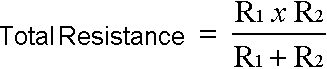
People commonly hook up two or more speakers to the same channel out of an amplifier in parallel. This is achieved by hooking up the negative wire from the amp to all the negative connections of the speakers, and the positive to all the positive connections of the speakers. By doing this, the load seen by the amplifier is lower. For example, if two 4-ohm speakers are wired-up in parallel, then their total resistance will be half, or 2 ohms. If three speakers are wired up in parallel, and they all have the same resistance value, then the total load would be a third of the value of each speaker's resistance. Here's a formula to calculate parallel total resistance for two speakers:

sp_wiring_p_resist1.gif


For more than two speakers, use the following formula:

sp_wiring_p_resist2.gif


So what are the advantages and disadvantages of this scheme? First, if one of the speakers burns out, then the other one(s) keep playing. If the amplifier is not designed to receive lower loads provided by hooking the speakers up in this fashion, you might end up destroying your amplifier. Check your manual or consult an expert.

Series Resistance

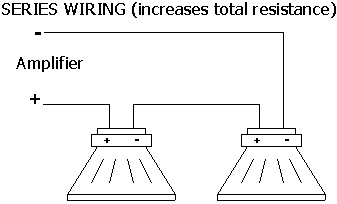
sp_wiring_series.gif


Speakers are hooked up in series to decrease total load to an amplifier. To hook up speakers in series, connect the positive terminal of the amplifier to positive of one speaker, then hook up negative of that speaker to positive of next speaker, and so on. Then hook up negative of last speaker to negative of the amp. It is a lot easier to calculate total resistance for speakers hooked up in series. This is easily done by adding up all the individual resistances:

sp_wiring_s_resist.gif


The disadvantage of hooking up speakers in series other than getting less power out of an amplifier, is that if one of the speakers burns up, the other one(s) stop working.

 
Activity
No one is currently typing a reply...
Old Thread: Please note, there have been no replies in this thread for over 3 years!
Content in this thread may no longer be relevant.
Perhaps it would be better to start a new thread instead.

About this thread

stones

10+ year member
Senior member
Thread starter
stones
Joined
Location
Sask
Start date
Participants
Who Replied
Replies
14
Views
1,096
Last reply date
Last reply from
stones
IMG_20260516_193114554_HDR.jpg

sherbanater

    May 16, 2026
  • 0
  • 0
IMG_20260516_192955471_HDR.jpg

sherbanater

    May 16, 2026
  • 0
  • 0

New threads

Top