Most Effective Way to Crossover

morechikin

Junior Member
Hi all!

Very first post here, but I thought this would be a viable topic.

My setup is geared towards SQ. Current setup is fairly modest with HAT Imagines running in component configuration with the tweeters on passive, Infinity Kappa 120.9w sub running through an Alpine PDX-9V and a RF 360.3 handling the DSP duty.

The question is essentially two parts. Would it be better to use the Amp's crossover controls or build the crossovers through the DSP and leave the amp bandpass? Depending on that answer, is it better to run the tweeters active or remain passive?

Maybe it doesn't really make a big difference one way or the other as far as results go, but I'm new to this so hoping to get some more expert input from you all.

 
If you have a RF 360.3, you might as well use it to it's full potential and go fully active with it. That's what I would do. It's much easier to deal with than using your amp's crossover knobs. It does take a bit of work though so if you're just looking for a set it and forget type of setup, then passive would be less of a headache. All depends on your goals. If you wanna go ahead and go active with your tweeter, then make sure the filter is on pretty high first (like 3.5k maybe) and work your way down until you hear distortion. You can easily blow your tweeters if you don't set a filter first. With passive you don't have to worry about that because the passive crossover will already do that but you can't change it around like you can with an active crossover.

What vehicle is this in? Have you done any sound deadening of any sorts?

 
My goals are actually varied since the RF360.3 is such a versatile unit. For most of my listening, I will be looking for a really clean, crisp sound, but I would like to push some good dbs when the weather is nice and I want to blast some metal. The DSP's 4 separate presets will help me have a setup for each "kind" of listening I want to do.

The the car is a G8 and is fully treated already. I have a nice seal on the door drivers that produces some really great midbass already. I'm just looking for more clarity as I learn more and more about what to do/not do. I am leaning more towards full active to have the most control. If it's easier to manage the crossovers through the DSP, as you mentioned, that is probably what I will do.

 
I see no need for different presets unless you'll have some speakers, such as the rears, attenuated most of the time. I use 1 preset and adjust my subwoofer amplifier's bass boost and/or use the DSP's remote, which is set to change the level of the subwoofer. Yes, there is an apparent difference between the two adjustments as the bass boost is a single band of EQ. In my case I can adjust the center frequency on the amplifier. I have no issues with blasting metal or enjoying virtually anything with this single tune and the bass adjustments.

Take this DSP thing slowly. Yes, it is much easier and better to set all of your crossovers on a DSP than on the amplifier. Run the tweeters active if you have the amplifier channels to spare.

If you don't own a PC-based RTA setup now is the time to get the parts and practice. Don't tune strictly by ear. Trust the measurements. I can help with that.

 
I see no need for different presets unless you'll have some speakers, such as the rears, attenuated most of the time. I use 1 preset and adjust my subwoofer amplifier's bass boost and/or use the DSP's remote, which is set to change the level of the subwoofer. Yes, there is an apparent difference between the two adjustments as the bass boost is a single band of EQ. In my case I can adjust the center frequency on the amplifier. I have no issues with blasting metal or enjoying virtually anything with this single tune and the bass adjustments.
Take this DSP thing slowly. Yes, it is much easier and better to set all of your crossovers on a DSP than on the amplifier. Run the tweeters active if you have the amplifier channels to spare.

If you don't own a PC-based RTA setup now is the time to get the parts and practice. Don't tune strictly by ear. Trust the measurements. I can help with that.
Good point on the sub bass knob on the DSP. I do not have an RTA setup, but I have heard good things about REW as a software package, which I believe is free. Do you recommend a specific microphone or any omni-directional will do?

To your point, I have been tuning a little bit at a time by ear and the results are ok, but not wonderful. It seems the more I learn about this stuff, the more I know I know I don't know...kind of like trying to drink from a firehose.

 
Good point on the sub bass knob on the DSP. I do not have an RTA setup, but I have heard good things about REW as a software package, which I believe is free. Do you recommend a specific microphone or any omni-directional will do?
Dayton UMM-6. I definitely recommend REW. I use it and it's a huge time saver once you know your way around it and some tricks.

To your point, I have been tuning a little bit at a time by ear and the results are ok, but not wonderful. It seems the more I learn about this stuff, the more I know I know I don't know...kind of like trying to drink from a firehose.
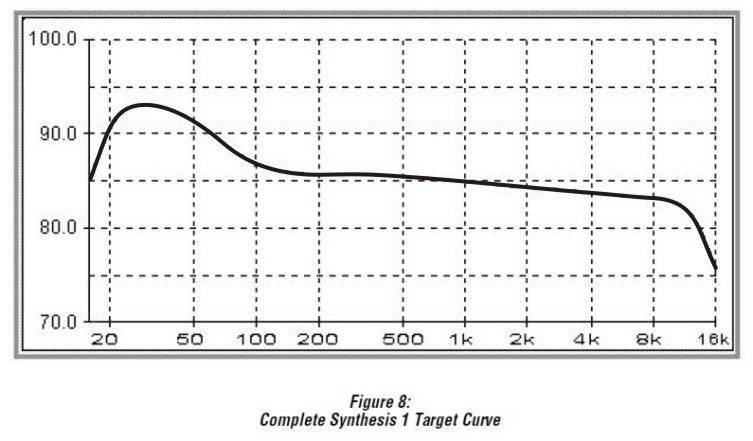
What helps is to have a goal, or more specifically, a target. A frequency response curve that resembles this is something to consider when you take your measurements and EQ the system:

933859b1_SynthesisTarget.jpeg


Note the rise in the bass, the slope down to flat in the midrange, and the gradual roll-off at the right side. You're unlikely to get your system to measure exactly like this, and if you get close you might decide you don't like it, but it's progress. Try to get your RTA measurements in REW to be flat within 3 dB + or - of the target curve. I can't give you a step-by-step tuning guide, but you should try to make the left side and right side of the car measure the same. There will be dips(aka nulls) that you can't fix, but you can bring peaks down.

 
I will grab one of those mics then. There is actually a very well done tutorial series using REW that I found on Youtube so I will use that target response curve as a baseline goal and adjust to my taste from there.

So I am going to ask a dumb question now, but I think it's prudent since I have yet to find a thread that really spells it out. If the goal of a SQ system is to reproduce music as it was originally recorded, then having your response curve being as flat as possible should be the overall goal, correct? Then any variations in the curve are due to individual taste in music (if those variations are intentional and not a function of the car). Am I on the right track here?

 
If the goal of a SQ system is to reproduce music as it was originally recorded, then having your response curve being as flat as possible should be the overall goal, correct? Then any variations in the curve are due to individual taste in music (if those variations are intentional and not a function of the car). Am I on the right track here?
We can't ignore "the function of the car". Some people might be satisfied with a "flat" response curve in a home listening room, but the car makes some drastic changes to what we hear that no speaker can ever be engineered to overcome. The "Synthesis" target curve I posted is for JBL's most expensive home audio systems, which use proprietary DSP and multiple subwoofers, among other things. Harman, the parent company of JBL, has done research with a variety of listeners to determine that people prefer not a system that measures flat with pink noise, but one with emphasized bass, flat midrange, and a gentle downward tilt on the top end.

You're right that individual preferences must be considered, and this is a must for any vehicle set up for daily listening and not to score the maximum number of points in a sound quality competition. Some people want even more bass, maybe more midbass, and maybe more treble. Most people have no idea and need to be taught what to listen for. You have the tools at hand to make the kind of changes to your system on this fine level to match a target curve. It's up to you to figure out what kind of "seasoning to taste" must be done.

 
Activity
No one is currently typing a reply...
Old Thread: Please note, there have been no replies in this thread for over 3 years!
Content in this thread may no longer be relevant.
Perhaps it would be better to start a new thread instead.

About this thread

morechikin

Junior Member
Thread starter
morechikin
Joined
Location
Omaha, NE
Start date
Participants
Who Replied
Replies
7
Views
3,301
Last reply date
Last reply from
trumpet
IMG_20260516_193114554_HDR.jpg

sherbanater

    May 16, 2026
  • 0
  • 0
IMG_20260516_192955471_HDR.jpg

sherbanater

    May 16, 2026
  • 0
  • 0

New threads

Top