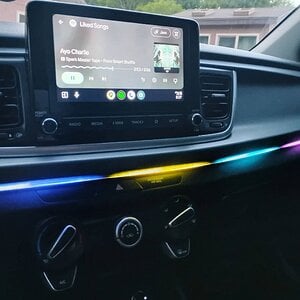
Lights dim alot and...

If you think a 90 amp factory alternator can keep 4 batteries fully charged, you're delusional. All that adding an extra battery does is allow you to be able to run longer with the car off. When the car is running, i.e. when the lights are dimming, the alternator that's having trouble keeping one battery charged has to work harder to keep another charged. That doesn't make any sense. Your system runs off of the battery, and usually, it drains it pretty quickly. Therefore, if the alternator cannot charge it fast enough, i.e. voltage drop, another can't help.

Actually most good aftermarket batteries these days (Such as Kinetik) have extremely low resistance. Infact, my 3) Kinetik HC2400s have a combined resistance lower than my factory battery. So not only will they charge with ease from the stock alternator, they also discharge alot of current very fast. They also have an extremely low self discharging rate, which means the cells will not heat up when using multiple batteries. basically you can add as many batteries as you want without having to use an isolator.

I have a few HC2400s run from my stock alternator, I run a Hifonics Maxximus and voltage is 14.9 when car is running and drops to 13.9 when playing full tilt. Lights dont dim at all.

 
Actually most good aftermarket batteries these days (Such as Kinetik) have extremely low resistance. Infact, my 3) Kinetik HC2400s have a combined resistance lower than my factory battery. So not only will they charge with ease from the stock alternator, they also discharge alot of current very fast. They also have an extremely low self discharging rate, which means the cells will not heat up when using multiple batteries. basically you can add as many batteries as you want without having to use an isolator.
I have a few HC2400s run from my stock alternator, I run a Hifonics Maxximus and voltage is 14.9 when car is running and drops to 13.9 when playing full tilt. Lights dont dim at all.
I don't doubt you know more about car audio than I do, but I still disagree. It makes no sense that if you are already having voltage drops, that adding another source of drain on the alternator will make it work more efficiently. Again, I could very well be wrong, but it just doesn't seem that adding another battery to a weak electrical system will improve the situation more than upgrading the alternator and/or doing the big 3.
 
I have a lot of dimming too, I'm going to do my big 3 with some 4gauge i have laying around

if that doesn't help me, i'll either upgrade the battery or the alternator

don't know which, i've been reading and it seems that everyone has a different opinion on what is the best route to go by

 
If you think a 90 amp factory alternator can keep 4 batteries fully charged, you're delusional. All that adding an extra battery does is allow you to be able to run longer with the car off. When the car is running, i.e. when the lights are dimming, the alternator that's having trouble keeping one battery charged has to work harder to keep another charged. That doesn't make any sense. Your system runs off of the battery, and usually, it drains it pretty quickly. Therefore, if the alternator cannot charge it fast enough, i.e. voltage drop, another can't help.
Actually most good aftermarket batteries these days (Such as Kinetik) have extremely low resistance. Infact, my 3) Kinetik HC2400s have a combined resistance lower than my factory battery. So not only will they charge with ease from the stock alternator, they also discharge alot of current very fast. They also have an extremely low self discharging rate, which means the cells will not heat up when using multiple batteries. basically you can add as many batteries as you want without having to use an isolator.
I have a few HC2400s run from my stock alternator, I run a Hifonics Maxximus and voltage is 14.9 when car is running and drops to 13.9 when playing full tilt. Lights dont dim at all.
This is an effect of time more than anything. More batteries, especially Kinetiks which are an easier on the alternator, can be fine in a daily system that isnt pushed full tilt all the time and is allowed to recharge when needed (either through alternator or outside charger)

It is obviously preferred to have an alternator that can keep up with batteries, but in the real world is often less required than one would think. I mean how long can you actually listen to 5k watts? Thus these downtimes can allow even a stock alternator to charge the batteries.

I always would recommend a ho alternator when using large systems but its also important to know why just because it says so in theory, it doesnt necessarily translate directly to real life apps.

Make sense? //content.invisioncic.com/y282845/emoticons/smile.gif.1ebc41e1811405b213edfc4622c41e27.gif

 
I don't doubt you know more about car audio than I do, but I still disagree. It makes no sense that if you are already having voltage drops, that adding another source of drain on the alternator will make it work more efficiently. Again, I could very well be wrong, but it just doesn't seem that adding another battery to a weak electrical system will improve the situation more than upgrading the alternator and/or doing the big 3.
Upgrading the alternator is one of the best things you can do. Although the first thing you should do is to replace the stock battery with an upgrade.

Adding a second battery to a weak electrical system will help as long as its a good battery with low ESR, but eventually the stock battery will have to be replaced anyway.

What happens is any electrical component in the car will draw current from the dominant voltage source. When the car is running this is the alternator. When current demands are high enough to drop the voltage below a certain point, the battery then becomes the dominant voltage source. At this point, current is coming from the batteries while the alternator charges the battery. In the case of a system with a second battery with low ESR, the extra battery's load will be so minimal that the current it can deliver to the electronic components exceeds the extra demand it puts on the alternator for charging purposes.

Any decent amp these days will draw enough current to drop voltage to a level where the battery will be taking over in the car, especially since alternators are getting smaller in new cars these days. So it helps to have extra current capabilities on the battery to keep a minimal voltage drop from the batteries. If the batteries voltage drops less, then the alternator has to do less work to charge them back to full.

My stock electrical system had a steady voltage of 14.6v DC when car was running. With the extra Kinetiks it now rests at 14.9v DC. and the alternator is working less.

 
This is an effect of time more than anything. More batteries, especially Kinetiks which are an easier on the alternator, can be fine in a daily system that isnt pushed full tilt all the time and is allowed to recharge when needed (either through alternator or outside charger)
It is obviously preferred to have an alternator that can keep up with batteries, but in the real world is often less required than one would think. I mean how long can you actually listen to 5k watts? Thus these downtimes can allow even a stock alternator to charge the batteries.

I always would recommend a ho alternator when using large systems but its also important to know why just because it says so in theory, it doesnt necessarily translate directly to real life apps.

Make sense? //content.invisioncic.com/y282845/emoticons/smile.gif.1ebc41e1811405b213edfc4622c41e27.gif
Upgrading the alternator is one of the best things you can do. Although the first thing you should do is to replace the stock battery with an upgrade.
Adding a second battery to a weak electrical system will help as long as its a good battery with low ESR, but eventually the stock battery will have to be replaced anyway.

What happens is any electrical component in the car will draw current from the dominant voltage source. When the car is running this is the alternator. When current demands are high enough to drop the voltage below a certain point, the battery then becomes the dominant voltage source. At this point, current is coming from the batteries while the alternator charges the battery. In the case of a system with a second battery with low ESR, the extra battery's load will be so minimal that the current it can deliver to the electronic components exceeds the extra demand it puts on the alternator for charging purposes.

Any decent amp these days will draw enough current to drop voltage to a level where the battery will be taking over in the car, especially since alternators are getting smaller in new cars these days. So it helps to have extra current capabilities on the battery to keep a minimal voltage drop from the batteries. If the batteries voltage drops less, then the alternator has to do less work to charge them back to full.

My stock electrical system had a steady voltage of 14.6v DC when car was running. With the extra Kinetiks it now rests at 14.9v DC. and the alternator is working less.
//content.invisioncic.com/y282845/emoticons/thumbsup.gif.3287b36ca96645a13a43aff531f37f02.gif Makes sense now, thanks. //content.invisioncic.com/y282845/emoticons/smile.gif.1ebc41e1811405b213edfc4622c41e27.gif
 
This is an effect of time more than anything. More batteries, especially Kinetiks which are an easier on the alternator, can be fine in a daily system that isnt pushed full tilt all the time and is allowed to recharge when needed (either through alternator or outside charger)
It is obviously preferred to have an alternator that can keep up with batteries, but in the real world is often less required than one would think. I mean how long can you actually listen to 5k watts? Thus these downtimes can allow even a stock alternator to charge the batteries.

I always would recommend a ho alternator when using large systems but its also important to know why just because it says so in theory, it doesnt necessarily translate directly to real life apps.

Make sense? //content.invisioncic.com/y282845/emoticons/smile.gif.1ebc41e1811405b213edfc4622c41e27.gif
That was exactly what I was going for actually. You have x amount of Ah to work with, and adding another battery won't give you more. Now I understand what y'all actually meant, I'm good to go //content.invisioncic.com/y282845/emoticons/biggrin.gif.d71a5d36fcbab170f2364c9f2e3946cb.gif
 
Cool, no problem.

BTW, I hope I was clear that it has to be a good battery with low ESR. Simply adding a second OEM battery may not help. So its not a matter of who's right, who's wrong, or who said what. The theories do apply, but all the data and specs must be accounted for.

 
Activity
No one is currently typing a reply...
Old Thread: Please note, there have been no replies in this thread for over 3 years!
Content in this thread may no longer be relevant.
Perhaps it would be better to start a new thread instead.

Similar threads

About this thread

Adrian15XXX

10+ year member
Senior VIP Member
Thread starter
Adrian15XXX
Joined
Location
Chicago, IL
Start date
Participants
Who Replied
Replies
26
Views
1,399
Last reply date
Last reply from
Ineed$
IMG_20260515_202650612_HDR.jpg

sherbanater

    May 15, 2026
  • 0
  • 0
IMG_20260515_202732887_HDR.jpg

sherbanater

    May 15, 2026
  • 0
  • 0

New threads

Top