Giving the RE XXX another Try *Pic*

ffunny how the red and green are nearly identical thoughout the FR whike addind mma wreaks havoc on FR..
The neat thing to notice is how much adding mass effects the FR above 2k Hz vs adding inductance, as you put it in your post. I posted the graph above 2k for a reason - to show how each added variable effects the FR of the driver on the top end. And you're right on the note of the FR's being almost identical except for efficiency between the raw driver and the driver with added inductance. Kinda cool isn't it? Knowledge is power my friends. //content.invisioncic.com/y282845/emoticons/smile.gif.1ebc41e1811405b213edfc4622c41e27.gif

 
its funny u say that kuz i heard one in a bandpass and the sealed chambers was ver small and it sounded like monkey azz rubbing together with rocks in it
80
Man are you still on the bandpass enclosure kick? //content.invisioncic.com/y282845/emoticons/biggrin.gif.d71a5d36fcbab170f2364c9f2e3946cb.gif

 
The neat thing to notice is how much adding mass effects the FR above 2k Hz vs adding inductance, as you put it in your post. I posted the graph above 2k for a reason - to show how each added variable effects the FR of the driver on the top end. And you're right on the note of the FR's being almost identical except for efficiency between the raw driver and the driver with added inductance. Kinda cool isn't it? Knowledge is power my friends. //content.invisioncic.com/y282845/emoticons/smile.gif.1ebc41e1811405b213edfc4622c41e27.gif
Thanks for that graph I was going to post it but I couldn't find it anywhere I thought it was either you or John who posted it the first time, but I couldn't remember which forum lol.

 
This graph is pure frequency response and hold true to most cases. However, the FR in some horns are rather odd and doesn't resemble that one bit and most ts parameters goes out the window.

Tuan

 
Mms has nothing to do with bandwidth no matter what kind of speaker you're talking about. Inductance effects bandwidth, not Mms. Mms effects efficiency and Fs. Take a look at this picture and tell me which one has more mass and which one has higher inductance (same driver - one is the reference line [driver as is], the other is with inductance added, and the other is with mass added):
Bandwidth.jpg


Mms's role in subwoofer design is closely associated with BL and Cms as it relates to the F3 of the system in its target enclosure size and type, not with how high the driver will play (aka: bandwidth).
I noted that mms only plays a significant role in higher frequencies. It certainly affects bandwidth in tweeters, right? At what point would you say it starts playing a significant role in upper freq response?
 
I noted that mms only plays a significant role in higher frequencies. It certainly affects bandwidth in tweeters, right? At what point would you say it starts playing a significant role in upper freq response?
With everything else kept the same, mass doesn't effect the high frequency cutoff in tweeters anymore than it effects the high frequency cutoff in midranges or woofers. Mass definitely has an effect on sensitivity and Fs. In tweeters, the shape/contour of the dome and what you do with the dome has a large impact on HF extension. For instance, ring radiators (think of it as putting a phase plug on a tweeter) have a pretty significant impact on HF extension - especially in regard to high frequency off-axis response.

'Ever put your finger on an inverted dome tweeter and notice the sound difference? It immediately gets a LOT quieter, but it still plays just as high.

Here's a good example of the latter focused on on-axis response: Click me to see the PDF!

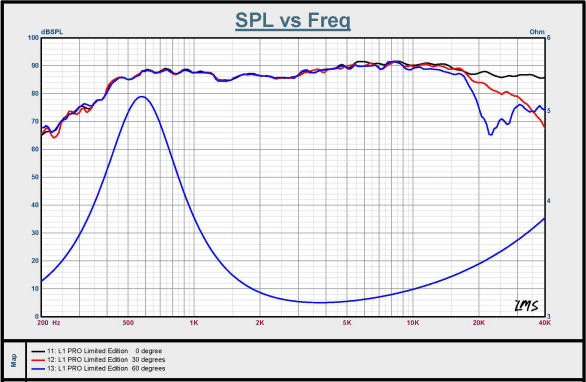
And for both on and off-axis, the new Hybrid Audio L1 Pro SE tweeter demonstrates this excellently (pay close attention to the range of the plot, as the top end cutoff is 40k, not 20k):

l1sechart-1.gif


Toxic, when you get into horn design you can tailor the horn type to do whatever your goal is. You can optimize them for wide dispersion, narrow dispersion, a certain sensitivity gain, certain bandwidth, LF extension, etc. After you build a bass horn you use knowledge of T/S's to either select, or build, a driver to suit the horn. You can also say the same thing about bandwidth in regards to a bandpass enclosure, as in you can tailor the range to be what you desire within the limits of the driver.

 
With everything else kept the same, mass doesn't effect the high frequency cutoff in tweeters anymore than it effects the high frequency cutoff in midranges or woofers. Mass definitely has an effect on sensitivity and Fs. In tweeters, the shape/contour of the dome and what you do with the dome has a large impact on HF extension. For instance, ring radiators (think of it as putting a phase plug on a tweeter) have a pretty significant impact on HF extension - especially in regard to high frequency off-axis response.
'Ever put your finger on an inverted dome tweeter and notice the sound difference? It immediately gets a LOT quieter, but it still plays just as high.
The fact the tweeter gets quieter does affect HF extension, since frequency reproduction is defined by output, in db's, at a given frequency. Its similar to the idea that tweeters can play a 20hz note, just not at an audible level. But a subwoofer, given its mms, simply cannot reproduce 20,000 cycles per second (20khz). If I understand you correctly, you are saying that adding mass to a tweeter will not affect bandwidth. If it simply shifts Fs, bandwidth remains identical but the passband is shifted lower. This seems ... unlikely. Lets say you triple the moving mass of a subwoofer, yes it will lower Fs and improve output, at say, 20hz. But will it still be able to cycle, at say, 150hz? As Fs shifts lower, the passband should narrow. Adding significant mass to a tweeter will lower Fs, it will no longer be able to reproduce 20,000 cycles, but will it still be able to pass the same number of octaves? Im tired, so maybe Im thinking incorrectly here. 3rd shift job gets to me about this time of day. //content.invisioncic.com/y282845/emoticons/wink.gif.608e3ea05f1a9f98611af0861652f8fb.gif

 
The fact the tweeter gets quieter does affect HF extension, since frequency reproduction is defined by output, in db's, at a given frequency. Its similar to the idea that tweeters can play a 20hz note, just not at an audible level. But a subwoofer, given its mms, simply cannot reproduce 20,000 cycles per second (20khz). If I understand you correctly, you are saying that adding mass to a tweeter will not affect bandwidth. If it simply shifts Fs, bandwidth remains identical but the passband is shifted lower. This seems ... unlikely. Lets say you triple the moving mass of a subwoofer, yes it will lower Fs and improve output, at say, 20hz. But will it still be able to cycle, at say, 150hz? As Fs shifts lower, the passband should narrow. Adding significant mass to a tweeter will lower Fs, it will no longer be able to reproduce 20,000 cycles, but will it still be able to pass the same number of octaves? Im tired, so maybe Im thinking incorrectly here. 3rd shift job gets to me about this time of day. //content.invisioncic.com/y282845/emoticons/wink.gif.608e3ea05f1a9f98611af0861652f8fb.gif

I think what he's saying is that as long as the same amount of current switches back and forth as many times as needed the sub has no choice but to play the frequency put into it. The sub won't move as far anymore, but that's true of all frequencies due to the added mass lowering effeciency and high frequencies need less displacment/stroke anyway due to the extra cycles. I think you end up with a design that play just lower due to the reduce fs, just as high because of the same inductance, but does it all at a lower reference level which is why bandwidth is unaffected on the top end. I've seen a few subs able to play to the 1-2k range due to low inductance, with alot more mass on them than most midranges that can play no higher. Aura NS, Mag v4, and AE AV's all come to mind. Granted at some point these subs will all begin to beam like a freaking flashlight, but I don't think that' the issue here lol. I may be wrong though, I'm trying to sort this out completely too.

 
I agree that bandwidth is only considerable if the output is closely within the linear level range and therefor should narrow the passband. The ultimate goad would be finding the proper point of lowering Fs with add mms while retaining efficiency while retaining the desired bandwidth. A pretty challenging task.

 
In a very simplified thought, I consider a lower moving mass to lend itself greatly to high degree of resolution more than anything else, but that's on a subjective front so I guess it's not very applicable here.

 
I think what he's saying is that as long as the same amount of current switches back and forth as many times as needed the sub has no choice but to play the frequency put into it. The sub won't move as far anymore, but that's true of all frequencies due to the added mass lowering effeciency and high frequencies need less displacment/stroke anyway due to the extra cycles. I think you end up with a design that play just lower due to the reduce fs, just as high because of the same inductance, but does it all at a lower reference level which is why bandwidth is unaffected on the top end. I've seen a few subs able to play to the 1-2k range due to low inductance, with alot more mass on them than most midranges that can play no higher. Aura NS, Mag v4, and AE AV's all come to mind. Granted at some point these subs will all begin to beam like a freaking flashlight, but I don't think that' the issue here lol. I may be wrong though, I'm trying to sort this out completely too.
Yep, good stuff in this post. I agree, and I've experienced the same thing. To build on that thought, using a signal generator I've verified that my 15" LMS 4000 will play up to 8kHz. I'm not saying that it plays cleanly at that frequency or flat in relative level up to that point, as it was clearly not meant to be used that high in frequency. But more importantly, it has a terrible sensitivity specification due to the motor topology and the moving mass is not very low on these drivers. The inductance, however, is extremely low at rest, and very stable throughout it's stroke. There's not even any appreciable IM distortion for the midrange while the driver is stroking nearly two inches. Eventually it creeps in but two inches is a lot of travel for the vocals not to be disrupted. Again, that's not how I use it. It was simply a test I performed out of curiosity.

 
The fact the tweeter gets quieter does affect HF extension, since frequency reproduction is defined by output, in db's, at a given frequency. Its similar to the idea that tweeters can play a 20hz note, just not at an audible level. But a subwoofer, given its mms, simply cannot reproduce 20,000 cycles per second (20khz). If I understand you correctly, you are saying that adding mass to a tweeter will not affect bandwidth. If it simply shifts Fs, bandwidth remains identical but the passband is shifted lower. This seems ... unlikely. Lets say you triple the moving mass of a subwoofer, yes it will lower Fs and improve output, at say, 20hz. But will it still be able to cycle, at say, 150hz? As Fs shifts lower, the passband should narrow. Adding significant mass to a tweeter will lower Fs, it will no longer be able to reproduce 20,000 cycles, but will it still be able to pass the same number of octaves? Im tired, so maybe Im thinking incorrectly here. 3rd shift job gets to me about this time of day. //content.invisioncic.com/y282845/emoticons/wink.gif.608e3ea05f1a9f98611af0861652f8fb.gif
I'm always impressed with your line of thinking, as you always have a sort of Spock-like approach to things, and this is no exception. And please forgive me in advance for even considering to inform you. //content.invisioncic.com/y282845/emoticons/biggrin.gif.d71a5d36fcbab170f2364c9f2e3946cb.gif But I think that there's a very simple bit of information that will help to solidify this for you in simpler terms. I like to use simpler terms because I'm not an engineer and I lack the vocabulary sometimes, along with the ability to articulate my point at other times. Regardless of where Fs is, below Fs the suspension is responsible for controlling the moving mass. Above Fs, the motor is responsible for controlling the moving mass. Let's not get into modal behavior within the cone or dome, or different cone material compositions that might have an affect on FR (internal damping and whatnot, the smoothing effect of talc filled poly, etc), or any other limiting factor that the soft parts may have on high frequency extension. It would be solely the inductance of the system that would determine how high it would play, regardless of how sensitive the system was. At least that's how I've understood up to this point. And again, that's not all-inclusive. Just a simple approach for the theory of it all. I would gladly concede if an engineer were to point out something that I have wrongly stated.

 
Activity
No one is currently typing a reply...
Old Thread: Please note, there have been no replies in this thread for over 3 years!
Content in this thread may no longer be relevant.
Perhaps it would be better to start a new thread instead.

About this thread

Toxic Tuan

10+ year member
CarAudio.com Elite
Thread starter
Toxic Tuan
Joined
Location
Orange County, CA
Start date
Participants
Who Replied
Replies
106
Views
7,091
Last reply date
Last reply from
Smigletat
IMG_20260516_193114554_HDR.jpg

sherbanater

    May 16, 2026
  • 0
  • 0
IMG_20260516_192955471_HDR.jpg

sherbanater

    May 16, 2026
  • 0
  • 0

New threads

Top