ddm reading

Your not pulling 1600w. To pull that the amp would need to be 100% efficient.
Correct. Usually, with the electrical that is left over, you will get about 60-70% of the alternator amps to use for aftermarket. Say 60% to be safe. You have to figure for the amount of power the stock system will use. Say the amp is a 125A and the BATT is at 13V average with about 45Ah. You will be able to get about 585 watts from the batt and 975 watts from the alt. That is a total of 1560watts of supply (averaged). And then the amplifier will produce about 70% efficiency on average, so if the amp is 1500W@100% efficiency, then it will produce 1050w (averaged). So, the stock system will be able to handle this amp, but not much after that, maybe a 400W amp to the fronts it can handle as well. But not much more than that.

You also have to check if the amps fuse is more than the amp will produce at peak to make sure the amp is a true power amplifier. Do this by using the amps power rating, such as say for example, 1500@1Ohm, and get the amperes. Which is 38.73A. So, that amp would need say (2) 25A fuses, or (2) 40s, for example. This will let you know that the power rating is somewhat acceptable. Other things like the transformers inside the amplifier will tell the tale better, but this is an idea of a good amp. So, say the amp has (2) 25A fuses, which means @1ohm, it can produce 2500Wpeak. Which is 1250rms or efficiently 875W continuous. This is very rough estimations, but good ballpark idea of what really goes on with power. obviously the wattage is not completely accurate, as voltage will tell the tale in a real test of the amp, but without knowing anything else about it, that is what you can gather from it respectively with a bit of ignorance on its actual ratings.

Maybe that will help a bit on whether you will know if the amp is good enough for power and everything else.

 
fixed

IMG_0914.jpg


can someone verify i shoulkd do this?
I verify. The higher you set LPF, the more it allows the output of the LF response to perform, BUT be careful setting this too high, as it may cause cancelalation with the mirange drivers based on time delay from the trunk. You may not notice it on music, but on test tones, it can be audible. Considering the vehicle is small in comparison, you may not hear it at all, but it will be present.

 
no it needs to be adjusted because the OP has his subwoofer out LP at 85 HZ

Quote from the OP

these are the deck settings:

Pro Equalizer:

bass 60hz q 2.0

mid 1.0hz q 1.25

treb 10.0hz q FI

Audio:

Sub W LPF - Low 85hz - goes up to 200?

Sub W LVL - 8/8

HPF on

Amp gain - high power

loud OFF

 
he already has his subwoofer crossed over at 85 hz
So adding the amp crossover at 65 hz is wrong

Either use the crossover on the deck or use the crossover on the amp - not BOTH
it cant be turned off, its actually at 55hz on the deck, wont save when i change it for sum reason to 85 lol, it goes 55, 85, 120 , 200 or something like that..

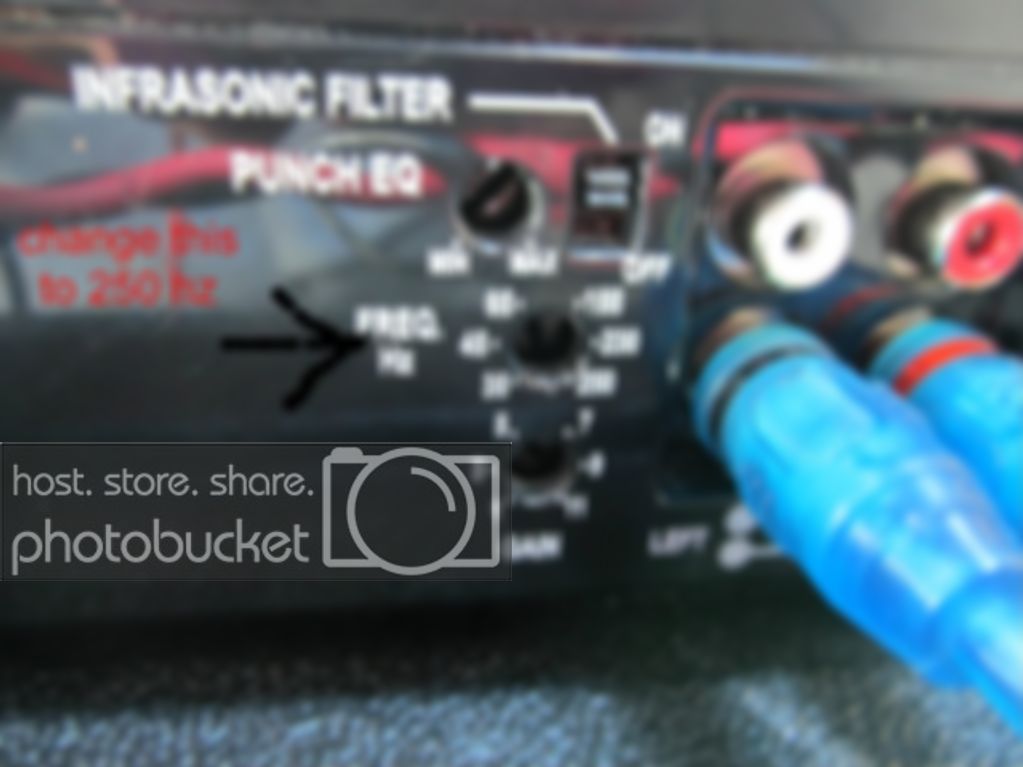
so i should go in my car, and change the freq to 155, then set my gain till it reads 38.7 volts on the ddm??

what should it say on the deck?

 
he already has his subwoofer crossed over at 85 hz
So adding the amp crossover at 65 hz is wrong

Either use the crossover on the deck or use the crossover on the amp - not BOTH
Yes! This is good information because by setting them both, you are only filtering the already filtered response, making the output even less sensitive. Great post crispin!

BUT, in regard to setting it lower than 250, that is acceptable in an LPF anywhere above 150. Bass frequencies, unless circulated through a pro audio driver with high sensitivity and higher Fs free-air, setting anywhere above 150 is ok. In most conventional designs for car audio use, especially for trunk use, a filter is already set by the enclosure, such as in a proper tline, that filters acoustically the higher frequencies of the design. Electrical filters are another story, which is what is being dealt with here. BUT, most designs exhibit less efficiency above 150Hz, and phase usually just goes crazy anyway when tuned low in the actual design. You cannot get efficiently more than an average 1.5 octaves from a design in subwoofer use. So, say you set it at 250, which is ok, then you are allowing OUT_OF_PHASE response to be played with the in-phase response, which is usually 30-90Hz respectively in most subsystems. So, setting it lower than 250, but equal to or above 150 is acceptable. And the more you filter the out of phase response, the cleaner it will sound. You cannot argue physics. From 150Hz down, the 1.5 octave range is 50-150Hz. In which I am sure the design is capable below 50Hz in phase. But again, you have to check the design capabilities on that, but generally, 30-90 is in phase in most designs for musical output. And when using bandpass designs, (even more acoustical filtering), the in phase response is less, which is why people say they can become less musical. There is a reason the LPF goes down to 35Hz. It is because the maker of the amplifier understands acoustical filtering as well.

You gotta understand this to give a good answer.

 
it cant be turned off, its actually at 55hz on the deck, wont save when i change it for sum reason to 85 lol, it goes 55, 85, 120 , 200 or something like that..
so i should go in my car, and change the freq to 155, then set my gain till it reads 38.7 volts on the ddm??

what should it say on the deck?
You should allow the output of the deck to be always as flat as possible if you are utilizing an amp for output to the drivers. But the reason filters exist in HUs is because they do not have to be used with amplifiers or crossovers. So, if you cannot turn the LPF off, set it high and allow every bit of output through to the amplifier for the amp to control the response from there. Since the amp essentially amplifies the response, it is better in theory to have it control the filters.

Why would you filter it before it even gets amplified? This lessens your options of variable settings. I use an external crossover to set everything on my system for that reason.

 
Activity
No one is currently typing a reply...
Old Thread: Please note, there have been no replies in this thread for over 3 years!
Content in this thread may no longer be relevant.
Perhaps it would be better to start a new thread instead.

About this thread

cbuts

10+ year member
CarAudio.com Elite
Thread starter
cbuts
Joined
Location
canada,ont
Start date
Participants
Who Replied
Replies
115
Views
5,782
Last reply date
Last reply from
cbuts
IMG_20260516_193114554_HDR.jpg

sherbanater

    May 16, 2026
  • 0
  • 0
IMG_20260516_192955471_HDR.jpg

sherbanater

    May 16, 2026
  • 0
  • 0

New threads

Top