Component Speaker Help

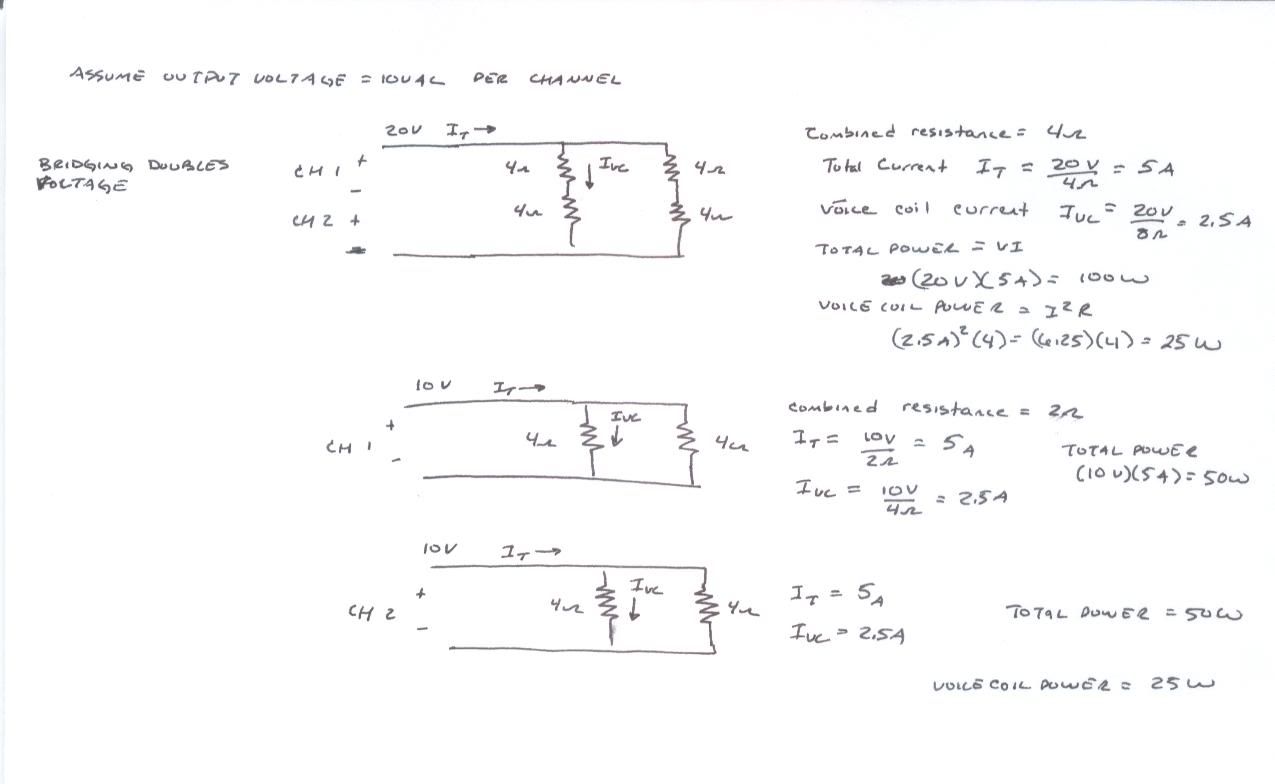
bridgingvoltagecurrent.jpg


Bridging a 4 channel amp uses less current than the same amp ran in 2 ohm stereo (assuming same power output). bridging makes more power by doubling voltage (which quadruples power).

Further,

If the impedance load is the same, and the same power is attained, then voltage is the same and current is the same. A non-bridged 2 ch making the same power as a bridged 4ch into the same load will draw the same current as the same voltage.

Now, the efficiency is a different story, but the amps are different so no direct comparison is reasonable and it depends on the amps used. THD is another concern, but you generally have more available power when bridged so you are operating lower on the exponential THD curve.

Finally, you have more options with 4 channel amps, including active or bi-amp. //content.invisioncic.com/y282845/emoticons/smile.gif.1ebc41e1811405b213edfc4622c41e27.gif

 
So a 4 channel amp is my best bet? Im a noob yall are kinda confusing me
sorry, Zako and I got into a more detailed discussion.

i recommend a 4 channel amp. but if you can find a good price on a nice high-power 2 channel, then that is ok too. Boston Acoustics has a line of high power 2 channel amps.

i will say that gain setting is more tricky with bridged 4ch, as is splitting the signal. you should use a DMM to set the gains on any bridged amp configuration.

 
Activity
No one is currently typing a reply...
Old Thread: Please note, there have been no replies in this thread for over 3 years!
Content in this thread may no longer be relevant.
Perhaps it would be better to start a new thread instead.

About this thread

elballz12

10+ year member
Member
Thread starter
elballz12
Joined
Location
Decatur, AL
Start date
Participants
Who Replied
Replies
20
Views
4,517
Last reply date
Last reply from
elballz12
IMG_20260516_193114554_HDR.jpg

sherbanater

    May 16, 2026
  • 0
  • 0
IMG_20260516_192955471_HDR.jpg

sherbanater

    May 16, 2026
  • 0
  • 0

New threads

Top