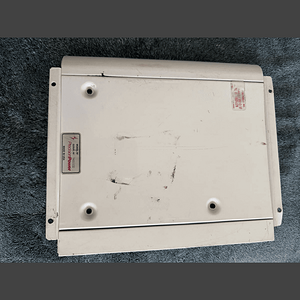
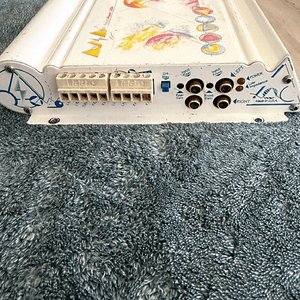
If your lights dim with the beat, or your speakers start smoking without permission, or your CD skips a beat or two, your amplifier may be trying to use more fast energy than the electrical system can supply. Unfortunately, your car's electrical system is not thinking about the needs of your amplifier. Power is being robbed from your audio system by such trifling matters as: the engine and lights. This may leave your amplifier hungry for power, and worse, delivering destructive distortion when it fails to get it.
Understand of course, that no capacitor is a substitute for an adequate amplifier to provide the amount of bass energy you want to project. Nor will it substitute for an inadequate car power supply. You may have to install a stronger alternator if you have one of the more powerful systems. The rest of your system must also be "up to spec" to serve that purpose.
Technically, a capacitor is an electronic device which consists of two rolled up plates of electrically conductive material separated by an insulator known as a dielectric. Within this frame an electrical field charge is developed. The quantum of this charge is the capacitor's value, measured in farads. It is largely determined by the surface area of the plates, the effective distance between the plates, and the chemical composition of the dielectric material.
Audio capacitors are energy reservoirs that store the necessary power your amplifier will need to punch those big bass notes while limiting clipping . They store power during intervals when it is not required, which is most of the time, and release it when a short term transient demand exceeds what is available from the car's power system. A stiffening capacitor for your amp is the simplest way to be sure your system always gets every bit of immediate current it needs.
From the smallest .5 farad, to 10 farads, there's a capacitor suitable for your installation. Mount them as close to the amplifier as possible, and use at least .5 farad (500,000 microfarads) per 500 watts RMS of power output. Using more will not cause problems. On the other hand, it will not contribute to the operation either, and it's easier on the wallet to just get what you need.
Many capacitors are rated for ESR. This is the Equivalent Series Resistance of a capacitor. A perfect capacitor would have only capacitance. All conductors have resistance. In a capacitor, there are many conductors such as terminal leads, foil and even the dielectric electrolyte. The resistance of all of these conductors contribute to the capacitor's series resistance. It's essentially the same as having a resistor in series with an ideal capacitor. Capacitors with relatively high ESR will have less ability to pass current from its plates to the load (the amplifier).
Discharging the Capacitor:
If you plan to remove your capacitor for any reason, you may want to completely discharge the capacitor to avoid a potential hazard. To discharge the capacitor (only after it's disconnected from the system, of course), will need to enable the current to flow from one terminal to the other. You can use either a test light or resistor for this purpose. Some large capacitors tend to develop a charge similar to a battery and will produce a small voltage across its terminals. Since, in a large capacitor (over .5 farad), even a small voltage could be dangerous. After it is discharged, you may want to connect the terminals together with a piece of wire or resistor. Even if the capacitor design doesn't permit it to develop adverse voltages when unused, leave the terminals connected as a visual confirmation of the unit's safety.
Charging with a Resistor:
Many capacitors will need to be intialized with a 10 to 50 ohm resistor connected to the power main for usually 8 to 25 seconds depending on the size. After charging is completed, simply connect the power main VERY Carefully. //content.invisioncic.com/y282845/emoticons/greedy.gif.5a53e6246569d7ab79867170f3b06629.gif