

BrazilianBassBuster
CarAudio.com Newbie
As shared in this thread, I plan on building a large BP6 box with more than 300 L. Since it is tuned to reproduce the 20-60 Hz range at 120 dB, it will need serious bracing. The He15 driver has an amazing peak-to-peak displacement of 5 liters, and it will be fully used.
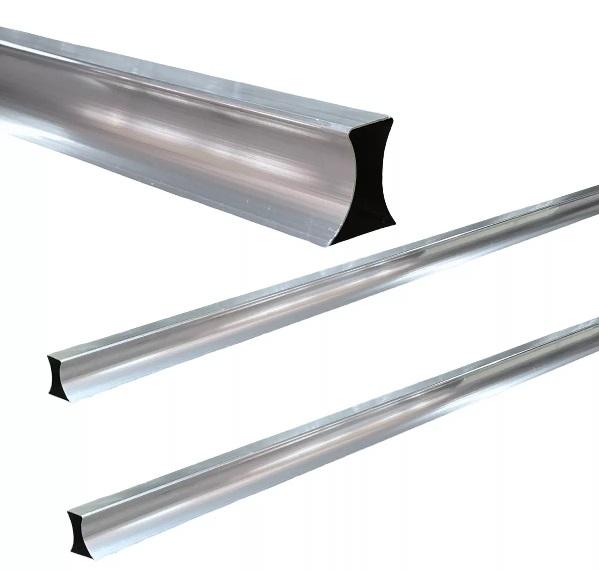
So I'm afraid that the wood of the walls and bracing could add too much volume and make the box too heavy. So I thought about using a thinner wood and bracing it with many aluminum bars like this:
Below is an estimate of the box dimensions:
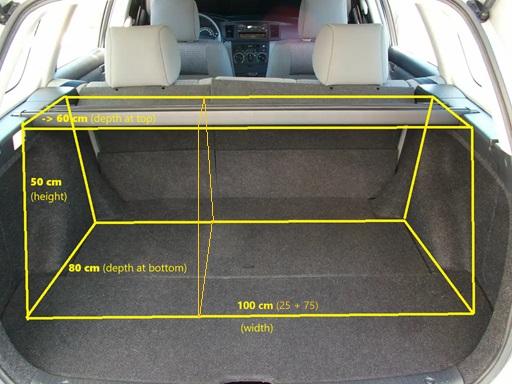
Doing a rough estimation of this as a rectangular parallelepiped measuring 50 x 70 x 100, I get a surface area of 3.1 m² and a volume of 350 m³.
Doing some calculations, I noticed the minimum wood thickness I can use is probably 15 mm. But one square meter of cheap 10 mm plywood already takes up 10 liters and 7 kg. With 15 mm and 3.1 m², the external wood occupies 46 Liters (10 L/m² x 1.5 x 3.1 m²) and adds 32.5 kg (7 kg/m² x 1.5 x 3.1 m²). That is too much.
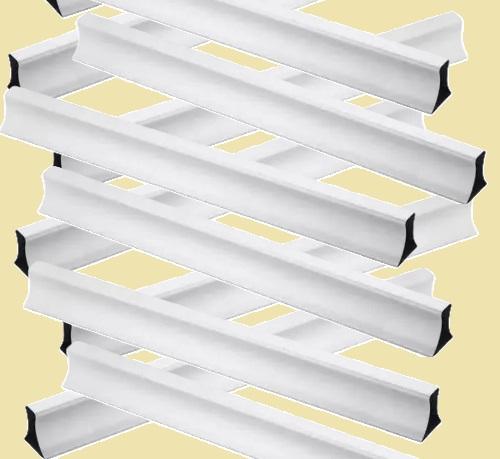
So the idea is to use the aluminum bars every 20 cm, then place a second layer over it, every 30 cm, similarly to this image:
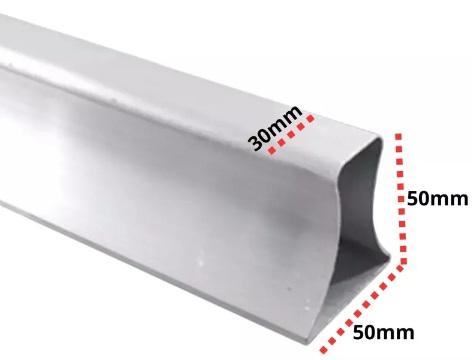
With the 20 cm spacing and 5 cm base, 25% of the internal surface would be covered with aluminum:
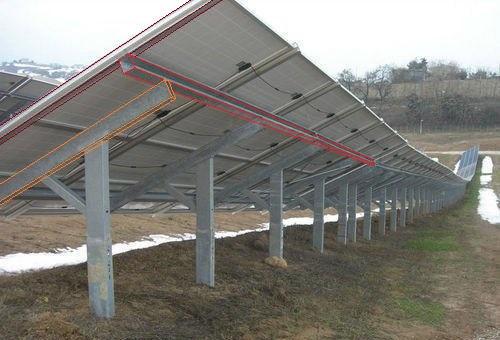
This technique is used to support solar panels. This is a multi-layer example:
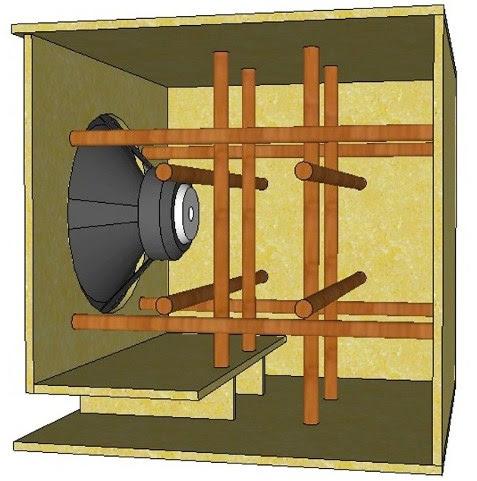
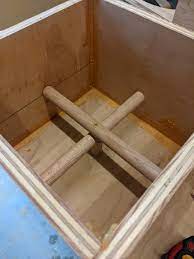
Besides that, I believe I would also have to add some round pieces of wood screwing together the opposing walls:
Now I'd like some feedback, please.
Do those bracing ideas look effective?
With all of that bracing, should it be fine to go with 10 mm plywood instead of 15 mm, even at 120 dB sub-bass?
Has anyone ever had success with thin walls, such as 6 mm?
So I'm afraid that the wood of the walls and bracing could add too much volume and make the box too heavy. So I thought about using a thinner wood and bracing it with many aluminum bars like this:
Below is an estimate of the box dimensions:
Doing a rough estimation of this as a rectangular parallelepiped measuring 50 x 70 x 100, I get a surface area of 3.1 m² and a volume of 350 m³.
Doing some calculations, I noticed the minimum wood thickness I can use is probably 15 mm. But one square meter of cheap 10 mm plywood already takes up 10 liters and 7 kg. With 15 mm and 3.1 m², the external wood occupies 46 Liters (10 L/m² x 1.5 x 3.1 m²) and adds 32.5 kg (7 kg/m² x 1.5 x 3.1 m²). That is too much.
So the idea is to use the aluminum bars every 20 cm, then place a second layer over it, every 30 cm, similarly to this image:
With the 20 cm spacing and 5 cm base, 25% of the internal surface would be covered with aluminum:
This technique is used to support solar panels. This is a multi-layer example:
Besides that, I believe I would also have to add some round pieces of wood screwing together the opposing walls:
Now I'd like some feedback, please.
Do those bracing ideas look effective?
With all of that bracing, should it be fine to go with 10 mm plywood instead of 15 mm, even at 120 dB sub-bass?
Has anyone ever had success with thin walls, such as 6 mm?
Last edited:









