Any way to manipulate the overal impedance(ohms)?

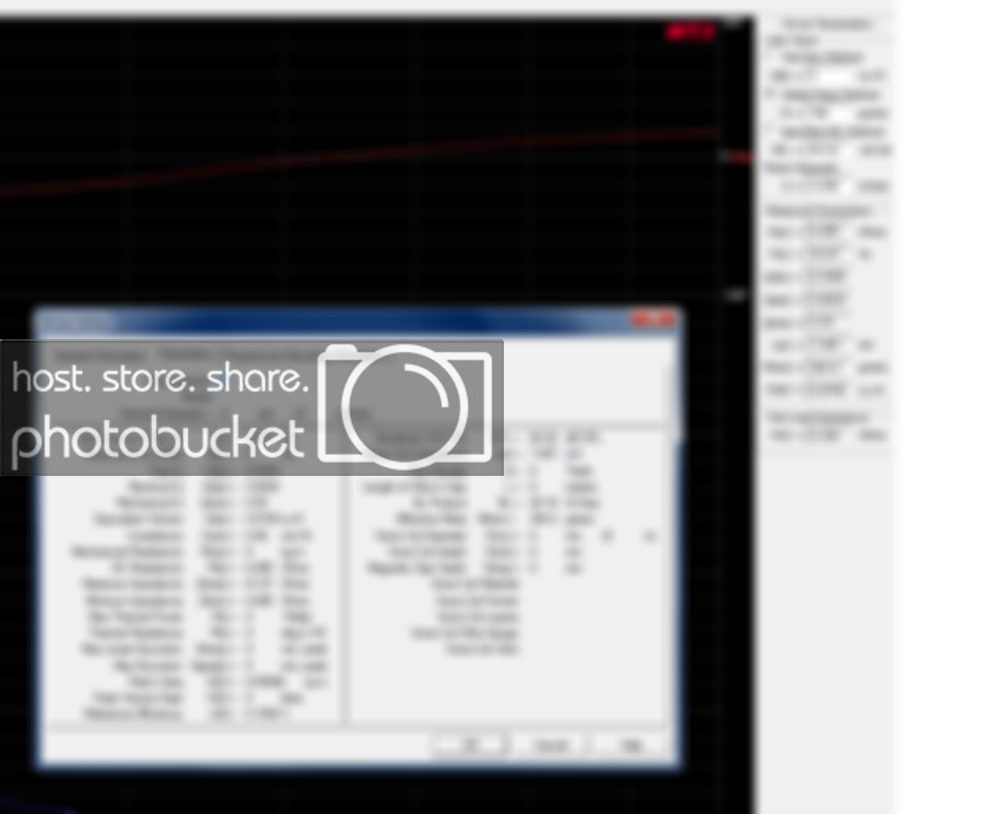
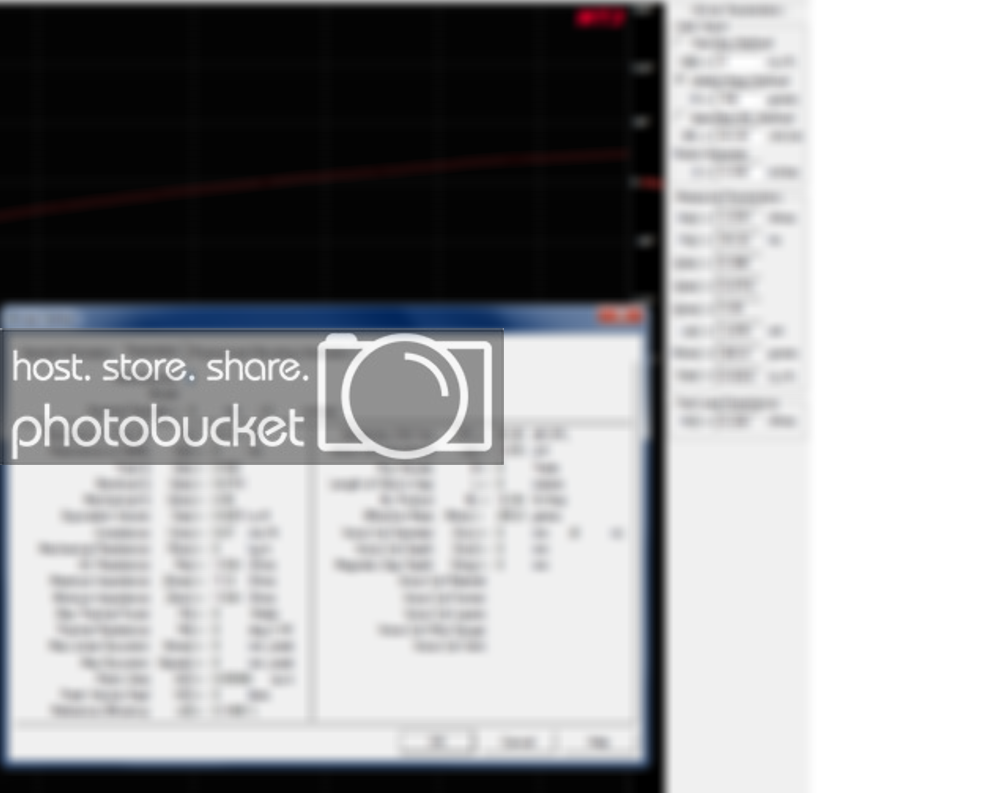
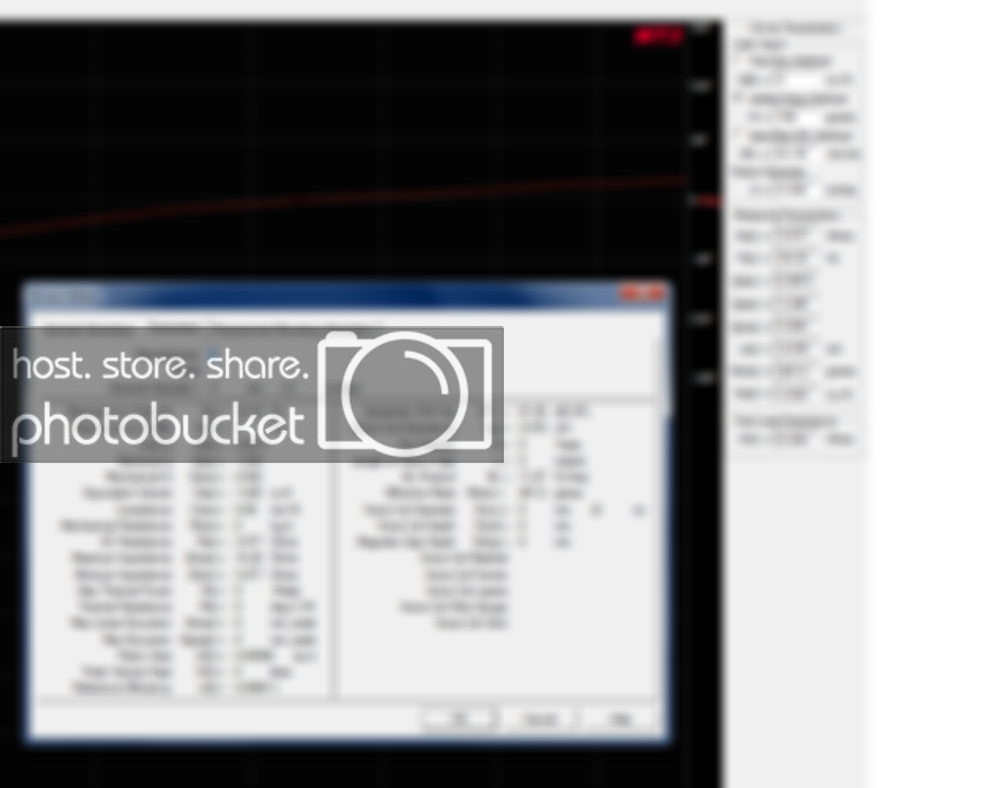
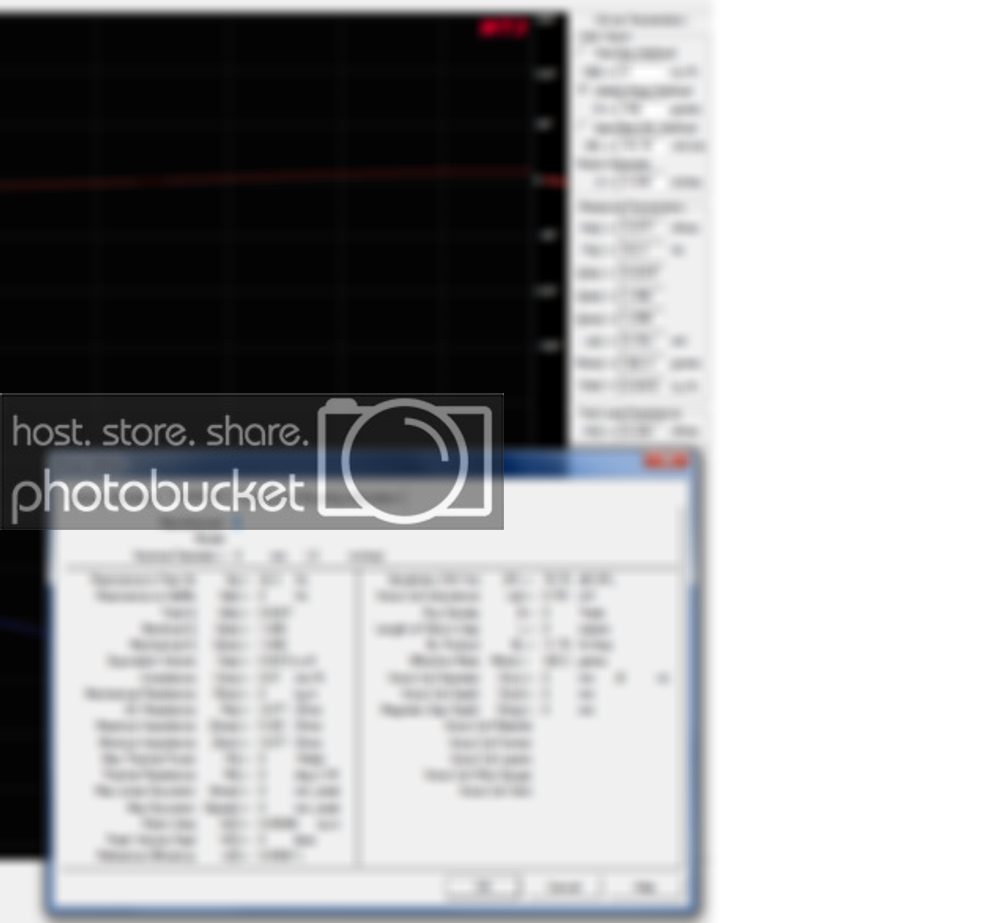
Take a DVC driver, run T/S parameters on a single coil with the other coil open. Make notes.

Run the numbers again on a single coil but with a resistor between the terminals of the unused coil. Make notes.

Run the numbers again on a single coil but with a higher value resistor between the terminals of the unused coil. Make notes.

Run the numbers again on a single coil and short the other coil. Make notes.

Compare notes. Among other things, notice how driver Q changes?

With the unused coil being shorted you have higher braking force (higher electrical damping) than with the coil open. Lower BL, lower thermal limits, lower sensitivity, etc...

 
If you short out the voice coil of a speaker it will take more effort (energy) to move the cone through the magnetic field. Whether you can discern that by "tapping' on the cone I don't know. But actually pushing on it you WILL feel more resistance.
That's exactly what I thought...

If you power a DVC sub with just one coil, the voltage across the unused coil will be exactly the same as the voltage across the powered coil. You have the same number of turns traveling at the same rate through the same magnetic field. It's a generator. Now if you short out the unused coil, current will flow. Power will be consumed. That power must come from the amplifier. More input current, same voltage, means the impedance that's reflected back to the amplifier is lower. This is Physics 101.
I said this earlier and was called incorrect :/

Maylar, I wish you post more often, I think a lot of people on this board would benefit from your knowledge. However being an EE I imagine you have much more important and time consuming things to do then post on a message board. I'm 7 credit hours away from being an official EE myself. //content.invisioncic.com/y282845/emoticons/smile.gif.1ebc41e1811405b213edfc4622c41e27.gif

 
Now if you short out the unused coil, current will flow. Power will be consumed. That power must come from the amplifier. More input current, same voltage, means the impedance that's reflected back to the amplifier is lower. This is Physics 101.
Perhaps we are calling 'shorting out the coil' something different...? Connecting the pos and neg terminals together means the circuit is closed, but there is no anode or cathode for current to flow from or to. So where is this current moving to, and how is it being consumed?

 
Perhaps we are calling 'shorting out the coil' something different...? Connecting the pos and neg terminals together means the circuit is closed, but there is no anode or cathode for current to flow from or to. So where is this current moving to, and how is it being consumed?
A coil moving in a magnetic field develops an induced voltage across it. Shorting it will cause current to flow through the winding, like shorting out one of the secondary windings of a transformer, or the output of a generator. Power is consumed by the coil itself as heat.

From an electrical standpoint I'm looking at it like it's a generator. If there's something unique about speakers that makes this an invalid comparison, I'd like to know where my logic is failing. It wouldn't be the first (or last) time I was wrong.

 
A coil moving in a magnetic field develops an induced voltage across it. Shorting it will cause current to flow through the winding, like shorting out one of the secondary windings of a transformer, or the output of a generator. Power is consumed by the coil itself as heat.
From an electrical standpoint I'm looking at it like it's a generator. If there's something unique about speakers that makes this an invalid comparison, I'd like to know where my logic is failing. It wouldn't be the first (or last) time I was wrong.
No, there is nothing unique about a speaker motor, in the context of this discussion, that Im aware of either. //content.invisioncic.com/y282845/emoticons/wink.gif.608e3ea05f1a9f98611af0861652f8fb.gif Yes, a closed circuit would allowed the induced current to flow, I suppose. But where my confusion comes in is when its suggested this induced current will act as a damper. One coil is powered, and its current creates a magnetic force that reacts to the stationary magnetic field of the slugs. It seems to be a leap in logic to suggest that the induced current presented to the secondary coil would create a perfectly opposite force on the motion of the coil (from the powered coil). So yes, if you were to take your hand and move the cone/coil back and forth, you could/would register voltage on the voice coil (your generator parallel). But again how/why would we assume this current would create an opposite magnetism to the powered coil, thus creating this natural damping situation that's been suggested here. All Ive seen explained is that the shorted coil would generate more heat, which is counter to improving performance, not a benefit.

Im not claiming you are wrong, Im not an EE like yourself. Im asking, and in some cases *somewhat* disagreeing, to further the discussion, and hopefully learn something new in the process.

Good discussion here maylar, cheers for that. //content.invisioncic.com/y282845/emoticons/toast.gif.bc0657bf54b9ee653b6438524461341e.gif

 
No, there is nothing unique about a speaker motor, in the context of this discussion, that Im aware of either. //content.invisioncic.com/y282845/emoticons/wink.gif.608e3ea05f1a9f98611af0861652f8fb.gif Yes, a closed circuit would allowed the induced current to flow, I suppose. But where my confusion comes in is when its suggested this induced current will act as a damper. One coil is powered, and its current creates a magnetic force that reacts to the stationary magnetic field of the slugs. It seems to be a leap in logic to suggest that the induced current presented to the secondary coil would create a perfectly opposite force on the motion of the coil (from the powered coil). So yes, if you were to take your hand and move the cone/coil back and forth, you could/would register voltage on the voice coil (your generator parallel). But again how/why would we assume this current would create an opposite magnetism to the powered coil, thus creating this natural damping situation that's been suggested here. All Ive seen explained is that the shorted coil would generate more heat, which is counter to improving performance, not a benefit.
Im not claiming you are wrong, Im not an EE like yourself. Im asking, and in some cases *somewhat* disagreeing, to further the discussion, and hopefully learn something new in the process.

Good discussion here maylar, cheers for that. //content.invisioncic.com/y282845/emoticons/toast.gif.bc0657bf54b9ee653b6438524461341e.gif
Moving a coil through a magnetic field will induce a torque on the motion. There has to be physical resistance, otherwise it wouldn't take any effort to spin a generator.

 
Yep. Just take a raw driver and set it on the table or floor in front of you. Move the cone outward and get a feel for how much effort it took. Now short the coil and repeat. It should be very noticeable that the braking force is making it harder to move that coil through the flux. Granted, this exercise would be more noticeable on drivers with a somewhat soft suspension and a decent BL figure. Very stiff suspensions with multiple spiders may make it hard to discern the effect.

Or...

If you happen to have a raw coil and motor sitting nearby, set the coil in the gap and move it up and down while noticing the effort it took. Now short the leads and try to move that coil up down.

Viola! Back EMF.

 
Series

Series.png


Parallel

CoilsParallel.png


Open Coil

opencoil.png


Shorted Coil

Shortedcoil.png


Yes, you can alter the impedance via a resistor. That is basically what the old Stinger Accumatch was. But the problem is, all the additional energy your amplifier puts out due to that newly lowered impedance, goes straight into dissipated heat from the resistor. In other words, the speaker itself will see no benefit at all, while your stereo will be drawing more power from your alt/batt that will be completely wasted.
So long answer short, yes. But you wouldn't want to. The Stinger Accumatch was a gimmick.
I believe the Stinger accumatch, just like the Veritas accumatch, is an auto transformer or 'autoformer'. Although such a device will introduce some additional losses (as well as distortion) they do work as intended.

 
IOW, shorting the second coil will not affect damping in any noticeable way. Tapping on the cone of a woofer, shorted or otherwise, proves absolutely nothing, and will sound exactly the same unless psychoacoustics play a role.
ahem?

Don't be so quick to tell people 'it's all in your head'. Shorting the coil is a trick so well known and proven, like in this very thread, that I think you probably might want to take that statement back.

Same goes with autoformers (Accu-match). Those things work but can roast lesser amps.

 
ahem?
Don't be so quick to tell people 'it's all in your head'. Shorting the coil is a trick so well known and proven, like in this very thread, that I think you probably might want to take that statement back.

Same goes with autoformers (Accu-match). Those things work but can roast lesser amps.
Maybe you missed the last few posts on the topic. I already addressed the fact that I was incorrect.

As for the accumatch, I looked up some more info on them since yesterday, it seems I was fed some wrong information on them years ago and they do not work the way I thought they did. I guess Im 0 for 2 in this thread. lol

 
Activity
No one is currently typing a reply...
Old Thread: Please note, there have been no replies in this thread for over 3 years!
Content in this thread may no longer be relevant.
Perhaps it would be better to start a new thread instead.

About this thread

ATN2DETAILING

10+ year member
Senior VIP Member
Thread starter
ATN2DETAILING
Joined
Location
BURBANK
Start date
Participants
Who Replied
Replies
78
Views
3,625
Last reply date
Last reply from
duanebro
IMG_20260516_193114554_HDR.jpg

sherbanater

    May 16, 2026
  • 0
  • 0
IMG_20260516_192955471_HDR.jpg

sherbanater

    May 16, 2026
  • 0
  • 0

New threads

Top