Bumpin Buick's box is 4.5cf tuned to 45hz technically. However the port fires up against the back of the vehicle in close proximity to the back hatch door. This essentially extends the apparent length of the port. The guess is that because most of the woofers peaked around 38hz or so, tuning would be 36-38hz. Next time I come down I'll bring the laptop and measure the impedance curve of the woofer in the box to get the exact tuning. This is a case where the placement of the box not only affects the in vehicle response but actually physically alters the tuning of the box. Clearly his system is intended to be an SPL type system. That is what he has been doing all the testing for. If we had time to measure the transfer function in the 4runner and build a box tuned to the frequency where there is the most cabin gain, Bumpin Buick could easily gain another 4-5dB over what we did in a random box with random tuning. Typical SUV transfer functions have a maximum amount of gain slightly higher in frequency than where that box was tuned.
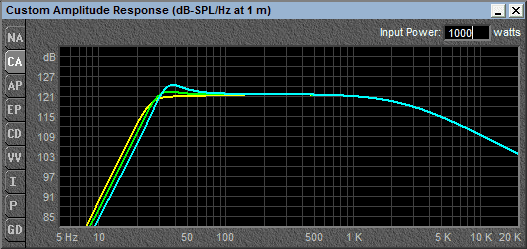
Regardless, the tuning of the box doesn't affect high frequency response much at all. Tuning higher has a very minimal effect at the higher frequencies, but a large effect at tuning. Here is an example. This is a large 5 cubic foot enclosure with tunings of 28, 32, and 38hz.
You can see that there is a difference at and around tuning frequencies, but once you get up to the 70hz range there is virtually no change.
Now lets talk about SQ systems
There are 2 things that affect sound quality specifically with the woofer. One is the response and how flat it is in the vehicle. The other is the amount of distortion produced. It is my goal to create drivers with the lowest amount of distortion possible. To get the lowest amount of distortion with a given woofer in a vehicle , home, etc with that driver means you want the most efficiency in the system. The more output you get with less power input the better. This also gives you more headroom for uncompressed transient peaks. More power means more heat and increases thermal issues and distortion. So, a vented box for a subwoofer will give you much more efficiency at the lowest frequencies than a sealed box. The standard misconception is that you want a sealed box to be "tighter", "faster", etc. However, you get much lower distortion at a given SPL from the vented box.
Now, regarding response, that is another issue to look at. Yes, a low tuned vented box that is flat outside a vehicle is going to have an increase of output down low in frequency in a vehicle. That is an effect of the vehicle regardless of what woofer you ever put in the box. There are then 2 ways to try to flatten response. One, you can try to design your enclosure so the rolloff of the box does the exact opposite of the increase from your vehicle. This isn't very practical though as box rolloff never perfectly matches the transfer function of the vehicle, but is the easiest option and for that reason many people choose to do that. The other option is most ideal, will give the flattest response, lowest distortion, but is more time consuming, more difficult, and requires the use of EQ. This is the same that we do for home theaters, high end recording studios, live sound systems, etc. You design the system to get the maximum amount of clean output you can get, then flatten the response appropriately with EQ. In the end you have the flattest response possible with the lowest distortion.
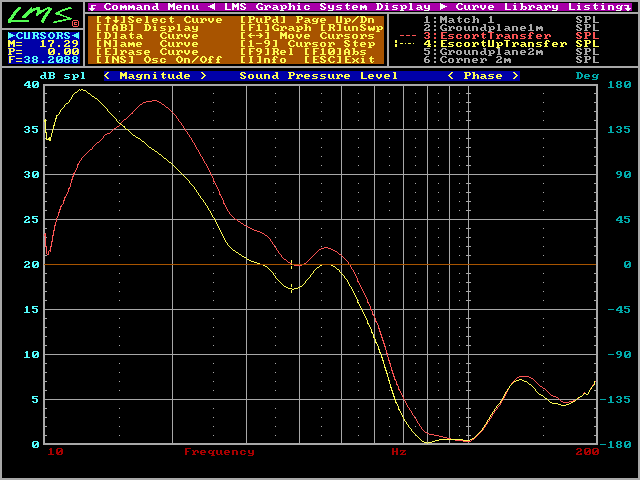
Now, lets look at getting that flat response in a vehicle. In a typical car you have one initial peak around 50hz range followed by another large peak well below that. In an SUV this will sometimes vary. Here is a transfer function from a mid 90's Escort for example, just like Kenny's.
There is one peak about 50hz and then another down at 20hz. Because of the 2 separate rises in gain it is very difficult to get perfectly flat response without some additional type of EQ. However if you draw a line from 70hz to 30hz the closest approximation you get is about an 18dB per octave rise. A sealed box will drop at 12dB per octave. If you had a sealed box with F3 of 70hz you'd flatten the response some, but still have a slightly rising response at 6dB per octave on the low end. You'd also still have the big bump at about 45hz to contend with.
The ideal situation for flattest response of the bass and lowest distortion is often to go with a tuning that creates a peak to fill in the area between those 2 bumps. In this case tuning to 25hz in 3cf with the aV15X does very well. The following graph has 4 curves. The blue is with a sealed box for the AV15X modeled response. Orange is with the AV15X vented 3cf tuned to 29hz modeled response. Then the green curve is what happens with the sealed AV15X with cabin gain included. The yellow is what happens to the vented with cabin gain included.
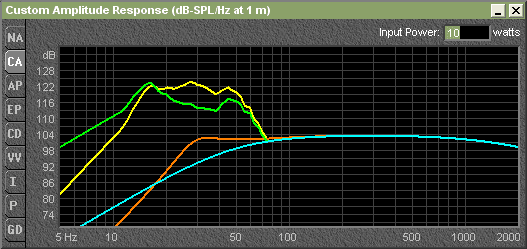
The interesting thing here is that the vented box fills in that dip between the two bumps. The response is +/-3dB from 15hz to 50hz. Distortion for a given SPL is also MUCH lower than a sealed box because the woofer requires only about 20% of the power to get the same SPL's as it does in the sealed box. Excursion is kept to a minimum. Thermal issues are kept to a minimum. All around this is a much lower distortion option. You'll also notice that no matter which box you use the response greatly drops off above 50hz due to the vehicle itself. You can put any woofer in that you wish and the same still happens, it is not an issue with the AV woofers. This is all just general info. If you are looking for SQ only and not concerned about maximum SPL and don't wish to mess with EQ, the sealed box is the way to go. You can always add EQ later to pull out the 50hz bump and taper off the response more if you wish.
The best possible results for SQ though come with the vented box. Again you get a nice flat response 15-50hz. You then have 2 options to fix the bass to the rest of the system. One, you can crossover to your midbass drivers just over 50hz. Then you can simply lower the level of the subwoofer to match the midbass. If you don't have that luxury of having a midbass capable of 50hz, then you can lower the level of that area with a single bandpass filter from 15-50hz to match the rest of the system. You then have MASSIVE amounts of headroom, extremely low distortion bass, and very flat response.
This is again not specific to the AV15.
This is all just general information on getting the flattest response in an SQ system. BUT, you can't say you want an SQ system, then change your mind in the middle and say you want it to punch you in the chest and make you feel like you're going to pass out. The two are just not the same system.
John





 //content.invisioncic.com/y282845/emoticons/confused.gif.e820e0216602db4765798ac39d28caa9.gif


