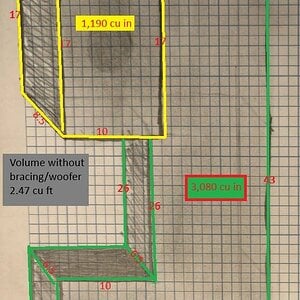
alright, the problem is that most people are not building 4th orders correctly. Yes, you are losing one wave, but in fact, that is a good thing. It keeps the woofer in check with more power. 4th orders are incredibly efficient, especially large ratio (4:1 and up), plus, they have a very wide bandwidth, of course, this depends on design. Now, to properly build a 4th order, you need to start with the sealed chamber. Take your woofers Vas, and divide it by the volume that you think the rear should be in liters, now for an sa12, that would be 21.21/28.3168, then you add 1, which will give you 1.749, now, take the square root of that number =1.323 and now multiply that by the Fs of the driver so you would get 44.569 because the Fs of the sa12 is 33.7hz. Now, the 44.569 that you just got is called the sealed chamber resonance, this is simply just a mathematical guess, but it is a start. I prefer an Fc of about 45-52, depending on the application.
So now you have your sealed chamber size, now, pick what ratio you want to do, I am a fan of large ratio 4ths, simply because of the gained output, but they tend to lack in a transient response and low end (although still much better than that of a bass reflex enclosure because the sealed enclosure has a slow roll off), the ratio that you pick will depend on what sort of efficiency, goals, and space you have.
Now you are almost there, build the sealed chamber, and the ported (front chamber) now the port area should be about half that of the cone area, at least thats where I like to start at, but this will depend on goals and woofers as well. Now, build your enclosure that you have designed, but leave the loading wall off.
the next step is to find the actual sealed resonance of the rear chamber, you can do this with a DATS, or a meter, but I prefer my DATS. if you use a dats, run an impedence sweep and see at what frequency your impedence peaks at, then tune your front chamber to that frequency. The same can be accomplished with a meter and a sine sweep, but like I said, a DATS is the prefered method.
So why a 4th you say? WHEN DESIGNED AND BUILT PROPERLY they can give the woofers a much higher mechanical power handling, have superb low end, play a very large bandwidth, very flat. They are super efficient, the can pretty much do it all. I am not saying that the 4th is the end all be all for any system, I love the ones I have built, and maybe if you feel up to it, you should try one someday, you just might be pleasantly surprised. I am skimping on a lot of info here, simply because it would take me far too long to type all of it.