I'm unsure why I supplied all this information, maybe I foresaw a headache on the horizon... lol
But since I shared I may as well just throw it out there. Its not a comprehensive collection of how to regarding 4th orders but is pretty spot on as to what to seek when designing.
The email:
Are you still designing 4th order bandpass boxes? I know we talked years ago when I was first building a 4th order. I was pleasantly surprised how good the box I designed sounded in a UTV. I've built one with a Sundown E10 that actually sounded pretty good for what it was. I now have 2 separate Kawasaki KRX that I'm putting a 4th order bandpass in the bed with the port cut into the rear window opening into the cab. I already built one for a Sundown Classic SA12 that was a 2.25:1 ratio tuned to 52Hz with a 6"x7" port 13" in length. It hits pretty damn hard but I always wonder if I'm still doing it right or leaving something on the table.
So I've designed another one for the other KRX which will have a Rockford Fosgate P3D4-12. That one also has a 2.25:1 ratio (1ft cubed front chamber, 2.25ft cubed rear chamber) tuned to 50Hz and a 5"x7.5" port ~13" in length. I like a musical box that can play all types of music.....it can go from hip hop to country to hard rock. Below are the WINISD graphs for the RF.
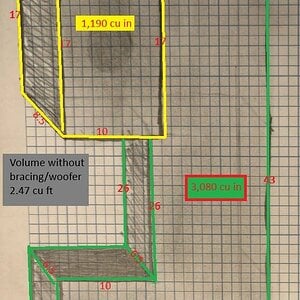
Look good to you or do you think you could design one even better? I have no problem paying but if this is pretty dang close I'd just stick with it. The box itself gets pretty involved so I can fit a cooler behind it. I'll take care of that end of it. The one attached is towards the end of building the Sundown box. I throw the design in sketchup and verify volumes. I used a double baffle with extra support under it and the basket mounted in the rear chamber for cooling. Thanks for your help.
My response:
Right off the bat id offer this advice, as an example a 2:1 4th order should be 2ft3 vented and 1 sealed. This will allow more port area in the vented chamber without excessive port length and because of the additional port area will have greater output potential.
Try to avoid hi ebp subs, they're typically not suitable for a 4th for many reasons I can't list here.
I always tune the front chamber to rear chamber resonance thus the impedance curve will be smooth and equal on both sides of tuning.
Port ratio can affect maximum velocities allowed as a lower ratio port is more efficient.
Always keep in mind that typically a 4th will lower power handling somewhat as band pass 4ths have that sealed side. Best solution but not a total fix is to keep the driver motor in the vented side.
And lastly but probably where most people make a critical mistake is overall ratio. Avoid building a 3:1 ratioed 4th. It'll be peaky around tuning and not musical. I typically design my 4ths between 1.5-2.25:1 ratio depending on how it models up.
The way you are describing your take on 4ths seems to have the ratio backwards. Designing like that needs a huge ratio just to get extension and I'd bet it limits output quite a bit as a side effect.
Try for a tuning between 45-47hz with the greater ratio as the front chamber. Size the sealed so the resonance is in that range then tune the front (start at 1.5:1) chamber to rear resonance. You'll see the impedance curve nice and equal. Then it's time to size the ratio for response.
I'm pretty sure I could improve on your design but I'm unwilling to get too involved when too many space constraints are listed right off the bat. I do this as a hobby not a job so I can walk away before taking on something too involved.
So instead I threw out a bunch of advice, I'm usually unwilling to share all this but in lieu of actually doing the design I am going to help and hope you can absorb all this information and incorporate it into any 4th you build going forward.
Good luck
I'm hopeful this information can help anyone building a 4th, especially newer enthusiasts.
Diy is becoming a thing of the past... lol... I just hope somehow this doesn't expedite the AI takeover somehow .
.
I don't see how as there is always that finer tuning and hard won knowledge predicting how any design reacts in any environment.
Is this thread worth being stickied in this section? And if it is I think allowing additional information or debate to be added would be a good thing.
But since I shared I may as well just throw it out there. Its not a comprehensive collection of how to regarding 4th orders but is pretty spot on as to what to seek when designing.
The email:
Are you still designing 4th order bandpass boxes? I know we talked years ago when I was first building a 4th order. I was pleasantly surprised how good the box I designed sounded in a UTV. I've built one with a Sundown E10 that actually sounded pretty good for what it was. I now have 2 separate Kawasaki KRX that I'm putting a 4th order bandpass in the bed with the port cut into the rear window opening into the cab. I already built one for a Sundown Classic SA12 that was a 2.25:1 ratio tuned to 52Hz with a 6"x7" port 13" in length. It hits pretty damn hard but I always wonder if I'm still doing it right or leaving something on the table.
So I've designed another one for the other KRX which will have a Rockford Fosgate P3D4-12. That one also has a 2.25:1 ratio (1ft cubed front chamber, 2.25ft cubed rear chamber) tuned to 50Hz and a 5"x7.5" port ~13" in length. I like a musical box that can play all types of music.....it can go from hip hop to country to hard rock. Below are the WINISD graphs for the RF.
Look good to you or do you think you could design one even better? I have no problem paying but if this is pretty dang close I'd just stick with it. The box itself gets pretty involved so I can fit a cooler behind it. I'll take care of that end of it. The one attached is towards the end of building the Sundown box. I throw the design in sketchup and verify volumes. I used a double baffle with extra support under it and the basket mounted in the rear chamber for cooling. Thanks for your help.
My response:
Right off the bat id offer this advice, as an example a 2:1 4th order should be 2ft3 vented and 1 sealed. This will allow more port area in the vented chamber without excessive port length and because of the additional port area will have greater output potential.
Try to avoid hi ebp subs, they're typically not suitable for a 4th for many reasons I can't list here.
I always tune the front chamber to rear chamber resonance thus the impedance curve will be smooth and equal on both sides of tuning.
Port ratio can affect maximum velocities allowed as a lower ratio port is more efficient.
Always keep in mind that typically a 4th will lower power handling somewhat as band pass 4ths have that sealed side. Best solution but not a total fix is to keep the driver motor in the vented side.
And lastly but probably where most people make a critical mistake is overall ratio. Avoid building a 3:1 ratioed 4th. It'll be peaky around tuning and not musical. I typically design my 4ths between 1.5-2.25:1 ratio depending on how it models up.
The way you are describing your take on 4ths seems to have the ratio backwards. Designing like that needs a huge ratio just to get extension and I'd bet it limits output quite a bit as a side effect.
Try for a tuning between 45-47hz with the greater ratio as the front chamber. Size the sealed so the resonance is in that range then tune the front (start at 1.5:1) chamber to rear resonance. You'll see the impedance curve nice and equal. Then it's time to size the ratio for response.
I'm pretty sure I could improve on your design but I'm unwilling to get too involved when too many space constraints are listed right off the bat. I do this as a hobby not a job so I can walk away before taking on something too involved.
So instead I threw out a bunch of advice, I'm usually unwilling to share all this but in lieu of actually doing the design I am going to help and hope you can absorb all this information and incorporate it into any 4th you build going forward.
Good luck
I'm hopeful this information can help anyone building a 4th, especially newer enthusiasts.
Diy is becoming a thing of the past... lol... I just hope somehow this doesn't expedite the AI takeover somehow
.I don't see how as there is always that finer tuning and hard won knowledge predicting how any design reacts in any environment.
Is this thread worth being stickied in this section? And if it is I think allowing additional information or debate to be added would be a good thing.