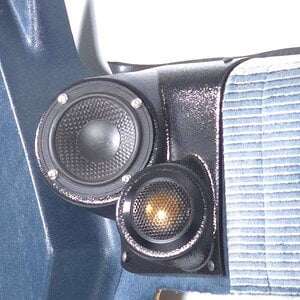
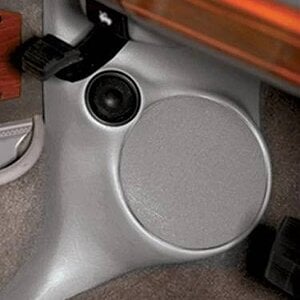
Not a fan of center channel use.
*NOTE*
I understand people like full-range rear output, minimalistic - limited/narrow bandwidth, differential rear fill, surround sound, and other saturated listening environments, not for or against, just talking about a 3-way setup and staging.
I already have a Dolby Atmos 9.4.4 for my HT setup, for both discrete listening and any manner of surround or multi-channel playback - strictly stereo in the car.
I dealt with all kinds of different recording and mixing applications when getting my sound engineering certs.
What you come to realize is that almost everything (musically speak-er-ing) you're going to listen to is mixed for stereo playback, not Atmos or other forms of discrete or simulated multi-channel playback.
A sound engineer is going to get with the artist, and together they are mixing to create the stage, in stereo, that they want you to hear in your mind's eye.
Using the center channel, for me, simply moves the stage forward or backward, and it does muddy the stage a bit.
Using a 3-way setup allows you to further control the beaming and staging (height), fairly dramatically, over a conventional 2-way.
It allows you to move the entire stage upward and outward, which is not really possible (to the same degree/level) with a conventional 2-way
And the reason I always start with 3-400hz in the doors for my midbass, 250-300hz to 3.5k for the mids (usually in a .5 to 1L sealed/stuffed enclosure or IB where possible.
Not using a center channel also helps in dealing with crossover-induced phase issues, as anytime you assign "different" x-over frequencies to any of the drivers in the stage, there's potential phasing anomalies/issues, even if it's just a center channel.
Using a good quality DSP may also negate phase issues, as they generally have very linear phase-neutral bandpass reproduction output before amplification.
The use of a 3-way stage can essentially negate most issues with beaming, nulls, etc., at least to the extent that one can, before final tuning in a vehicle environment.
The next thing is location, temp mount your drivers, measure, listen, measure, adjust, measure, listen, adjust, etc.
Once all is as flat as can be, then attenuate to personal taste.
If you've done what you can for location, crossovers, etc, then you tune to a single seat for personal playback, in the best stereo stage you can master, that is the best for your front stage in the auto environment.
AND
You're now listening to it the way it was meant to be heard, by the artist and the mixing engineer.
Now, let's talk about pro-style, multi-driver, balls-to-the-walls LAF tuning...