why exactly does impedance change?

IgnoreMe
5,000+ posts

CarAudio.com VIP
just thought of this recently and a google search didnt end up with any real good info.

anyways, im wondering, how come resistance changes when the coil is moved inside the motors magnetic field?

one would think that being set to read ohms using a dmm and connecting to the speaker terminals, that the impedance should stay the same (yet we all know this isnt the case). i mean, your connected to something physical (the coil in essence), which has a set impedance. so why exactly does moving it change its value?

im assuming the magnetic field is what effects it, but how does a magnetic field affect a resistance value of something physical? //content.invisioncic.com/y282845/emoticons/confused.gif.e820e0216602db4765798ac39d28caa9.gif

ps: only info i found was on something called "field impedance" but i got confused by the article //content.invisioncic.com/y282845/emoticons/crap.gif.7f4dd41e3e9b23fbd170a1ee6f65cecc.gif

 
The coil has a set resistance, not impedance. Impedance by its very definition is variable with frequency since it includes resistance to the change in current caused by inductance as well as capacitance. Add a secondary fixed magnetic field that the coil is moving within and now you have back-EMF to deal with as well. The coil acts like a generator with the current induced by the coil moving in the motor's field working opposite the current flow from the amp. The amount that the cone moves determines the back EMF which is evidenced by the impedance being he highest at Fs in a free-air environment where the cone is moving the most.

 
The coil has a set resistance, not impedance. Impedance by its very definition is variable with frequency since it includes resistance to the change in current caused by inductance as well as capacitance. Add a secondary fixed magnetic field that the coil is moving within and now you have back-EMF to deal with as well. The coil acts like a generator with the current induced by the coil moving in the motor's field working opposite the current flow from the amp. The amount that the cone moves determines the back EMF which is evidenced by the impedance being he highest at Fs in a free-air environment where the cone is moving the most.
shit, i should of mentioned, im talking about like when im pushing on the cone by hand //content.invisioncic.com/y282845/emoticons/crap.gif.7f4dd41e3e9b23fbd170a1ee6f65cecc.gif . like say the sub is not hooked up to any power so there is no current going through the coil.

for example, when im hooked up to the sub with the dmm, it says 2 ohms. when i push on the cone the value changes. no power is running throught he coil. im just simply putting it from point a to point b and holding it there.

i was trying to take out amplifier power, and an actual freq, as variables that would change the reading. im having a hard time grasping why the resistance reading changes with no power hooked up. ive always accepted it and thought nothing of it, but now yeas later, i am wondering why.

 
Frequency, heat, whether it's at rest or not... etc, etc.
nG
i know that ng, im just wondering why the resistance of the physical coil actually changes.

i mean if i hook my dmm up to a 2 ohm resistor, i can move it, kick it, piss on it (well maybe not that), and it will always read 2 ohms.

so why, when i hooked up to the coil ( something that has a given resistance), does the resistance change, when you would expect it to stay the same. i mean, when the cone moves, the coil doesnt change its properties, yet the resistance still changes. if i were to take the coil out, set it down, and measure it, it would always give me 1 reading, but when its in the motor its resistance properties change.

helotaxi explained it to me, but he mentioned actual current running through the coil a couple times in the post. i forgot to mention i was talking about no power in the circuit (as i explained earlier, so that there is no variables). so im just trying to basically understand if his explanation is also accurate for when there is no power in the circuit.

 
i know that ng, im just wondering why the resistance of the physical coil actually changes.
This is your core question at heart, so I'm addressing this alone.

The resistance of the physical coil itself does not change... take a recone for example... the coil itself sitting in an outside/open environment. It stays the same, say except when you apply extreme heat or cold. (Think a physics lab not sure if you ever had college physics).

When the coil is introduced into the magnetic gap of the motor, it begins to be affected by its environment. Since the coil is in a magnetic gap, it will change. IMPEDANCE but not resistance.

When AC voltage is introduced into the system (by an amplifier), it becomes and electromagnet and that is where impedance changes with frequency etc.

It's not the end all explanation, maybe Neil will show up an post something //content.invisioncic.com/y282845/emoticons/wink.gif.608e3ea05f1a9f98611af0861652f8fb.gif...

Hope it helps.

nG

 
shit, i should of mentioned, im talking about like when im pushing on the cone by hand //content.invisioncic.com/y282845/emoticons/crap.gif.7f4dd41e3e9b23fbd170a1ee6f65cecc.gif . like say the sub is not hooked up to any power so there is no current going through the coil.
for example, when im hooked up to the sub with the dmm, it says 2 ohms. when i push on the cone the value changes. no power is running throught he coil. im just simply putting it from point a to point b and holding it there.

i was trying to take out amplifier power, and an actual freq, as variables that would change the reading. im having a hard time grasping why the resistance reading changes with no power hooked up. ive always accepted it and thought nothing of it, but now yeas later, i am wondering why.
As soon as you push on the cone, you are generating current in the coil. This is the back-EMF. You are moving a coil of wire in a magnetic field; a basic generator.

 
Gauss' Law.

That of a Gaussian surface, in this case it would be a cylinder. You can take it from there if you read up on Gauss' Law. You learn this stuff in Electromagnetics.

 
Ok, so the first very important distinction to be made.

Electrical Resistance - the measure of an objects opposition to Direct Current through said object

For interests sake:

R = (l*p)/A

The resistance of an object ® is given by the product of the length (l) and the resistivity of the material (p) divided by the cross sectional area of an object (A)

Impedance - the measure of an objects opposition to Alternating Current through said object

Complex Impedance considers two parts...the resistance and the reactance of the object. Reactance is what we really want to look at here, and more specifically, the inductive reactance. A speaker voice coil is, after all, an inductor.

As inductance increases, so does the impedance of the object. This is one of the primary driving forces behind an increase in impedance.

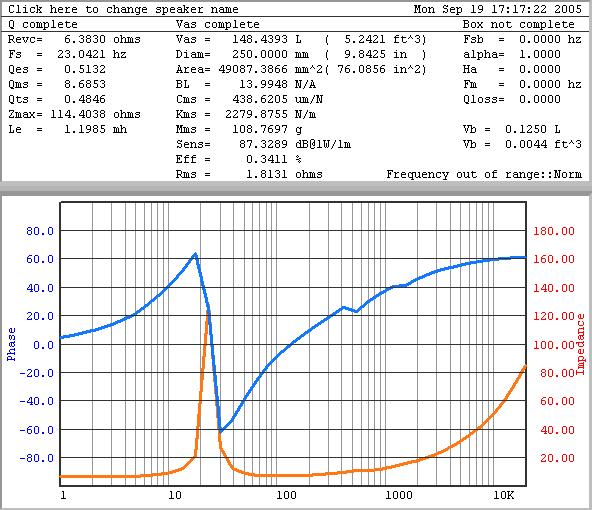
Here is a picture that demonstrates how a speaker's impedance may vary with frequency. Thank you to npdang at http://www.diymobileaudio.com for the image.

impedance.JPG


Take a look at the orange trace. It shows a large spike at the driver's resonant frequency (Fs), then flattens out, then increases proportionally with frequency.

The proportional increase with frequency is due to the rising inductance of the driver. As frequency increases, so does inductance, and so does impedance.

What else can cause impedance to increase? Well, we know that inductance increases with the amount of current flowing through the conductor (Linkwitz, Klippel, et al), so increased current can cause impedance to increase as well. And because we've made that crucial link between inductance and impedance, we can assume that impedance will increase in the rearward direction due to Back EMF (Back ElectroMotive Force).

Back EMF is the source of opposition to current flow (also sometimes referred to as CEMF, or Counter ElectroMotive Force). Back EMF is caused by a change in the electromagnetic field. Back EMF increases when the coil moves in the rearward direction because the magnetic field changes significantly in the rearward direction...the permeability of the free space changes. So EMF increases and impedance increases in the rearward direction.

For a subwoofer specifically, capacitance causes the largest increase in impedance. Where inductance (and therefore impedance) increases proportionally with frequency, capacitance (and therefore impedance) is inversely proportional to frequency. At resonance, the speaker network (as described by Olsen, Thiele, Small, et al) has an increased capacitance. Since this occurs at low frequencies, there is a very large spike in capacitance (and therefore impedance). This can be seen in the image I linked to above as the large impedance spike (on the orange trace) around resonance (below 30 Hz).

Why does a speaker's impedance change from one box to another? Well, the air inside and outside the enclosure represent an additional....environmental, I suppose....impedance to movement. So you have impedance rise from the enclosure as well.

And lastly, even the amplifier introduces some back EMF, so changing the amplifier can cause changes in impedance from one system to another.

There are a lot of different reasons why impedance changes. Even temperature plays a part. In moving electromotive designs such as a speaker, predicting changes in impedance in every aspect is not a simple task.

Perhaps not the best explanation, but hopefully it helps.

Different homework you can read:

1. Gaussian Law

2. Lenz's Law

3. Klippel's paper on driver Non-linearities.

All can be found using google.

 
helotaxi, ng, neil: thank you, i appreciate the info guys! will be doing some more reading as well //content.invisioncic.com/y282845/emoticons/wink.gif.608e3ea05f1a9f98611af0861652f8fb.gif

 
dd, you make very technical posts. Unfortunantly you spend a lot of time on small details and miss key concepts.

do not be discouraged by the following, but try to take in some of it and think about how simple things can be expressed by technicalities, and not the converse (how technicalities can describe simple things) :

1.) capacititance is shown in the plot, but not where you say -- notice impedance phase is positive below 30hz!

2.) EMF is the long road to the answer. the short road is "transducer". a transducer converts electrical energy into mechanical energy and vice versa.

3.) resistance represents "used" energy, and things that use energy.

4.) reactance (inductance, capacitance) represent things that can store and release energy.

5.) From 3 and 4, it seems that mass and springiness can take energy from the electical system (when the cone is forced to move) and return it later. Mass pulls the coil through the gap, and sprininess pushes it back. these are opposite, just like inductance and capacitance.

6.) air also has mass and compliance -- and as such can affect the mechanical system that is the cone, which in turn affects the electrical system.

7.) impedance is maximized (in free air) at Fs. The impedance is based upon the coupling across the gap (BL), as well as Fs, Mms, and/or Cms (as knowing 2 gives you the other).

8.) increasing Kms without increaseing Fs (eg, increasing Kms and Mms) will cause the impedance peak to rise.

9.) The bandwidth of the peak will give you Qms (for free air)

10.) a box will change Cms (by an amount given by Vas and Vb), and thus changes Fs, and Qms, and Qes, and thus Qts.

edit -- and at resonance, inductance (mass) and capacitance (springiness or opposite of compliance) is balenced. it can be seen as the mass (inductance) transfering all of its energy to the spring (capacitance) each cycle, and losing an amount given by the resistance on each cycle -- the amp must/can only provide only an amount of power equal to this loss on each cycle. this resistance is made up of various things, such as mechanical losses, and acoustic energy that is abosorbed.

 
Hello all,

Brand spanking new to this forum. Although, I have been active in others for over 10 years. I hope to pop in here once in a while and learn a little / contribute a little. Some of you may know me from rec.car.audio, ECA, or DIYMA.

IgnoreMe,

I see others have baffled you with techno-lingo that even they themselves may not fully understand. Hell, I've designed electronics for 15 years and still do not grasp the entire electro-mechanics of a simple fuggin loudspeaker.

To make it simple. A conventional DMM measures resistance by sending a known current through a resistive load and measures the voltage drop across it. Ohms law states V=IxR. You can re-arrange this to read R=V/I. So, if you know current, and can measure voltage, you can calculate resistance.

Now, a loudspeaker is a transducer. In case of a loudspeaker, this means that if you supply a current to it, it will move. On the contrary, if you move it, you will induce a current.

Now think about that DMM forcing a current through the voice coil to take a resistance measurement. Push on the cone and you'll induce a current that will either add or subtract from the current being injected buy the meter. The meter knows no different and calculates resistance based on whatever it sees. In this instance, by pushing the coil you are corrupting its reading.

That is why you see the resistance measurement change when you monkey with the speaker.

Is this good enough?

Ge0

 
IgnoreMe,
I see others have baffled you with techno-lingo that even they themselves may not fully understand.
Thats because they're too busy deciding which is more important to explain to him - the electrical characteristics specifically or the interaction of electromechanics //content.invisioncic.com/y282845/emoticons/laugh.gif.48439b2acf2cfca21620f01e7f77d1e4.gif Either way, Ge0's answer was a bit more down to earth for feeding the masses on a car audio fourm.

 
Hello all,
Brand spanking new to this forum. Although, I have been active in others for over 10 years. I hope to pop in here once in a while and learn a little / contribute a little. Some of you may know me from rec.car.audio, ECA, or DIYMA.

IgnoreMe,

I see others have baffled you with techno-lingo that even they themselves may not fully understand. Hell, I've designed electronics for 15 years and still do not grasp the entire electro-mechanics of a simple fuggin loudspeaker.

To make it simple. A conventional DMM measures resistance by sending a known current through a resistive load and measures the voltage drop across it. Ohms law states V=IxR. You can re-arrange this to read R=V/I. So, if you know current, and can measure voltage, you can calculate resistance.

Now, a loudspeaker is a transducer. In case of a loudspeaker, this means that if you supply a current to it, it will move. On the contrary, if you move it, you will induce a current.

Now think about that DMM forcing a current through the voice coil to take a resistance measurement. Push on the cone and you'll induce a current that will either add or subtract from the current being injected buy the meter. The meter knows no different and calculates resistance based on whatever it sees. In this instance, by pushing the coil you are corrupting its reading.

That is why you see the resistance measurement change when you monkey with the speaker.

Is this good enough?

Ge0
yes that makes a lot more sense.

i always like to see DD's response to technical questions. unfortunately i usually have to go back to understand the terminology as im just not familiar with any of it.

i appreciate everyones responses though. there arent very many times when i learn new shit on this site anymore lol, so when i get answers that are more in depth, like in this thread, i feel like im still learning new shit instead of being stuck with the same crap over and over again.

 
Thats because they're too busy deciding which is more important to explain to him - the electrical characteristics specifically or the interaction of electromechanics //content.invisioncic.com/y282845/emoticons/laugh.gif.48439b2acf2cfca21620f01e7f77d1e4.gif Either way, Ge0's answer was a bit more down to earth for feeding the masses on a car audio fourm.
Thanks Snoopdan. BTW, that is a righteous avatar!!! The Hoff AND Coleman!!!

Ge0

 
Activity
No one is currently typing a reply...
Old Thread: Please note, there have been no replies in this thread for over 3 years!
Content in this thread may no longer be relevant.
Perhaps it would be better to start a new thread instead.

About this thread

IgnoreMe

5,000+ posts
CarAudio.com VIP
Thread starter
IgnoreMe
Joined
Location
caraudio.com
Start date
Participants
Who Replied
Replies
16
Views
2,046
Last reply date
Last reply from
Flipx99
IMG_0710.png

michigan born

    May 14, 2026
  • 0
  • 0
IMG_0709.png

michigan born

    May 14, 2026
  • 0
  • 0

New threads

Top