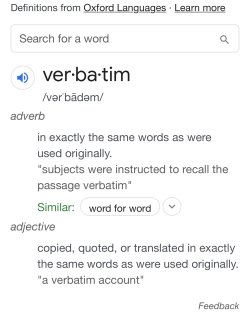
Yes. Exactly the same words as were used originally.
It does not say ALL of the words used originally.
The Cambridge Dictionary references this example of “verbatim”. Pay very CLOSE attention: “I can remember lines from movies verbatim”
Notice it says “lines from movies” and not EVERY line from movies, yet still describes the memorizing as “verbatim”. As in “word for word”. No alteration of the words within the quote. Identical.
Here’s another explanation. Note that in the example provided, they use a PARTIAL quote of the original text to show how it works:
Plagiarism, collusion and other examples of misconduct

academicintegrity.unimelb.edu.au
Verbatim copying/direct copying example
What is it?
When parts of another person's work are copied directly and presented as your own work. Any use of the exact words of another person or organisation should be placed in quotation marks (“ ”) and cited appropriately, in accordance with the conventions used in your field of study or discipline.
Scholarship example
Original referenced text
The shifting fortunes of war had a terrible impact, and not just on those who were killed or maimed in the fighting. When the republican General Custine's forces took the city of Mainz in the Rhineland in October 1792, local patriots created a Society of Friends of Liberty and Equality with five hundred members, adapted their own version of the 'Marseillaise', the 'Bürgerlied der Mainzer', and planted a liberty tree.
Text used with permission, from p. 182 of: McPhee, P. (2016).
Liberty or death: The French revolution. Yale University Press.
Note: This reference is formatted in APA 7 style. See
Re:cite for other styles.
Good scholarship
After the capture of the city of Mainz by General Custine, “local patriots created a Society of Friends of Liberty and Equality with five hundred members” (McPhee, 2016, p.182).
Sorry, but all the name calling in the world isn’t going to change the rules of writing, and it isn’t going to make your opinion correct.