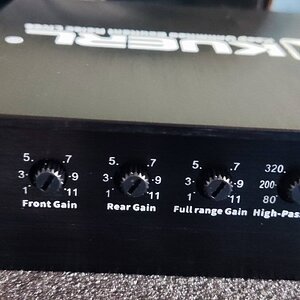
I guess if you are willing to risk the possibilty of frying it, yup, I agree, you gotta start somewhere. Hope it wasn't too expensive of a learning curve! //content.invisioncic.com/y282845/emoticons/tongue.gif.6130eb82179565f6db8d26d6001dcd24.gifI have a nice zapco amp im gonna try and fix I think I know what I did wrong. But the crossfire is toast! I have to start some where dont I?
+100000 x 10^100!this all sounds incredibly far fetched. I'd like to see what you think you're doing that leads to any of these being true.
What the heck is capacitor efficiency? Are you talking about how much leakage a capacitor has? If so, that is so small its not even worth talking about. All of those capacitors are wired in parallel. Adding more capacitors actually REDUCES the ESR (equivalent series resistance) and makes the entire system more robust.If you went down to get more material, you were not done. So the amp wasn't complete, you didn't have it set right.
I didn't see the username who said this seems far fetched, but removing as much resistance from the line as possible will reduce distortion and also decrease the heat in the amp because there are less items inefficiently handling the power, you must at least agree with this, right?
example 10 capacitors that are each 75% efficient will produce more heat than if you had only 8 or 5, etc. right?
Also, wouldn't you have less distortion if you could run from source directly to speaker but the connected line adding additional power (not possible of course, but ideal) than if you had to run from the source, through a line, to an amp running a separate power and ground, through, components of the amp that are usually only matched by +/- .5% at best to the reference and then out through another set of wires to a speaker.
shut up this is CA.COM you have few posts therefore are dumb GTFO he is gunna use monster wire next time and this won't happen+100000 x 10^100!
Removing internal capacitors helps an audio amp? WTF... and you want to talk about increased distortion???? Those caps are there to regulate the switching power supply. They keep the DC that is going to the audio section of the amplifier at DC. Without those caps, your transistors will not have a solid DC supply. They will have a big DC voltage offset with a bunch of AC voltage on the same line and this will CERTAINLY increase distortion.
What the heck is capacitor efficiency? Are you talking about how much leakage a capacitor has? If so, that is so small its not even worth talking about. All of those capacitors are wired in parallel. Adding more capacitors actually REDUCES the ESR (equivalent series resistance) and makes the entire system more robust.