And I still don't agree with the EQ part. How on earth is lowering my low-end with an EQ going to make me happy, when I want more low end than I already have?
I think expectations are a big part here too. Your original goal was for it to sound good, so I gave you suggestions on that. I have spent hours and hours in AIM discussing things and trying to help you figure out the problem. First your sub output on your head unit didn't work, but you swore up and down that everything was fine in the signal to the amp. Now because the sub output doesn't work you have it run off the front output, getting the same signal as your front stage. This means they are getting the same signal but at a time delay due to the distance and there will be some cancellation between them at the crossover frequency. I've suggested playing around with raising the LPF all the way up to get a better idea of what's going on. I've suggested adjusting the phase on the subwoofer amp which would eliminate the cancellation once the phase is correctly aligned. Your amplifier is rated at 75x2 or 300W bridged at 4ohm. Yes, they have a birth sheet that says something like 1000W RMS, but that is very misleading. There is a huge difference between RMS, and continuous power which is what you should really look at. RMS power doesn't technically exist. Just power. RMS current x RMS voltage = Power. RMS power is just .707 x the peak power. You can have a power supply cap that for a brief moment will let you deliver a large amount of power and voltage and put this high rating on it. That doesn't mean it delivers that in a real world application. Think about it though. If the amplifier really was able to deliver a continuous 1000W would it make any sense to call it a 150W amp? As a result I asked you to measure voltage and current when you thought things were loud. This would tell you what your amp is really delivering. You are likely well underpowered and have plenty of room to go. I explained how to measure the power to get an accurate check of what is going on. You told me you measured 40 amp which would equate to 6400W being output by your 150W amp. I don't think that is the case. In addition to all of that, your port is way too small. You start to get into power compression issues with only about 200W input and begin losing output from there on up.
You say you want more low end than you already have but also say that the AV15 currently "makes the wipers dance off the windshield with lil john" and makes "my spoiler look like it's about to rip itself to shreds." If you truly have 1000W being delivered to it and no port compression issues, you'll be capable of upper 140dB range at 30hz. That sounds like to most people it is quite loud from what you said yourself, especially with all of the things going against you above. If you want more output, tune it higher at loss of some extension.
It's surely not too much, but killing that as well is going to piss me off more. If the science behind it makes sense, then so be it, I just can't wrap my head around it.
You aren't losing any low end output. You are simply matching the high end output to it. The same as when you match levels on your front stage to the sub.
I don't beleive an EQ should be used on the subs, there's no reason the enclosure cannot be manipulated to fit the vehicle/issue. If it can',t then you aren't using the right driver. If that were teh case, it wouldn't matter what drivers we were using, we could EQ every one of them to give the same response, just different output levels. 1 problem at a time.
Now you are back to wanting flat response where before you wanted an even more exaggerated lowe end than the huge peak you have already. You just can't have both from the same sub. Well you can, but it requires two EQ settings and multiple ports to tune to different frequencies. My DCX2496 has 2 settings for the sub. One is for my daily use system with the small subwoofer. It's flat to under 10hz. The other one is specific for SPL type use, just need to get an amp for this. The daily use system is EQ'd flat and then EQ'd back up to my liking in the region for kickdrum, bass guitar, etc so it sounds how I like it. Loading a different EQ program gives me more output where i need it for SPL. Unfortunately I really do only have a 300W amp for the subs.
One more time, look at the transfer function of the Escort. This was measured from an escort just like yours. It is accurate and it tells you what is going on.
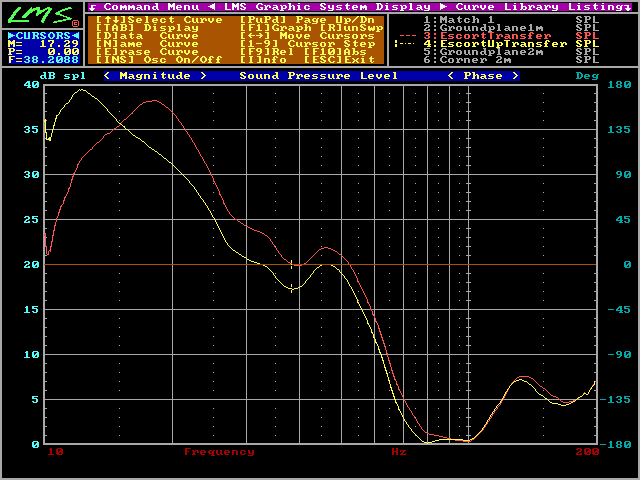
The closest approximation is that the cabin gain is around an 18dB per octave rolloff from 75hz to 19hz if you ignore the bump at 45hz or so. A sealed system rolls off at 12dB per octave so you'll still have significantly more low end than needed to match the upper bass. A vented tuned to 75hz would give you a 24dB rolloff. You need to be right in the middle to get nearly flat, BUT as you said, you still want MORE low end also and aren't looking for flat. You are limited on the upper end to the efficiency of the driver (90.5db) plus the gain from the amp (1000w = 30dB gain) or around 120dB. There is no way around that unless you get more power or more efficiency. That is where the TD18H+ comes in because it is 8dB more efficient. It has the highest Xmax (14mm) of any prosound driver in it's class. It has the lowest distortion and the best power compression as well. You can put in enough power to reach peaks of over 130dB before cabin gain is figured in. Kick drum at only a few feet away at 130dB is LOUD.
Also still possibly considering the 18. My logic says the 18 makes sense at least. Same displacement as the AV15, more efficient, john claims 8db more at 70Hz, therefore it should get louder up there, no??
Yes, 98dB 1W/1m, 8dB or so louder than the AV woofers. High efficiency with very low power compression and distortion. Regardless though you still need to look at the other issues you are having. They will apply to any woofer.
John








