Hi everyone. Sorry I'm late here, but I thought some of these things had been cleared up in the past but apparently they were not. Regarding the original question. The AV15H and TD18H+ have almost equal displacement capability down low. The AV15 has 23mm Xmax but smaller Sd and the TD18 has 14mm Xmax but larger Sd. Both have 2.5" coil with the full copper sleeve next to them. Power handling is almost identical. We have prosound customers running the TD18H+ with 2500W on a nightly basis. Elite Audio is able to get output in the range of 145dB at the stage for live events with their stack of them. They abuse them quite a bit with no issues. I will have a single TD18H+ in the truck when I bring it up to Michigan Tech. Bose301's can give you his thoughts after the 18th.
Now regarding the current situation. Lets look at a few things. The AV15X is about 90.5dB 1w efficiency or 94.3dB 2.83V sensitivity. The AV15X is flat to over 2KHz where it then has a really nasty cone breakup. The output you have up high is not determined by the enclosure but only the woofer and power applied. Also cabin gain is pretty much non-existent above 70hz or so. Regardless if you apply 1000W you are gaining 30dB over the 1W efficiency no matter what woofer you apply it to. That doesn't take into account any losses due to power compression though which could be a few dB if the coil temperature goes way up after continual use. Regardless that is the rage of 120dB. This is significantly higher than most any front stage is going to get. The best Scan Speak, Seas Excel, etc will get you around 110dB max at full input power. Nearly all dome tweeters regardless of silk, alum, titanium dome, etc are going to be limited to much less output than that. This means with no cabin gain at those high frequencies you have significantly more output than almost any front stage could ever match. Obviously there are some extreme options out there which can exceed those levels but for the most part that gives you an idea.
I'll copy a lot of this from the CAF post that went through most of this and the issues before.
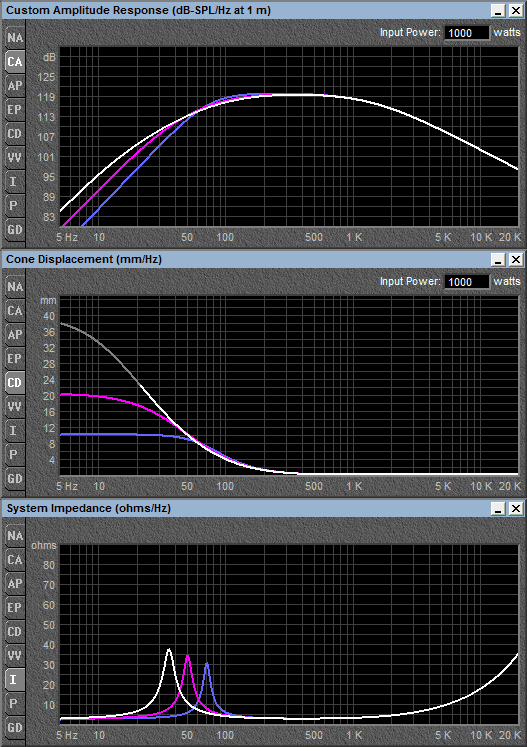
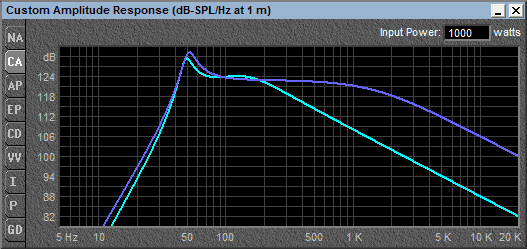
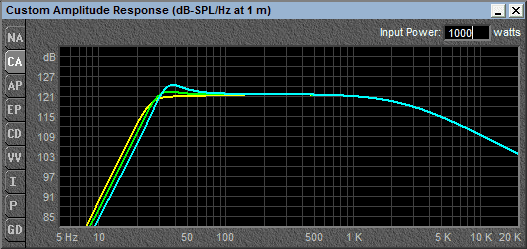
As far as box design goes, you can put the woofers in really any size sealed box, vented box, or PR box you wish. The woofer honestly does not care what box it is in. You get different shape curves with various tunings and box sizes. The AVH is intended more for high tuned SPL applications OR for smaller sealed or PR enclosures. The AVX is more for everyday use and can be used in mid to large size sealed or vented boxes. Below are various curves I have modeled for people.
Here are 3 suggested sealed enclosures for the AV12H
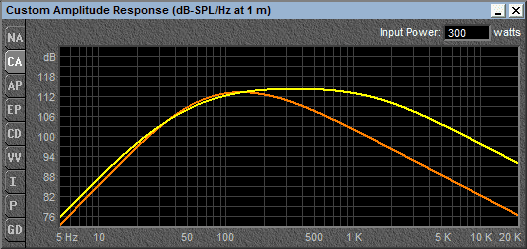
AV12H vs IDQ 1cf sealed comparison. Yellow is the AV12H
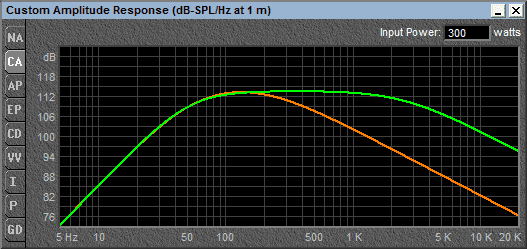
AV12X vs IDQ 1cf sealed comparison. green is the AV12X
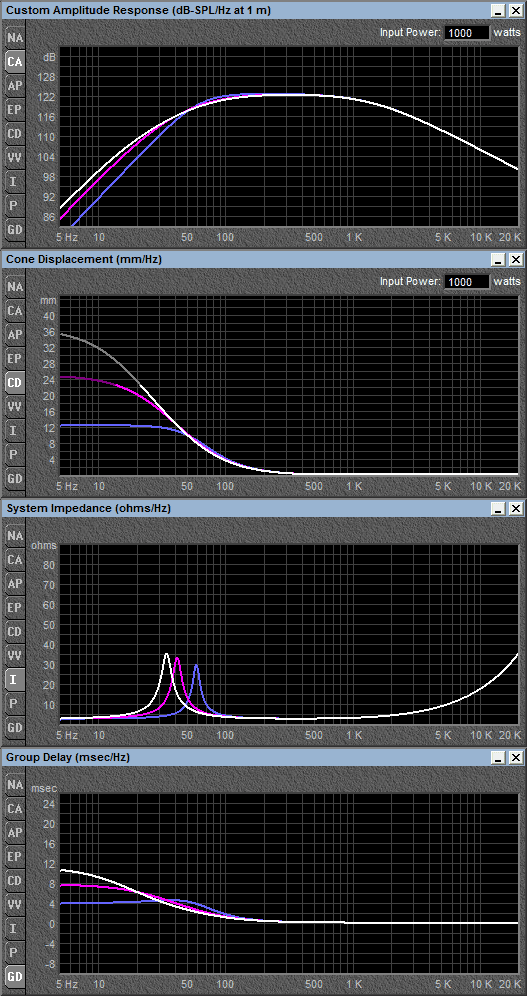
AV15H suggested sealed enclosures
AV15H vs DD9515G in an the DD suggested SPL Tune. AV15H is the dark blue
Single AV15X with various tunings
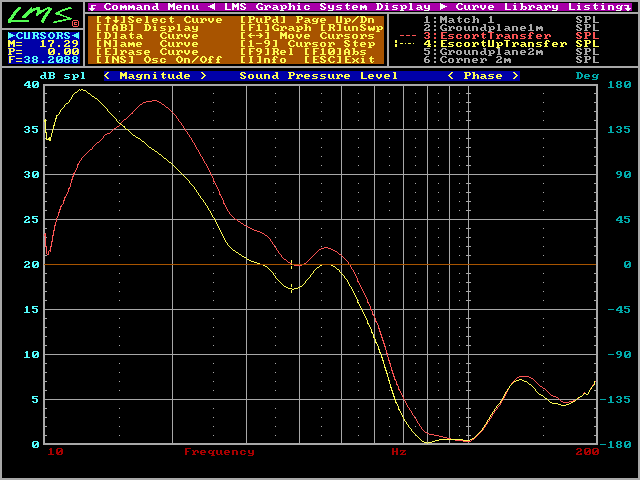
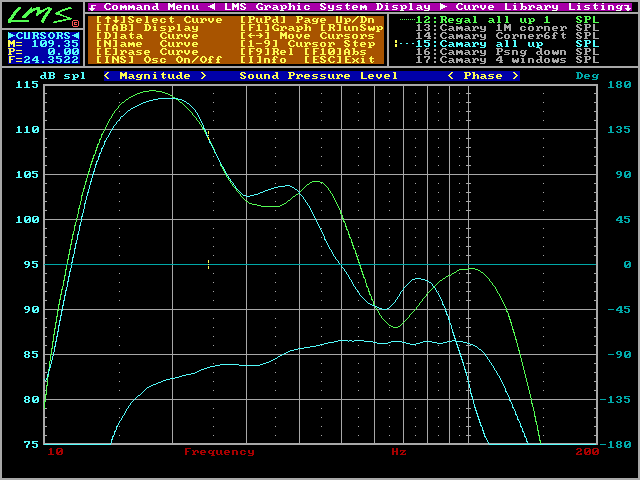
Of course it is important to match the output to your cabin gain. The first thing I do in any install is get an idea of the cabin gain. Here are a few transfer functions measured so you can see how much gain there is:
Ford Escort transfer function mid/late 90's:
Comparison between buick regal and toyota camry response
The regal and camry are quite similar as they are both 4 door vehicles with similar cabin size. If you wish to see a few other curves to see what happens with windows up or down and mic position from driver head to apex of dash, feel free to check out the page. Keep i mind this is like 8 yrs old now:
http://www.aespeakers.com/basszone/deonspace/cabin.html
Kenny mentions that with the current amp that the AV15 "makes the wipers dance off the windshield with lil john" and makes "my spoiler look like it's about to rip itself to shreds." Clearly the woofer is doing it's job, moving air. Looking at the cabin gain though you can see why there is so much less output up high. You have as much as 30dB on the low end of cabin gain in his vehicle. This is equivalent of having 1000X the power at those frequencies! Yes, one thousand times the power. 10 log 1000 = 30dB gain with 1000W input power. If you have 1000x the power at one frequency than you do at another, you will likely barely notice the other frequency being played.
When bass is overpowering at the low frequencies there are 2 options. One is to go sealed. This will restrict the excursion of the driver rolling off the output. However you now need as much as 10x the power to get the same amount of output as you did in the vented box. This means much more distortion from thermal issues and flux modulation issues based on the current in the coil. Using much more power down low also means your amplifier has nowhere near as much headroom available. The other option is to use EQ to pull down the output on the low end. Where you would need 100W to get a given level at 30hz in the sealed enclosure you now may need only 10-20W. Much less thermal related distortion. Your amplifier now has much more headroom for the higher bass frequencies where you do need the power as there is no cabin gain.
This is the same concept that is used with compression drivers for every pro audio system out there. The horn makes the lower frequencies of the compression driver very efficient. The output is then EQ'd back flat and in the end the gain is cutting distortion by 10-20x and greatly increasing the overall output capability.
Here is a typical response curve from a compression driver. This is an 18sound ND1075 on their XT1086 horn.
You can see the intentionally rising response as you go lower in frequency which when EQ'd flat gives a much lower distortion system.
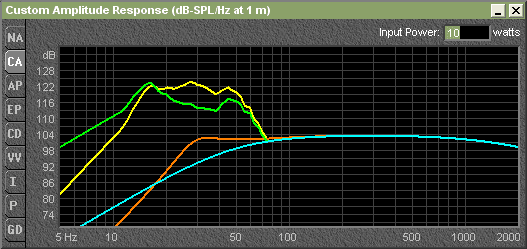
Now let's apply that to the car subwoofer world. The following graph shows the vented AV15 tuned to 28hz in orange vs the sealed in light blue. Then we apply the escort transfer function to both. Yellow is the response of the vented vs the sealed in green.
Now you will notice a few things here. The yellow curve is actually +/- 2dB from 16hz to 50hz. The green curve does clearly have less output from 20-50hz but it is still very overpowering in that range. The issue is also that you are still using the same amount of amplifier power so you haven't saved any headroom on the amp.
The ideal solution would be to use a notch filter to pull down the 16-50hz range. You have about a 24dB slope at both ends. A notch filter with 24dB bessel slopes to pull down that region about 18dB would would be ideal to flatten out the response. Implementing that filter would give you a response +/- 2dB from 12hz to 100hz. You'd also have tons of headroom and amp power available. Midbass would be proportional to the low bass output. Distortion is extremely low this way as well. You'll be capable of the same overall SPL levels at the low end, just everything will be in proper proportion.
Now you may not want to pull that range down the full amount. Your own desires may want a slightly rising response, bump in the 30-45hz range where the lowest stuff in most rap music is centered. You can adjust it to whatever your own tastes are.
John