audioholic
5,000+ posts
not a moderator
I realize this is a troll thread, but just to clarify a few things mentioned here...
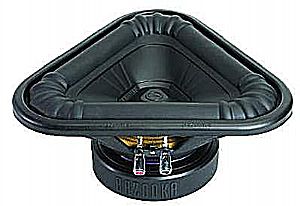
Technically, neither a square cone nor a round cone reproduces sound waves more or less accurately than the other, theoretically speaking. In an imaginary world where both cone shapes have zero mass (or even equal mass) and infinite rigidity, and all other factors being equal, both cone shapes would reproduce a sound wave with the same accuracy. A speaker cone is nothing more than a diaphragm whose motion excites air molecules to create the sound waves.
But this is not that imaginary world, all other factors cannot be equal. Simple geometry tells us a conical shape is inherently stronger than a square. At the farthest edge of a round cone, every point along that edge is equal distance from the center (where the force of the t-joint/voice coil transfers energy to the cone). This means every point along the edge of the round cone is experiencing the same amount of stress. But a square cone's edge has points that are farther from the center, at the corners. This means the corners experience higher levels of stress than the flats of the square cone. Ever notice the strengthening ribs on (most) square cones that extend out to the corners? That's why they are there. Cone deflection (warping) is a much bigger problem on square cones than on round ones. So square cone manufacturers must add to the moving mass by way of those strengthening ridges. You can draw your own conclusions from what increased moving mass does to performance. The corners also mean the cone's surround must have that accordion design at the corners.
In short, a square cone must utilize mechanical tricks in order to compensate for the weaknesses the cone shape lends to the operation of the speaker, a round cone does not.
Also worth noting, it is true that a square cone offers more cone area than a round one. But this added cone area is not free, so to speak. More cone area means a larger enclosure in order to maintain the same speaker/enclosure alignment. Kicker never mentions this when they talk about 'more cone area', they imply the added area is a free byproduct of the cone's shape with no downside. A marketing ploy. If it were me, and I wanted more cone area than a 12" round cone offers, Id simply buy a 15" round coned sub.
The only true advantage a square cone offers is more efficient use of space on the baffle. You can butt the square cones up against each other with no gaps between them. But even this advantage is very limited in its practical applications, being that it requires an installation space with limited baffleboard area, but plenty of depth for the enclosure to offset the added enclosure size necessary.
Hope this clears up any confusion some of the previous replies in this thread have created... be it legitimate replies, or otherwise.
Cheers.
Technically, neither a square cone nor a round cone reproduces sound waves more or less accurately than the other, theoretically speaking. In an imaginary world where both cone shapes have zero mass (or even equal mass) and infinite rigidity, and all other factors being equal, both cone shapes would reproduce a sound wave with the same accuracy. A speaker cone is nothing more than a diaphragm whose motion excites air molecules to create the sound waves.
But this is not that imaginary world, all other factors cannot be equal. Simple geometry tells us a conical shape is inherently stronger than a square. At the farthest edge of a round cone, every point along that edge is equal distance from the center (where the force of the t-joint/voice coil transfers energy to the cone). This means every point along the edge of the round cone is experiencing the same amount of stress. But a square cone's edge has points that are farther from the center, at the corners. This means the corners experience higher levels of stress than the flats of the square cone. Ever notice the strengthening ribs on (most) square cones that extend out to the corners? That's why they are there. Cone deflection (warping) is a much bigger problem on square cones than on round ones. So square cone manufacturers must add to the moving mass by way of those strengthening ridges. You can draw your own conclusions from what increased moving mass does to performance. The corners also mean the cone's surround must have that accordion design at the corners.
In short, a square cone must utilize mechanical tricks in order to compensate for the weaknesses the cone shape lends to the operation of the speaker, a round cone does not.
Also worth noting, it is true that a square cone offers more cone area than a round one. But this added cone area is not free, so to speak. More cone area means a larger enclosure in order to maintain the same speaker/enclosure alignment. Kicker never mentions this when they talk about 'more cone area', they imply the added area is a free byproduct of the cone's shape with no downside. A marketing ploy. If it were me, and I wanted more cone area than a 12" round cone offers, Id simply buy a 15" round coned sub.
The only true advantage a square cone offers is more efficient use of space on the baffle. You can butt the square cones up against each other with no gaps between them. But even this advantage is very limited in its practical applications, being that it requires an installation space with limited baffleboard area, but plenty of depth for the enclosure to offset the added enclosure size necessary.
Hope this clears up any confusion some of the previous replies in this thread have created... be it legitimate replies, or otherwise.
Cheers.